Utility-belt artificial kidney module

OK, so it actually takes up the entire belt at the moment… but given a few more years of miniaturization the Wearable Artificial Kidney could end up no bigger than the holster for your cellphone:

A miniaturized dialysis machine that can be worn as a belt, the WAK concept allows patients with end stage renal failure the freedom to engage in daily activity while undergoing uninterrupted dialysis treatment.

Wearable Artificial Kidney

Worn as a belt, the device weighs just ten pounds (4.5kg), including the two nine-volt batteries that power it. The compact design, unlike conventional dialysis machines, will leave patients free to engage in the activities that normal kidney function would ordinarily allow them to enjoy. Walking, working and riding a bike can all be actively pursued without restriction while undergoing gentle, uninterrupted treatment 24 hours a day, seven days a week.
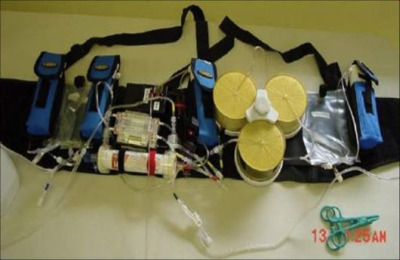
This really brings home the rapidity of progress for me; a teacher at my secondary school used to have to undergo dialysis treatment for kidney failure, and once a year he’d do a show-and-tell with the machine, which was roughly the size of a three-drawer filing cabinet. That was back in 1992… he was a PE teacher, too – no quitter, this guy – so he’d have loved the idea of the WAK.

How many more organs might we be able to replace with belt-worn machines? They’re probably not an ideal long-term solution, but this technology might keep people alive and active during the long wait for suitable transplant organs to come available. Or perhaps we’ll just go the route of the Mechanists – why wait for a biological organ if you can swap it out for a mechanical device that offers a greater degree of control? [image borrowed from linked article]
Scottish island to shift to tidal power

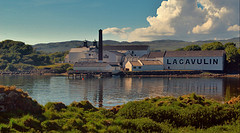
Lagavulin Distillery, IslayThe remote Scottish island of Islay suffers from irregular electricity supply thanks to being separated by the sea from the the soon-to-be-decommissioned Hunterston nuclear reactor on the mainland. That’s set to change, however, with ScottishPower about to sign a deal that will see the island getting all its power needs from tidal generators:

The company is close to signing a supply contract with Diageo, the drinks group, to provide electricity from the project to eight distilleries and maltings on Islay – including the makers of the renowned Laphroaig and Lagavulin whiskies.

The 10MW tidal project, one of the world’s largest, will provide enough electricity for Islay’s 3,500 inhabitants for 23 hours a day.

ScottishPower will submit a planning application in the next couple of months and expects the ten 30-metre underwater turbines to be operational in 2011. The turbines will cost about £50m to install.

Note that corporate tie-in? Smart move; gives you good leverage against the NIMBY lobby. In fact, the whole operation has a “hearts and minds” tone to it:

The Islay Energy Trust, a community organisation chaired by Philip Maxwell, has been helping to lobby local politicians and opponents of the project. In return, it will receive a small slice of the revenue to fund community projects on the island, such as a swimming pool.

I wonder if this will become a blueprint for renewable energy switchovers? Make the deal sweet enough, and the objections will shrink away… sounds like another battleground where the rules of infowar will come in handy. [image by _basquiat_]

The ten rules of infowar

By now you’re probably all familiar with the notion of 4th Generation Warfare, even if the name doesn’t ring a bell: it’s network vs. nation-state, the sort of seemingly unwinnable cluster-f*ck that keeps sucking up money and sending back bodybags from Afghanistan. But what about 5th Generation Warfare?

5GW is the next step along: network vs. network. It’s the sort of war that’s happening right now in the media channels and websites of the United States: an information war, largely bloodless but savagely partisan, driven by irreconcilable ideologies. It’s politics, in other words; politics in a networked age. According to Umair Haque, there are ten rules to learn if you want to win.

He’s directing them at the Obama Administration in light of the public drubbing they’re getting from the obfuscatory tactics of the opposition, but the rules probably apply just as well anywhere, from the world stage to the office where you work. Here are a couple of samples, but you’ll want to read them all:

5. Darwinian counterattacks. What happens after a networked offense? A counter-attack: the remaining nodes link up, share resources, and then launch a portfolio of different counterattacks. The fittest ones — those most threatening to the enemy — survives. It’s like what hedge funds do, except it’s not lame. To enable a Darwinian counter-attack, you’ve got to offer suggestions, tools, and methods for a range of potential counterattacks.

6. Hack your enemy’s weapons. In a 3G or 4G war, you can’t hack the enemy’s guns, bombs, or knives. In a 5G war, you can hack the enemy’s information weapons — and that’s an often explosively powerful tactic. “Death Panels”? Call them “Life Panels” instead, explain that old Republican Senators already benefit from them — and enjoy your rise to the top of Google.

[via Global Guerrillas]

Intelligent design vs. natural selection

flowerEric Drexler has written a paper entitled Biological and Nanomechanical Systems: Contrasts in Evolutionary Capacity that explores the differences between biological organisms and artificial machines, specifically why some products of intelligent design (i.e. design by humans) could never be created by natural selection. Drexler has written a short preface summarising his argument here:

The basic argument is as follows:

  • Evolvable systems must be able, with some regularity, to tolerate (and occasionally benefit from) significant, incremental uncoordinated structural changes.This is a stringent contraint because, in an evolutionary context, “tolerate” means that they must function — and remain competitive — after each such change.
  • Biological systems must satify this condition, and how they do so has pervasive and sometimes surprising consequences for how they are organized and how they develop.
  • Designed systems need not (and generally do not) satify this condition, and this permits them to change more freely (evolving in a non-biological sense), through design. In a design process, structural changes can be widespread and coordinated, and intermediate designs can be fertile as concepts, even if they do not work well as physical systems.

As I read it (and I could be wrong) the basic notion underlying Drexler’s argument is that the kind of mechanical precision demanded by human engineers is not present in the products of natural evolution. Artificial technologies are not yet fungible. If you remove any part of your CPU it will not work. If you remove some parts of someone’s brain then it still works. If you make a small alteration to an organism’s genome it may still work.

In order for evolution to work the replicator needs to function even when it has some small mutation. Artificial technologies generally don’t work when there is some small error in the manufacturing process.

[from Eric Drexler on Metamodern][image from bbjee on flickr]

With no direction at all – Dylan to voice your next satnav

Now talking devices are becoming more commonplace, the need for them to have interesting and appealing voices increases. The latest celebrity to lend their larynx to technology – in this case a satnav unit – may apparently be none other than Bob Dylan.

I’m opening myself up to a blizzard of abuse here, but as much as I admire Dylan’s lyrics, his voice has always rubbed me up completely the wrong way; I’d rather listen to someone torturing cats. Now, if you offered me a satnav voiced by Maynard James Keenan of Tool, complete with furious screeches and profanity when you fail to make the correct turn… that might even be worth buying a car for.