We have the (experimental) technology; we can rebuild you!

cyborg headLost an ear during the Reservoir Dogs Re-enactment Society meeting? No problems – we’ll just grow you a new one on a nanocellulose framework [via NextBigFuture]:

Previously, Paul Gatenholm and his colleagues [at Chalmers University, Sweden] succeeded, in close co-operation with Sahlgrenska University Hospital, in developing artificial blood vessels using nanocellulose, where small bacteria “spin” the cellulose.

In the new programme, the researchers will build up a three-dimensional nanocellulose network that is an exact copy of the patient’s healthy outer ear and construct an exact mirror image of the ear. It will have sufficient mechanical stability for it to be used as a bioreactor, which means that the patient’s own cartilage and stem cells can be cultivated directly inside the body or on the patient, in this case on the head.

“As yet we do not know if it will work. It is an extremely exciting project that brings together expertise in image analysis, prototype manufacturing, biomechanics, biopolymers and cell biology. If we succeed it will open up a whole range of new and exciting areas of use.”

And while we’re speaking about ears, did you ruin your frequency response curve watching avant-noise bands play dingy bars and lofts in eighties New York*? You’ll be needing a hearing aid, then… but not some ugly uncool thing lodged in your ear canal. We’ve got one that’ll slip over one of your back teeth [via BoingBoing]:

There are other hearing aid devices that utilize bone conduction. Most, however, use a titanium pin drilled into the jaw bone (or skull) to transmit sound to the cochlea. SoundBite seems to be the first non-surgical, non-invasive, easily removable device. While they are likely years from retail production, Sonitus Medical plans on having SoundBite ITMs fitted to each individual’s upper back teeth and fabricated fairly quickly (1 to 2 weeks).

Oh, so all that wide-bandwidth noise and late-night hedonism has burned out some of your brain-meat, eh? Well, we’ve got organic transistors that mimic the function of human synapses [via NextBigFuture again]… though quite how we’d patch them into your existing wetware is a bit of a mystery at this point. But hey, they’re called NOMFETs, so the internet should find plenty of macro jokes to make about ’em!

A biological synapse transforms a voltage spike (action potential) arriving from a pre-synaptic neuron into a discharge of chemical neurotransmitters that are then detected by a post-synaptic neuron. These are subsequently transformed into new spikes, leading to a succession of pulses that either become larger or diminish in size. This fundamental property of synaptic behaviour is known as short-term plasticity, which is related to a neural network’s ability to learn. It is this plasticity that Vuillaume and colleagues have succeeded in mimicking.

In the NOMFET, the pre-synaptic signal is simply the pulse voltage applied to the device and the output signal is the drain current, explains Vuillaume. The holes – the charge carriers in the p-type organic semiconductor employed – are trapped in the nanoparticles and act like the neurotransmitters. A certain number of holes are trapped for each incoming spike voltage and in the absence of pulses, the holes escape in a matter of seconds

This time delay is carefully adjusted by the researchers by optimizing nanoparticle number and device geometry. “The output of the NOMFET is thus able to reproduce the deceasing or amplifying behaviour typical of a synapse depending on the frequency of spikes,” said Vuillaume.

Er… your health insurance is fully up to date, right? [image by Bistrosavage]

[ * Guess who’s been reading a Sonic Youth biography this week… 🙂 ]
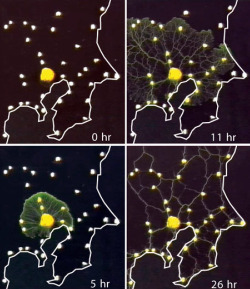
The mould, the map and the mass transit system

slime mould "transit network" (credit: Science/AAAS)There’s still much we can learn from the natural world – and not just the simple things. Nature has a way of solving complex problems without the need for cognition and abstract thought… or even sentience, in many cases. I remember being impressed as a child by the incredible power of tropisms in plants; the simple behaviour of growing toward a light source, for example, can make dumb vegetable matter seem tenacious, determined, relentless.

Well, it turns out that tropism can be pretty efficient, too, as discovered by a research team based in Tokyo. Having already discovered that slime mould can find the shortest route through a maze (provided there’s a food source to entice it), they made a simple map of Japan which used oat flakes to represent major population centres, and let the mould loose on it. End result: the networks of mould connecting the oat flakes closely resembled the country’s existing mass transit networks, or alternative layouts that were theoretically just as efficient. [via BoingBoing; image borrowed from linked article, credit Science/AAAS]

This reminds me of a (possibly apocryphal) story I read a long time ago about some architect employed to lay out a new section of campus for a college or business or something similar. Having set aside a large green space between a bunch of buildings, he was asked where the paths across it should go; his response was that the best way to make an efficient network of paths was to not lay any at all, and to let people walk as they wished across the green space for the first term. By the end of that time, the paths worn into the grass by pedestrians could be used as a map for the asphalters, showing not only the routes required but the comparative traffic densities thereof.

I’m not sure quite where I’m going with this, but I think it has something to do with dethroning rational planning processes in favour of waiting for the best methods or systems to emerge from the chaos of real life. For all our research, for all our academic disciplines and best practices, sometimes just letting things happen as naturally leads to the most efficient solution. I guess the trick is to recognise which problems are best solved in such a way, and which ones aren’t…

Silvia Moreno-Garcia explains the origins of “Biting the Snake’s Tail”

Mexico City skylineSo, did you read Silvia Moreno-Garcia’s latest Futurismic story, “Biting the Snake’s Tail”, published here yesterday? Well, you should – go do it now.

One of the great joys of author blogs, for me at least, is getting an insight into how stories came to be – to find out what inspired them, how they progressed from initial idea to finished work. Silvia has written a post that opens a door on “Biting the Snake’s Tail”, which takes place in a near-future iteration of Mexico City:

It was two years in the making. I wrote the first half of it after dreaming two parts of it: the detective walking through the rainy streets with the dog and the murder. In the original, the murder took place at a public bath house and the victim was a gay man.

When I was a kid and there was no water (yep, this was a problem in Mexico City even years ago) for the day, we sometimes went to the public bath house in Santa Julia. This meant paying a few pesos and you got a bit of soap, some shampoo and access to a shower area. I remember we took our own towels, but towels might have been supplied at a cost. Last year, when I was in Mexico City, water issues were pretty bad. About 5 million people (a quarter of the city) was suffering from a drought and predictions for 2010 were that even the ritzy neighbourhoods would be affected. Think a third of the city without water this year, taps running dry for many days at times.

Having been lucky enough to visit Mexico City, I know it’s the sort of place where stories wait for you around every street corner. Ludicrous wealth and grinding poverty live cheek by jowl, and history howls hungrily from beneath layered and crumbling facades of modernity… much like any big city, I suppose, but they don’t come much bigger than El D. F., and that history is marbled with conflict and the struggle to survive for as long as records have been kept. [image by alex-s]

For a privileged Euro like myself, Mexico City was a real eye-opener; I’ve been fortunate enough to have travelled a fair amount in my life, but few places have affected me quite so deeply. Travel is fatal to prejudice, as Mark Twain once said… I wonder if visiting new places in fiction can have the same effect? I certainly hope so – after all, as energy costs continue to increase, it’s going to be the only form of long-distance travel available to the vast majority of us… and there’s more than enough prejudice to go round.

NEW FICTION: BITING THE SNAKE’S TAIL by Silvia Moreno-Garcia

Our second story of the new decade is yet another return visit from a Futurismic fiction alumnus. We loved Silvia Moreno-Garcia‘s “Maquech” enough to publish it back in 2008, and “Biting The Snake’s Tail” takes us back to an exotic and ecologically crumbling Mexico City… but this time it’s in a noir-ish near-future police story, where what you don’t see is even more important than what you do. Enjoy!

Biting The Snake’s Tail

by Silvia Moreno-Garcia

Cops don’t go into the alcazabas. They’ll do raids every few months and confiscate mod-drugs for the sake of the TV cameras, but they don’t care what happens in the alcazaba’s colorless alleys. The gang leaders have established their own code of conduct, so what happens in the alcazaba is the business of the people who live there and not of the outsiders circling and enduring these cities within a city.

That’s why it was so bizarre to see all those officers in their blue uniforms running around La Catrina. I bet they were also pretty surprised to see me there in full gear with Arkasha at my side.

Gonzalo hadn’t told me what was going on. All he said was I had to get to La Catrina fast. Therefore, I was wearing the exo and the helmet, just in case things were really nasty. Arkasha was an added form of insurance. It’s funny how many people will run at the sight of a large dog, but not of a gun. Continue reading NEW FICTION: BITING THE SNAKE’S TAIL by Silvia Moreno-Garcia

How publishers can exploit “virtual currencies”

Given that publishing economics are pretty topical at the moment, this video embedded in this post from GalleyCat last Thursday seems either alarmingly prescient or laughably silly, depending on your viewpoint.

Here’s the thesis in a nutshell: those mind-numbingly infuriating and spammy Farmville games your friends play on Facebook are surprisingly good at generating income for their creators, so publishers should take a leaf from the same book to spice up their own online offerings. The theory does come from the president of a company called Orca which specialises in developing virtual currencies for corporations, so a certain bias in favour of the idea is to be expected…

Here’s an excerpt (which I’ve excerpted in turn from GalleyCat’s post – yay, lazyweb!):

“They convert [virtual currencies] at prices that are not easily divided–one dollar gives you 33 credits [for example] … People don’t necessarily think, ‘it cost me 42-cents to send my friend a virtual beer.’ I think when the publishing industry starts thinking about how they chunk up content–whether it be articles or chapters–it shouldn’t be a debate of whether an article is worth one dollar or three dollars. An article should cost 43 credits.”

My immediate instinct is that this idea stinks, though that’s probably due to my kneejerk loathing of Farmville, Mafia Wars et al; maybe there’ll be a way to graft virtual currencies onto the publishing ecosystem without introducing the intrusive “social” aspects (read as “spamming”) and underhand pricing structures that seem to inform such games, which I suspect wouldn’t gel well with the book-buying demographic. But then again, if you get rid of those aspects of the system, you’ll probably never make a dime with it… so it’s back to the drawing board, I guess.