
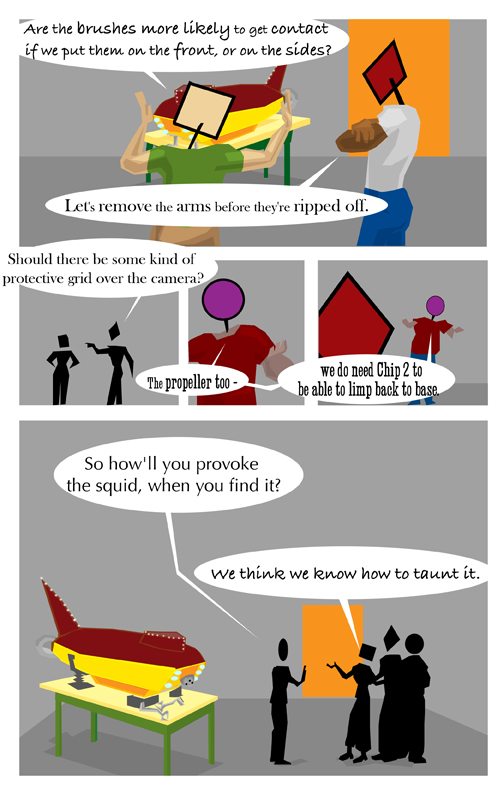
Personal Information is a new serial sci-fi webcomic from Sarah “Does Not Equal” Ennals.
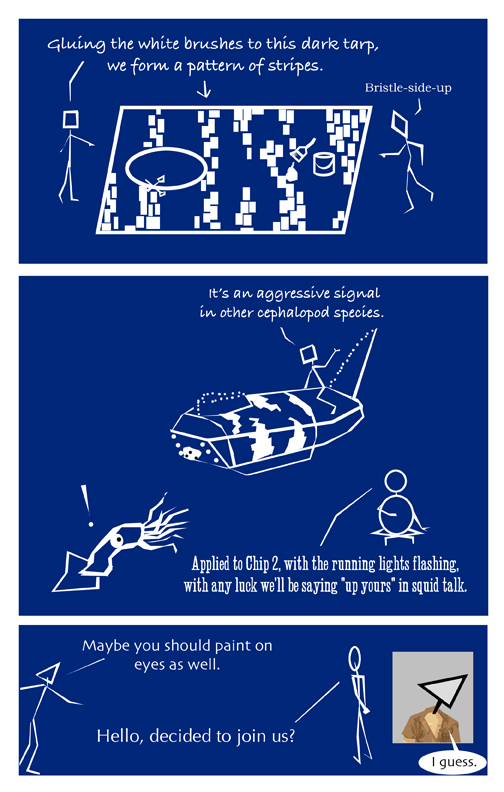
Personal Information is a new serial sci-fi webcomic from Sarah “Does Not Equal” Ennals.
Mary Elizabeth Williams takes to the pages of Salon.com to decry one of my own pet hates: the spoiler-police, those people who get angry at you for discussing a book, film or TV show that they haven’t seen yet [via Martin Lewis].
As a reviewer and critic, this is a particular bugbear for me. First and foremost, I believe that stories that can truly be spoiled by having major plot points revealed before reading and/or watching it are rarely stories worth bothering with. This is why The Sixth Sense wasn’t really a very good movie, for example; watch it a second time, and it’s just ninety-odd minutes of narrative prestidigitation. That said, there are exceptions (it’s very hard to discuss Nick Harkaway’s The Gone-Away World without talking about the pivot point twist at the middle of it, but knowing that twist actually makes a second reading a different and equally enjoyable experience), and it’s the mark of a good – or at least responsible – critic to be able to know the difference and act accordingly.
But secondly, it’s always baffled me that people bothered by spoilers couldn’t simply self-police the problem and, y’know, avoid reading reviews and discussions of the story in question before they get to it. Williams agrees:
… for the love of God, if you really don’t want to know about a book/movie/television show, do the rest of the world a favor and stop hanging out in the online discussion groups about it. Sure, if you live in a time zone where your favorite show has not yet aired, you could go on any of the many websites devoted to it and rage about the injustice of it all, like the poster in a “24” thread who complained, “Your East Coast arrogance that once it airs on the East Coast, it’s fair game to blog about — and ruin for us on the West Coast — is beyond stunning.” Or you maybe could restrain yourself from joining the discussion for three measly hours.
[…]
Do these die-hards ever consider that maybe they’re the ones spoiling things — for the rest of us? I promise I won’t blurt the ending of “The Girl With the Dragon Tattoo” when you’re behind me in the ticket line. If, in fact, you tell me directly you’ve never seen “The Third Man,” I will simply say you’re in for a treat. But how about you assume if you’re in an online discussion about the film, maybe that’s a space for people who’ve seen it and want to discuss it? Or the fact that you’re just now getting hip to “The Wire” doesn’t impose a cone of silence on it for anybody else?
Testify, sister!
The rise of the internet has seen many frustrated aspiring authors turn to forms of self-publication and showy promotional gambits in the hope of catching the eye of someone with a cheque-book and a pile of blank contracts, but this is probably the most spectacularly desperate-sounding tactic I’ve heard of so far: offering US$3,000 in cash prizes to people who can answer questions based on a close reading of the novel in question [via PD_Smith].
Furthermore (as if the general public needed more encouragement to sneer at the genre), the guy’s a science fiction author…
Riley decided to post the novel online for free earlier this month, giving those who read it the chance to win a chunk of a $3,000 prize money pot if they answer questions about the book correctly.
“I’m hoping that publishing the book online and pretty well paying people to read it will get it noticed on the internet, and ultimately discovered by a legit publisher,” said Riley on his website. “Crass gimmick? You bet. But if it works, I won’t look back.
“I’m 65 god-damned years old, this novel means more to me than anything in the world, and I’m desperate to get it published while I’m still alive. I know this may sound odd, but I feel western society needs this book. It’s a contribution I feel I must make.”
A quick scan of the first few pages suggests that Riley failed to sell his novel for the same reason that a lot of people fail to sell science fiction novels: he doesn’t appear to have read any that were published after 1975 or so, his infodumps make Asimov look like a minimalist poet, and the narrative mode he’s using is… well, let’s say “changeable”. In other words, I’m willing to bet that it’s just not very good, and even the prospect of winning a chunk of money isn’t enough to entice me to read any further.
However, Riley might end up with some degree of immortality from his experiment – if the Guiness Book of Records doesn’t have an entry for “biggest fee paid for an ultimately unsuccessful manuscript critique”, it’s high time they wrote one up. I honestly feel sorry for Riley – he obviously really wants to be a published author – but he’s about to find out, at great expense, that there aren’t any shortcuts.
 Unless you’ve been underneath that oft-mentioned hypothetical internet-proof rock for the last twelve hours or so, you’ll already have an idea of what today’s (and probably this year’s) big science story is. It is, of course, the announcement by Craig Venter and his team that they’ve successfully created the first fully synthetic self-replicating bacterial lifeform. There are many bits of coverage, though The Guardian has been good enough to include a document scan of the actual scientific paper on which the stories are based. [image credit Science/AAAS; ganked from Wired article]
The tabloid terror and hand-wringing will take a few days to filter through, I expect, as will the condemnations from religious figureheads and marginal cranks… quality fire and brimstone takes time to write, as any author will tell you. That said, The Guardian (yes, again – I’m just such a Limey pinko leftie progressive at heart, sorry) sets their religion-beat blogger on the matter early, and he manages to ask the questions that everyone else will pose, only without resorting to the apocalyptic imagery and overstatement required to elevate the uninterested to the outraged: has Venter made mankind into gods?
“Life is basically the result of an information process – a software process” says Venter, and “Starting with the information in a computer, we put it into a recipient cell, and convert it into a news species”. But though this information clearly exists in some sense, it’s impossible to say what kind of thing it is, because it isn’t a thing at all. Whatever this may be, it isn’t material, and it isn’t bound by physical laws. Information turns out to be as elusive and as omnipresent as God once was.
I don’t mean that they are both the same because clearly they are not. What’s important is that neither fits into any kind of common sense category; in orthodox theology, the idea of existence without God is senseless: not meaningless, but self-contradictory. Something similar is true of information in the sense that Venter uses it. It isn’t the things that people tell each other: it is the fundamental regularities of nature that scientists discover. A universe without information could not exist and certainly couldn’t contain scientists.
[…]
“We are limited mostly by our imaginations” Venter says. The worry is whether our imaginations will prove up to the task. The trouble with gods, as the Greek philosophers observed, is that they were not any morally better than humans, just more powerful.
Smart people, the Ancient Greeks. I can’t see synthetic life driving any definitive nails into the coffin of faith, myself; that particular battle is a movable feast, and I’m increasingly convinced we’ll never be free of it. But what’s very certain is that we just stepped into a bigger, scarier, more amazing and more science fictional world… and what’s almost as certain is that the real benefits and pitfalls of this new phase of scientific and technological endeavour will probably be very different to the speculative ones that will be kicked around for the next few weeks.
But hey, why let that stop us? Speculation can be it’s own reward, after all – at least, that’s one of the many reasons I enjoy reading good science fiction. So sound off in the comments – is Venter trespassing in the realms of the divine, or is this just the next glorious and inevitable step in the apotheosis of the naked apes?
Not-entirely-unsurprising news from the world of evolutionary psychiatry: human use of psychoactive compounds found in plants and animals is thousands of years old, and evolutionary selection may actually have favoured those of our ancestors who were wired to get a kick from certain substances:
According to Randolph Nesse, evolutionary psychiatrist at the University of Michigan, at some time in humanity’s distant past, individuals whose brains had a heightened response to emotion-linked neurotransmitters (such as dopamine and serotonin) were better suited to survival.
This meant that as the generations passed, heightened response became the norm. […]
Archaeologists have found evidence of kola nut (caffeine), tobacco (nicotine), khat (an amphetamine-like plant), betel nut, and coca, at various sites dating back at least 13,000 years, indicating that humans have, in fact, been drug users for a very long time. Across the globe, people in non-Western cultures are very familiar with these and other mind-altering substances.
“It’s widely believed that human drug use is a new and pathological phenomenon,” says Roger Sullivan, an anthropologist at California State University at Sacramento. “But psychoactive plant toxins were a mundane occurrence in the environments of hominid evolution, and our ancestors may have been exploiting plant drugs for very long periods of time.”
Sullivan and Edward Hagen of Humbolt University in Berlin believe that compulsively seeking these items in the past might have been adaptive during times when nutrients were hard to find.
Human beings: getting baked to deal with hard times since 11,000 BC. Goes some way to explaining why drug legislation – a very very recent phenomenon indeed – has done so little to stop folk wanting to get loaded… and promises a whole new generation of slogans from psychoactive evangelists.
Speaking of legislation, control and addictive substances, here’s a research project of staggering pointlessness: how many videos of people smoking cigarettes in a fetishistic context are easily viewable by teenagers on YouTube?
“The high frequency of smoking fetish videos concerns me,” says Hye-Jin Paek, associate professor of advertising, public relations, and retailing.
(With that sort of background, one assumes she’s eminently qualified to know how well associative imagery can push psychological buttons… )
Paek conducted the study of “smoking fetish” videos—videos that combine smoking and sexuality. “The fact that we can see the videos and analyze their content means that teenagers can see them too.
[…]
The majority of smoking fetish videos studied explicitly portrayed smoking behaviors, such as lighting up, inhaling, exhaling, and holding the tobacco product. More than half were rated PG-13 or R.
More than 21 percent of the videos contained at least one of the five fetish elements defined in the paper, including gloves, high heels, boots, stockings, and leather or latex clothes.
More than a fifth? O NOES! Well then, we’d better censor all that stuff pretty sharpish, hadn’t we – after all, wrapping up a behaviour one wants to discourage in veiled mystique, puritanical panics and age restrictions has always worked so well before… if we airbrush out everything we don’t like in the world, eventually everyone will be just as self-satisfied as we are!
[ Pre-emptive: I’m not suggesting that teenagers or anyone else smoking cigarettes is a “good” thing. What I’m suggesting is that worrying about videos of people smoking on YouTube as a strong cause of such is laughably foolish. ]