All posts by Edward Willett

I'm a freelance writer in Regina, Saskatchewan, Canada. I've written more than 30 books (I've lost count) on a variety of topics. My nonfiction titles include books on computers, diseases, genetics, and the Iran-Iraq War, some for children and some for adults. I've also written several biographies for children, on individuals as diverse as J.R.R. Tolkien, Orson Scott Card, Jimi Hendrix, Janis Joplin, and the Ayatollah Khomeini. I've loved science fiction and fantasy since I was a kid (thanks, Andre Norton, Madeleine L'Engle and Robert A. Heinlein!) and have also written young adult fantasy and science fiction. More recently I've turned to adult science fiction. My first adult SF novel, Lost in Translation, was published by Five Star in hardcover in 2005 and reprinted in paperback by DAW Books in 2006. My new SF novel for DAW, Marseguro, will be out in February, 2008. I write a weekly newspaper science column, I love good wine and good food, I'm married and have a daughter, and I'm a professional actor and singer when the opportunity presents itself, and act and sing just for fun when I can't find anyone to pay me for it. My website is at www.edwardwillett.com, and my blog is at edwardwillett.blogspot. com. And that is probably more about me than anyone could possibly want to know...

Frankenstein lives–as a musical!

Frankenstein the Musical In my quixotic attempt to keep the Futurismic readership updated on musicals with a SFnal aspect, I give you Frankenstein: The Musical, which has just begun performances at 37 Arts, an off-Broadway theatre in New York. Opening night is Thursday, November 1.

Brian Aldiss, for one, argues that Frankenstein was the first true science fiction novel. He makes a persuasive argument in his history of SF, Billion-Year Spree (later revised as Trillion-Year Spree–inflation was a killer in the ’70s and ’80s). (Image: Frankenstein: The Musical.)

[tags]Frankenstein, musicals, Brian Aldiss, science fiction[/tags]

Space mirrors best way to deflect asteroids

Asteroid deflection with space mirrors The best way to deflect incoming asteroids? Forget nuclear blasts, "gravity tractors" or  Bruce Willis or Clint Eastwood in a souped-up space shuttle: according to a new study at the University of Glasgow, focusing sunlight onto an asteroid with space-based mirrors is the way to go.

Mind you, it would take 5000 space mirrors to fend off something of the size the killed off the dinosaurs–more than five kilometres across–but you wouldn’t need nearly as many for smaller ones. (Via New Scientist Space.)

Other options considered in the study: ramming a spacecraft into the asteroid at high speed, digging up pieces of it and shooting them off into space, attaching a thruster, or painting one side to cause trajectory-deflecting uneven heat radiation. (Illustration: M Vasile et al, University of Glasgow.)

[tags]spacecraft, asteroids, planetary defense[/tags]

Using biometrics to identify potential terrorists

Airport Security Ever look at the guy next to you in the lineup at airport security and wonder, "Is he a terrorist?" Well, scientists at the University at Buffalo are working on automated systems to help answer that question before those questionable individuals ever get on the plane–although, unlike you, their suspicions hopefully won’t be fueled by a mistrust of bald men with earrings or the fact your ex-wife’s mother looked just like that before she started smashing your prize collection of Star Wars figurines.

Instead, the system will track faces, voices, bodies and other biometrics against "scientifically tested behavioral indicators" to provide a numerical score of the likelihood that an individual may be about to commit a terrorist act. (Via Science Daily.)

Smile for the camera! But not as if you have something to hide… (Photo from Wikimedia Commons.)

[tags]security, biometrics, terrorism, technology[/tags]

Jet-lagged hamsters, U.S. military among Ig Nobel winners

Pink-eyed white hamster It’s Ig Nobel time again, as the Annals of Improbable Research honors research achievements "that make people laugh – then think." This year’s winners include the U.S. military for its plans to make a "gay bomb," the use of Viagra to help hamsters recover from jet lag, and a medical study of the risks of sword swallowing. (Via New Scientist.)

The awards are handed out by real Nobel laureates, and the popular ceremony (this year’s theme: Chickens!) also featured a humorous "Moments of Science" skit and a contest to win a date with a Nobel laureate ("He’s shapely, he’s sassy and he’s smarter than you.")

Alas, no one from the U.S. military showed up to receive its Ig Nobel. (Photo from Wikimedia Commons.)

[tags]Ig Nobels, research, humor[/tags]

Space travel without propellant

800px-Aurora-SpaceShuttle-EO

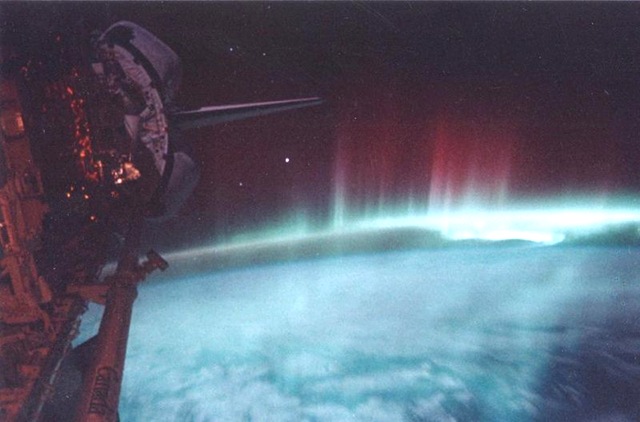
"Fuel? We won’t need no stinkin’ fuel for our spacecraft!" might be the motto of the Cornell Planetary Magnetic Fields Propulsion research team. Led by Dr. Mason Peck, the team envisions spacecraft that would be able to surf planetary magnetic fields, requiring little if any propellant. The effect to be harnessed, known as Lorentz forces, is small, so the spacecraft would likewise have to be small: imagine a swarm of millions of craft, each the size and mass of a single silicon wafer, gathering information, providing communications, or creating a distributed-aperture telescope kilometres in diameter. Such tiny, lightweight craft might even be perfect for the first trip to another star system. (Via Centauri Dreams.)

Hey, at 1/10th light speed, Proxima Centauri is only 43 years away… (Photo from NASA via Wikimedia Commons.)

[tags]space travel, propulsion, spacecraft, technology[/tags]