All posts by Paul Raven

Daddy, where does innovation come from?

Plenty of folk have been linking to this excerpt from Matt Ridley’s new book The Rational Optimist, and with good reason – it’s a provocative piece that plays to advocates (and opponents) of free trade, open exchange, copyright reform and much more. The basic thesis? The one persistent factor that has encouraged innovation and new ideas is the freedom to pass them around and build upon them.

You should read the whole thing, as Ridley takes down in turn the usual answers offered to the question of innovation’s source – science, capital, IP, government. But here’s some stirring stuff from the conclusion:

We may soon be living in a post-capitalist, post-corporate world where individuals are free to come together in temporary aggregations to share, collaborate, and innovate, and where websites enable people to find employers, employees, customers, and clients anywhere in the world. This is also, as the evolutionary psychologist Geoffrey Miller reminds us, a world that will put “infinite production ability in the service of infinite human lust, gluttony, sloth, wrath, greed, envy, and pride.” But that is roughly what the elite said about cars, cotton factories, and (I’m guessing) wheat and hand axes too.

Were it not for this inexhaustible river of invention and discovery irrigating the fragile crop of human welfare, living standards would stagnate. Even with population tamed, fossil energy tapped, and trade free, the human race could quickly discover the limits to growth without new knowledge. Trade would sort out who was best at making what; exchange could spread the division of labor to best effect, and fuel could amplify the efforts of every factory hand, but eventually there would be a slowing of growth. A menacing equilibrium would loom.

In that sense, Ricardo and Mill were right. But so long as it can hop from country to country and from industry to industry, discovery is a fast-breeder chain reaction; innovation is a feedback loop; invention is a self-fulfilling prophecy. Equilibrium and stagnation are not only avoidable in a free-exchanging world. They are impossible.

What are your thoughts – is Ridley on to something here, or just grandstanding to libertarians, valleygeeks and copyleftists?

It’s clear that Ridley feels economic equilibrium is something to be feared, and on that point I’m not entirely sure I’m in agreement with him… chasing after perpetual growth has been a pretty messy business in the long term, after all. But I can’t fault his thoughts about innovation. I wonder if it would be possible to entirely disconnect innovation from a money economy? Impossible right now, sure, but in a hypothetical post-scarcity future it might just fly.
Replacement arms: mechanical or biological?

Prosthetic limbs are still in their infancy, but there’s a lot of progress being made: Johns Hopkins Applied Physics Laboratory is working with Darpa (who else?), and has a research grant for trying out their mind-controlled modular prosthetic arm on five test subjects over the next couple of years [via SlashDot]:

Phase III testing – human subjects testing – will be used to tweak the system, both improving neural control over the limb and optimizing the algorithms which generate sensory feedback. The Modular Prosthetic Limb (MPL) is the product of years of prototype design – it includes 22 degrees of motion, allows independent control of all five fingers, and weighs the same as a natural human arm (about nine pounds). Patients will control the MPL with a surgically implanted microarray which records action potentials directly from the motor cortex.

Researchers plan to install the first system into a quadriplegic patient; while amputees can be outfitted with traditional prostheses, the MPL will be the first artificial limb that can sidestep spinal cord injury by plugging directly into the brain.

Great news, then, but it’s still a crude kludge compared to the original. Building a new biological limb from the ground up is way beyond our biotech capabilities as they stand… but our own bodies do a pretty good job of it when we’re developing in the womb, and young children can sometime regrow fully functional fingertips lost to accidents. So why can’t we make like salamanders and just sprout replacement limbs? It’s a vexing question, and extremely clever people are working hard to work out the answer. (You’ll have to go read the whole article, because it’s too full of proper science for one or two pulled paragraphs to do it justice.)

How to be a futurist

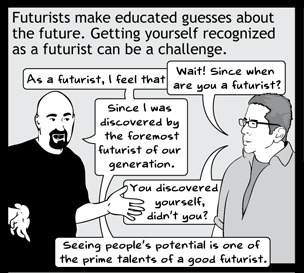
The irrepressible Scott “Basic Instructions” Meyer has the lowdown if you’re thinking of a career in futurism:

How To Be A Futurist - Basic Instructions

Click through for the whole thing. But take it from me, being a futurist is a lot of work for no money. Or maybe that’s just the way I do it… and I’ve never been featured in a world-famous pixelated webcomic, unlike another more notable futurist (late of this parish, and many others). I should have stuck to kitchen portering, I guess. Selah. 🙂

Geek sickness: can social rejection make you ill?

A UCLA experiment suggests that “social stress and rejection are related to the release of certain inflammatory chemicals in the body; these chemicals have been linked to several medical conditions, including asthma, arthritis, and some kinds of cancer. Ars Technica has the low-down:

In the study, a group of researchers recruited a bunch of students at UCLA and subjected them to socially stressful situations. The students were asked write a speech and then read it to a pair of evaluators, who then acted as if the speech were abhorrently subpar. After that, they had to perform mental arithmetic for a proctor who would appear impatient with them and urge them to go faster. A subset of the participants were also made to play a game of “Cyberball” with two other people, who were asked to socially exclude them.

Throughout these socially stressful experiences, researchers took mouth swabs of the students and monitored their activity in the dorsal anterior cingulate cortex, a part of the brain known to process rejection-related distress. (It’s possible that the swabbing added to the stress.) The two measures showed that greater activity in this area of the brain correlated with a rise in two inflammatory chemicals that are known to play a role in the onset or progress of conditions like rheumatoid arthritis, cardiovascular disease, depression, and various types of cancer.

Correlation is not causation, of course… or, as Ars more bluntly puts it, it’s unclear whether “being a nerd begets asthma, or if asthma begets a nerd”.

Anthologize: plugin exports WordPress blogs as ebooks

Here’s a heads-up for fellow webzine editors and publishers, fiction writers publishing their own work online, and other interested (or indeed interesting) parties: the Anthologize plugin for WordPress generates EPUB, PDF and “other mobile formats” from content stored on the blog in which it is installed. Dan Cohen, head of the team that produced it (in just a week, no less, using a funding grant from the Center for History and New Media at George Mason University) explains in a bit more detail:

[This plugin] converts the popular open-source WordPress system into a full-fledged book-production platform. Using Anthologize, you can take online content such as blogs, feeds, and images (and soon multimedia), and organize it, edit it, and export it into a variety of modern formats that will work on multiple devices. Have a poetry blog? Anthologize it into a nice-looking ePub ebook and distribute it to iPads the world over. A museum with an RSS feed of the best items from your collection? Anthologize it into a coffee table book. Have a group blog on a historical subject? Anthologize the best pieces quarterly into a print or e-journal, or archive it in TEI.

[…]

I suspect there will be many users and uses for Anthologize, and developers can extend the software to work in different environments and for different purposes. I see the tool as part of a wave of “reading 2.0″ software that I’ve come to rely on for packaging online content for long-form consumption and distribution, including the Readability browser plugin and Instapaper. This class of software is particularly important for the humanities, which remains very bookish, but it is broadly applicable. Anthologize is flexible enough to handle different genres of writing and content, opening up new possibilities for scholarly communication.

So, obviously intended for a userbase of humanities academics, but this could be a real kick-start for us fiction webzine types to start reaching out to the ereader audiences on a webzine budget*. All I need now is a few extra hours in every day of the week to investigate it further… *sigh*

Hopefully some smart people will retool it for some of the other open-source CMS platforms as well. I could very easily and quickly find a use for a ModX version….

[ Hat-tip to Alex “Xander” Ingram, Third Row Fandom’s in-house ebooks boffin. Big up yerself, Xander, and thanks for the notification. 🙂 ]

[ * Webzine budget (compound noun, colloquial) – (1): small change and used paperclips. ]