All posts by Paul Raven

Cyberstyle: military-spec wrist-mounted keyboard

Because I’ve had a busy weekend (and because I’m the ed-in-chief, and because I can), I’m going to kick the week off with a blatant no-context-necessary tech-geek “I want one of those!” post. No, it’s not a Barnes & Noble Nook (though if anyone would like to send me one of those, I promise to be extremely grateful!) – it’s the iKey AK-39 wrist-mounted keyboard, as flagged up at grinding.be last week.

iKey AK-39 wrist-mounted keyboard

Thinking about it, I’m kinda dating myself by admitting to that lust; a wrist-mounted keyboard is very much a cyberpunk1.0 fetish, a desire from someone who grew up around computers as clunky chunky beige boxes with frustrating limits on functionality, portability and availability. In less than half a decade, the physical keyboard will probably be a complete anachronism for any device with sufficient gee-whiz to be both desirable and useful. I know this intellectually, but kids growing up now know it instinctively. This isn’t your father’s Kansas, Toto. Insert further mangled “culture shock is no longer something that happens to other people now that I’m in my thirties” aphorisms here.

Another (shorter) changing-fashions point – isn’t it high time that the fad for branding products or businesses by grafting a lower-case ‘i’ onto the start of another word went somewhere and died quietly?

Old dogs and new tricks: web use good for the elderly brain

A silver surferYounger readers (or those with spousal units prone to nagging about excessive time spent in front of a computer) may wish to arm themselves with the news that internet use appears to restore and strengthen brain function, particularly in the elderly. In other words, surfing the web is keeping your brain young and fit. [via The End Of Cyberspace; image by mhofstrand]
For the research, 24 neurologically normal adults, aged 55 to 78, were asked to surf the Internet while hooked up to an MRI machine. Before the study began, half the participants had used the Internet daily, and the other half had little experience with it.

After an initial MRI scan, the participants were instructed to do Internet searches for an hour on each of seven days in the next two weeks. They then returned to the clinic for more brain scans.

“At baseline, those with prior Internet experience showed a much greater extent of brain activation,” Small said.

After at-home practice, however, those who had just been introduced to the Internet were catching up to those who were old hands, the study found.

Of course, this doesn’t take into account the theory that the structure of the web means we only ever get exposed to ideas that we already find agreeable, but I remain unconvinced of that notion, anyway. A brief glance at history shows that people were always perfectly capable of ignoring information that they found unpalatable, long before the internet (or even the printing press) existed…

But while you’re advising grandma to fire up Firefox, be sure to remind her that it’s an aid to learning, not a replacement for it. Recent research shows that we learn much more quickly if we take a chance to answer incorrectly before looking up the correct response… so try guessing before you Google it, in other words.

Optogenetics: the key to our cyborg future?

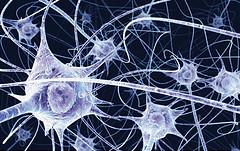
neuronsThere’s a lengthy but interesting piece up over at Wired about the relatively young discipline of optogenetics – the science of isolating and communicating with specific types of neuron using light. The discovery of the process is an interesting story in its own right, but the really futurismic bit is the implication tucked into the final few paragraphs:
Optogenetics has amazing potential, not just for sending information into the brain but also for extracting it. And it turns out that Tsien’s Nobel-winning work — the research he took up when he abandoned the hunt for channelrhodopsin — is the key to doing this. By injecting mice neurons with yet another gene, one that makes cells glow green when they fire, researchers are monitoring neural activity through the same fiber-optic cable that delivers the light. The cable becomes a lens. It makes it possible to “write” to an area of the brain and “read” from it at the same time: two-way traffic.

Why is two-way traffic a big deal? Existing neural technologies are strictly one-way. Motor implants let paralyzed people operate computers and physical objects but are incapable of giving feedback to the brain. They are output-only devices. Conversely, cochlear implants for the deaf are input-only. They send data to the auditory nerve but have no way of picking up the brain’s response to the ear to modulate sound.

No matter how good they get, one-way prostheses can’t close the loop. In theory, two-way optogenetic traffic could lead to human-machine fusions in which the brain truly interacts with the machine, rather than only giving or only accepting orders. It could be used, for instance, to let the brain send movement commands to a prosthetic arm; in return, the arm’s sensors would gather information and send it back.

Science fiction has been talking about the brain-machine interface for decades, but usually in terms of splicing the hardware into the nervous sytem in much the same way as connecting up a regular electronic circuit, and with little experimental evidence for its viability. As Chorost points out in the Wired piece, we’re not going to see commercially available optogenetic interfaces for some time yet, but this proof-of-concept work suggests it really is only a matter of time before we do. [image by LoreleiRanveig]

Mac Tonnies, Rest In Peace

Mac TonniesIt falls to me to pass on some very sad and unexpected news. Mac Tonnies, a long-term web-friend of mine and former columnist on the paranormal here at Futurismic, was found dead (apparently of natural causes) in his apartment yesterday. [image borrowed from UFOMystic]

I’m at a bit of a loss to know what to say, really. A part of me wants to laugh, because I know the sort of fun Mac would have had ragging on conspiracy-theory types who’d try to suggest some nefarious governmental cover-up was involved. But the larger part of me is simply gutted; Mac was a thoroughly decent and sensitive guy, and an unflinching contrarian thinker, even when considered among the already contrarian fields of transhumanism and the extranormal. He’d just finished the manuscript for a new book, which he’d been working on for a long time.

So, rest easy, Mac – you’ll be missed.

Secure your privacy: tell everyone everything

Privacy please!What if the best way to protect against identity theft was not to hide the fingerprints of your digital daily life, but to expose them to public scrutiny? It sounds like an Orwellian contradiction, but Alex Pentland of MIT’s Human Dynamics Lab believes that allowing limited access to logs of our electronic acitivities is actually much safer than relying on passwords or keys which can be phished or stolen. [image by hyku]

“You are what you do and who you do it with,” says Pentland. Researchers and corporations have realised the potential of such data mining, he points out. “It is already happening and it is time for people to get a stake.”

If people gain control of their own personal data mines, rather than allowing them to be built and held by corporations, they could use them not only to prove who they are but also to inform smart recommendation systems, Pentland says.

He recognises that allowing even limited access to detailed logs of your actions may seem scary. But he argues it is safer than relying on key-like codes and numbers, which are vulnerable to theft or forgery.

If I understand my cryptographic principles correctly (and I may well not, so do put me straight in the comments if I’m wrong), Pentland is proposing something a little bit like a public key verification system. Perhaps in this case “your best defence is a good offence”… the sort of thing that could easily be combined with some sort of reputation-based currency like whuffie? And hey, he’s advising we take our data back from the corporations that already scrape at it when we’re not watching. Makes sense, right?

“It is not feasible for a single organisation to own all this rich identity information,” Pentland says. What he envisages instead is the creation of a central body, supported by a combination of cellphone networks, banks and government bodies.

That bank could provide “slices” of data to third parties that want to check a person’s identity. That information could be much like that required to verify high-level security clearance in government, says Pentland.

Uh-oh… suddenly I’m not so keen on this idea, at least in the way Pentland is thinking about it. A peer-to-peer system, fine, I’m down with that… but handing the reins of identity verification over to banks and quangos, after having already admitted that private corporations are prone to abusing the crumbs of data we drop behind us all the time? That’s got to be a step sideways, if not backwards. Pentland has thought about ways to monetise the system, too:

An individual could also allow their data to be used by services like apps on their smartphone to provide personalised recommendations such as restaurant suggestions or driving directions. This has the potental to be much more powerful than the recommender systems built into services like Netflix and iTunes, and would help familiarise users with the value of the approach, says Pentland.

Pentland’s carrot seems to be much the same as the one dangled by the people behind Phorm: “if you’ve nothing to hide, there’s nothing to fear, and we’ll even be able to recommend you stuff that you’re more likely to want to buy!” Maybe I’m just being paranoid; I remain convinced that a certain degree of personal transparency is not only a societal good but a useful tool for personal security, but something about this particular formulation smells very bad indeed.