
All posts by Paul Raven

Amanda Palmer on passing the hat for art

guitarist buskerI imagine many of you have seen this elsewhere (judging by the dozens of different sources I saw it bounce through yesterday) but if not, here’s the one and only Amanda Palmer explaining why she’s not ashamed to ask her fans for money:

artists need to make money to eat and to continue to make art.

artists used to rely on middlemen to collect their money on their behalf, thereby rendering themselves innocent of cash-handling in the public eye.

artists will now be coming straight to you (yes YOU, you who want their music, their films, their books) for their paychecks.
please welcome them. please help them. please do not make them feel badly about asking you directly for money.
dead serious: this is the way shit is going to work from now on and it will work best if we all embrace it and don’t fight it.

unless you’ve been living under a rock, you’ve surely noticed that artists ALL over the place are reaching out directly to their fans for money.
how you do it is a different matter.
maybe i should be more tasteful.
maybe i should not stop my concerts and auction off art.
i do not claim to have figured out the perfect system, not by a long shot.

BUT … i’d rather get the system right gradually and learn from the mistakes and break new ground (with the help of an incredibly responsive and positive fanbase) for other artists who i assume are going to cautiously follow in our footsteps. we are creating the protocol, people, right here and now.

i don’t care if we fuck up. i care THAT we’re doing it.

It’s worthwhile reading for anyone who writes with the intent to sell their work, or those who publish at the small scale of webzines or print mags (or iPhone apps, or whatever other way you’ve decided to do it). As has been suggested before, dead-tree publishing is going to take a comparatively long time to catch up with the business models of the music industry, because the pressures of piracy and freely-available content aren’t so strong yet. But they will be… and it’ll happen sooner than you expect, especially if you just sit on your hands waiting for someone to give you the answer.

So be bold, try things. Throw the spaghetti at the wall and see if it sticks. Hal Duncan’s got the right idea – he’s doing a direct-to-audience publishing experiment on his blog right now. So go throw a few bucks in his hat, and know that you’ve bought good art… and helped feed the person who made it. [image by Martin Pettitt]

(Go throw Amanda Palmer a few coins, too; she’s not just a fine musician but a crusader for independent art, and that alone deserves your support.)
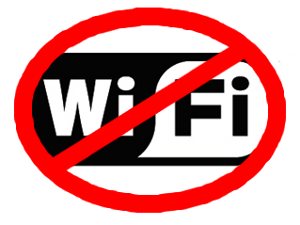

Wi-fi cold-spots and hot-boxes

No wi-fi logoI’ve been saying for a few years now that once we reach a saturation point with wireless internet access, cafes and other establishments will start advertising the absence of wi-fi in the same way the currently advertise its availability. Even an always-online geek like myself sometimes feels the urge to retreat from the cloud, after all, even if only so I can sit down in peace with a book for an hour or two.

But there are plenty of other reasons why you might want to spend time somewhere that wi-fi can’t reach you… or alternatively somewhere where there’s wi-fi available which can only be accessed by someone inside the building or room in question. The classical way to make a room impermeable to high-frequency signals is a Faraday cage, but that’s neither cheap or architecturally simple. Now there’s a much simpler option which may aid the proliferation of wi-fi cold-spots in urban areas – a special paint based on an aluminium-iron oxide that resonates in the same frequency range used by wi-fi routers.

And not just cold-spots. I can definitely see a market for wi-fi hot-boxes – rooms with carefully controlled physical access (think burly doormen and surly cashiers) wherein you and a bunch of, er, associates can set up an ad-hoc LAN connected to the web through a heavily encrypted router. No one outside that room – even the establishment’s proprietors – could know what data had been passed around within it.

If you’ll excuse me, I’m off to book a one-way ticket to Mexico City and draw up a business proposal…

Get your Ripley on with the Power Loader exoskeleton

Remember me comparing the HAL exoskeleton to the cargo-loader from Aliens? Yeah, well, so this is me eating my words – this thing is the real deal. Ladies and gentlemen, the ActiveLink Power Loader exoskeleton suit:

The so-called “Power Loader” suit — which takes its name from the fictional hydraulic exoskeleton suit appearing in the sci-fi classic “Aliens” (1986) — is built on an aluminum-alloy frame and weighs 230 kilograms (500 lbs). Described as a “dual-arm power amplification robot,” the exoskeleton suit is currently equipped with 18 electromagnetic motors that enable the wearer to lift 100 kilograms (220 lbs) with little effort. In addition, the Power Loader’s simple, intuitive control system employs direct force feedback, allowing the operator to directly feel the movement of the robot while controlling it.

There’ll be a version on the market by 2015, apparently, so start saving your pennies.

Geordi’s video-to-brain visor being built at MIT

Geordi LaForge stencil graffittiOK, so it’s going to be some time yet before Geordi LaForge video visors are high-street gadgets, but the underlying technologies are coming to fruition faster than I’d have ever expected. Via grinding.be we discover that a team at MIT have sussed a method for grafting a digital device to the optic nerve, enabling them to pipe electronically generated images direct the brain:

The implanted chip, according to the MIT team behind it, features a “microfabricated polyimide stimulating electrode array with sputtered iridium oxide electrodes” which is implanted into the user’s retina by a specially-developed surgical technique. There are also “secondary power and data receiving coils”.

Once the implant is in place, wireless transmissions are made from outside the head. These induce currents in the receiving coils of the nerve chip, meaning that it needs no battery or other power supply. The electrode array stimulates the nerves feeding the optic nerve, so generating a image in the brain.

The wireless signals, for use in humans, would be generated by a glasses-style headset equipped with cameras or other suitable sensors and transmitters tuned to the coils implanted in the head.

For now, however, the system has only been tried out in Yucatan minipigs. Three of the diminutive Mexican porkers have had the Star Trek/Gibsonesque implants for seven months, but as yet it’s difficult to tell just how well they work – as the pigs aren’t talking. The MIT boffins have fitted them with instrumented-up contact lenses to try to get an idea of what effects the implants have.

If you really need me to prompt you towards imagining the awesome and/or weird stuff that might happen as a result of this technology becoming readily available, I suspect you’re reading the wrong website. 🙂 [image by striatic]

Europe: less people, mo’ problems?

Global population density mapLeading on neatly from Tom’s post about sustainable population growth is another New Scientist piece, which posits that Europe’s predicted decline in population will actually bring a whole raft of economic and infrastructural problems with it:

… look a little deeper, and the picture becomes more complicated. Decreasing population does not necessarily promise environmental benefits. The cost per head of population for infrastructure such as sewage systems or electricity supply increases when population numbers go down, making clean water and non-polluting energy even more expensive than they are today.

So can Europe overcome its demographic and ecological challenges at the same time? The solution might be found in a rarely discussed concept: demographic sustainability.

High population growth, such as that now taking place in many African countries, is not sustainable. But very low fertility rates are unsustainable too. It will be hard for countries with persistently low fertility to remain competitive, creative and wealthy enough to keep ahead of their country’s environmental challenges. What is needed is a middle ground.

A demographically sustainable Europe needs to have a stable or slowly shrinking population as the existing infrastructure operates most efficiently when the number of inhabitants remains fairly constant. What would it take to achieve this? At present, the average fertility rate in Europe is 1.5 children per woman, and in countries below this line there is an urgent need for family policies to encourage women to have more children. Countries with fertility rates above 1.8, including France, the UK and Sweden, do not need further pro-birth policies as immigration will fill the demographic gap.

I’m not going to contest the maths, but I think pro-birth policies will probably be unnecessary. Climate change is going to produce a whole lot of environmental refugees in the next few decades, and those countries with a declining birth rate could open their borders to them – two birds with one stone, if you will.

However, if those countries also happen to be the ones most paranoid about being “overrun” by immigrants, I guess it’s back to the government-sponsored Have More Kids campaigns… [awesome CGI population density map image by Arenamontanus]

[ For the record, I think that it behoves us as a sentient species to limit our population so as to best protect and sustain the environment that keeps us alive (and hence protect and sustain ourselves). However, sentience and sense have never directly proportional, and show little sign of becoming so any time soon… so I guess mitigating the fallout is the best plan in the meantime. ]