 Jamais Cascio is stirring things up at Fast Company again, this time with a multi-part article on speculative future economies. In this second part thereof, he lays out three possible economic scenarios, one each for the United States, Japan and the European Union – the other major powers have been left blank deliberately.
The three scenarios are:
- Resilience Economics (US)
- Just-in-Time Socialism (Japan)
- Robonomics (EU)
They’re all optimistic – in that surviving the current downturn and the inevitable next one is a given – but they each have their downsides, also. Here’s a snippet from Robonomics:
The U.S. slowed down, Japan took control, and Europe… well, Europe got wired. Or got weird, depending on your perspective.
On the surface, you still have the same kinds of big companies, same kinds of consumption patterns, same kinds of advertising that you did a few decades earlier. But the twist is that almost nobody works–maybe about 25% of the population engages in income-generating employment, and at least half of that consists of educators, bureaucrats, and the self-employed. Manufacturing, transportation, and most basic services are done with robots, semi-autonomous systems that nobody even pretends have real intelligence, but work well enough to keep the economy humming. Personal service jobs remain in human hands, but those are often performed by recent immigrants, trying to earn the right to a BIG Card.
Go read all three, then pop back and leave a comment saying which one you’d choose. Personally, I’m kinda torn between Just-in-Time Socialism and Robonomics, though I rather expect the UK would end up with Resilience thanks to the fear of European amalgamation – a politcial bugbear almost as entirely predicated on disinformation and lies as the current healthcare debate in the US. [image by Unhindered by Talent]
Oh, and if you’re wondering which of them is dependent on sustainability…
… they all are–that is, environmental sustainability is intrinsic to all three of these models, as it will be intrinsic to whatever economic structures function successfully this century. As the next few decades unfold, any economic behavior that doesn’t take sustainability into account will fail.
So, where do you want to live?
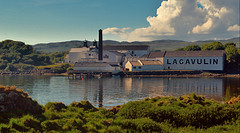 The remote Scottish island of Islay suffers from irregular electricity supply thanks to being separated by the sea from the the soon-to-be-decommissioned Hunterston nuclear reactor on the mainland.