All posts by Paul Raven

The dangerous dream of artificial intelligence

Robots will inherit the Earth!There are plenty of artificial intelligence skeptics out there, but few of them would go so far as to say that AI is a dangerous dream leading us down the road to dystopia. One such dissenting voice is former AI evangelist and robotics boffin Noel Sharkey, who pops up at New Scientist to explain his viewpoint:

It is my contention that AI, and particularly robotics, exploits natural human zoomorphism. We want robots to appear like humans or animals, and this is assisted by cultural myths about AI and a willing suspension of disbelief. The old automata makers, going back as far as Hero of Alexandria, who made the first programmable robot in AD 60, saw their work as part of natural magic – the use of trick and illusion to make us believe their machines were alive. Modern robotics preserves this tradition with machines that can recognise emotion and manipulate silicone faces to show empathy. There are AI language programs that search databases to find conversationally appropriate sentences. If AI workers would accept the trickster role and be honest about it, we might progress a lot quicker.

NS: And you believe that there are dangers if we fool ourselves into believing the AI myth…

It is likely to accelerate our progress towards a dystopian world in which wars, policing and care of the vulnerable are carried out by technological artefacts that have no possibility of empathy, compassion or understanding.

Now that’s some proper science fictional thinking… although I’m more inclined to a middle ground wherein AI – should we ever achieve it, of course – comes with benefits as well as bad sides. As always, it’s down to us to determine which way the double-edged blade of technology cuts. [image by frumbert]
Augmented reality contact lenses

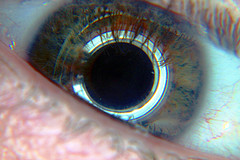
cyborg eyeAll this talk about augmented reality is all well and good, but wandering around holding up a little rectangular gadget to see things through is hardly an elegant science fictional solution, now is it?

As a fully paid-up cyberpunk, I want everything as tightly integrated to the meat as possible – so I want my AR operating no further from me than the surface of my eyeballs. Luckily I shouldn’t have too long to wait – at least not if Babak Parviz of the University of Washington has the successes he hopes for with his augmented reality contact lens concept:

Conventional contact lenses are polymers formed in specific shapes to correct faulty vision. To turn such a lens into a functional system, we integrate control circuits, communication circuits, and miniature antennas into the lens using custom-built optoelectronic components. Those components will eventually include hundreds of LEDs, which will form images in front of the eye, such as words, charts, and photographs. Much of the hardware is semitransparent so that wearers can navigate their surroundings without crashing into them or becoming disoriented. In all likelihood, a separate, portable device will relay displayable information to the lens’s control circuit, which will operate the optoelectronics in the lens.

These lenses don’t need to be very complex to be useful. Even a lens with a single pixel could aid people with impaired hearing or be incorporated as an indicator into computer games. With more colors and resolution, the repertoire could be expanded to include displaying text, translating speech into captions in real time, or offering visual cues from a navigation system. With basic image processing and Internet access, a contact-lens display could unlock whole new worlds of visual information, unfettered by the constraints of a physical display.

Parviz has a long old article there, and for those with a more technical bent it gives an insight into the way the contacts will actually work… though he’s canny enough not to put a solid date on the technology becoming available. [via New York Times; image by pasukaru76]

I wonder if he needs any test subjects?

NEW FICTION: IS THIS YOUR DAY TO JOIN THE REVOLUTION? by Genevieve Valentine

If you asked me for three words to describe this month’s Futurismic fiction offering, I’d give you “short, sharp and timely”. Genevieve Valentine wastes no words in revitalising (and spoofing) the classic sf dystopias in this brisk story of an all-too-plausible tomorrow. “Is This Your Day To Join The Revolution?” Read on and find out…

Is This Your Day To Join the Revolution?

by Genevieve Valentine

When Liz left her building, Disease Control workers were standing on the corners, handing out pills and little paper cups of Coke.

“Do you need one?” the old lady asked, holding up a handful of paper masks stamped with ads for Lavender Fields Sterile-Milled Soap. Liz pulled out the one she kept in her bag, and the lady smiled.

The TV in her subway car showed “What You Can Do on a Date.” The young man and woman went to the fair twice – once where he screwed everything up, and again where he helped her into the Ferris Wheel and handed her a paper mask before he put on his own.

The movie closed with swelling music and a reminder in cursive: ARE YOU DUE FOR A DATE? CHECK WITH YOUR DOCTOR. Continue reading NEW FICTION: IS THIS YOUR DAY TO JOIN THE REVOLUTION? by Genevieve Valentine →

Books you wish had been written, but weren’t

Wired‘s GeekDad blog has a post by Corrina Lawson in which she lists five books she wishes had been written, but which were not. They’re mostly continuations of a much-loved series or character, but none of the ones there particularly flick my switches.

So, I thought “why not throw that one open to the Futurismic gang over the coming long weekend?” Drop into the comments at the bottom of this post and call out the unwritten book (or books) you’d most love to have on your shelves.

I’ll start us off: I’d love for Bruce Sterling to write a sequel to Schismatrix (though I’m very certain he won’t), as I can’t think of another stand-alone novel that paints suuch a broad canvas of universe behind the action, and I’d quite like David Zindell to put aside the fantasy epics he’s doing currently for a return to the Requiem for Homo Sapiens universe – anything that combines deep metaphysical weirdness, galaxy spanning space-opera and subliminal references to the Illuminati is a guaranteed winner in this household.

What about you – if you could cause one unwritten book to be published, what would it be, and why?

http://www.wired.com/geekdad/2009/08/5-geeky-stories-we-wish-had-been-written-but-werent/

The intersection of gaming and guilt

Wii Fit water bottlesOver at The Guardian, Keith Stuart finds himself distressed by the rise of computer games that focus on physical fitness; his concern is that the whole appeal of computer games has always been the ability to live vicariously as someone other than yourself, and that this development suggests that body fascism is finally invading the game-space. [image by imjoshdotcom]

I understand the physical fitness potential of this procedure, but there are concerns about what this means for the future integration of virtual and physical identities. In the past we’ve been able to entirely separate the two – it’s the fundamental appeal behind online environments such as Second Life. Gaming has always been sort of transcendental – the player’s ability to perform stunning acrobatic leaps in Prince of Persia, or devastating roundhouse kicks in Tekken, has only ever been about hand-eye coordination, about skill. One notable exception was the very first Street Fighter arcade game, now largely overlooked and dismissed by gamers, which required you to punch large pads as hard as possible to pull off moves. It was inexact and clumsy and it created a higher physical baseline for protagonists.

But then fast-forward 20 years, to the unveiling of Microsoft’s Project Natal motion-capture system for the Xbox 360. The demos were all about people pulling off kicks and punches in their living rooms to create similar movements on screen. Going even further, Mylo, the virtual boy emulator created by the British studio Lionhead, will watch and read the player’s facial expressions, with the onscreen character reacting accordingly.

It feels like a strange ontological breach. Watch a gamer in action: it’s a totally unselfconscious activity. Bodies go limp, faces are twisted in weird contortions or slackened in hangdog wonder. Some read this negatively, equating it with the mindless consumption of junk TV – and now it seems even games publishers are developing guilt. And guilt is the emotion that often arises when bodies are scrutinised, especially among the demographic that buys fitness games. Sure there are health benefits to the increasing physicalisation of entertainment software, but there is also the underlying taint of pop-culture body fascism.

I can see where he’s going with this, but I think the point is overstated; rather than developing guilt, I think games designers are in fact responding to an increased demand for ways of making exercise fun. Where the line between wanting to be more healthy and obsessing over your physical persona is drawn is, I suspect, largely an individual matter; I’m absolutely positive that gaming will never develop a significant fraction of the coercive power of television.