All posts by Paul Raven

MMOs: the future of the nation-state?

World of Warcraft screenshotFinally! While not much of an MMO player myself (I don’t have the time to set my highly addiction-prone personality loose in alternative realities at the moment), the time I’ve spent in Second Life has convinced me that the metaverse is a hugely important sociopolitical step for us as a species. [image by fernashes]

So I’m really pleased to see social scientists like Aleks Krotoski of The Guardian saying that MMOs are harbingers of the doom of the nation-state:

Now, I don’t imagine that any of my mates would be willing to pledge allegiance to Azeroth, the fictional setting for their escapades and dance parties, but without question they experience a sense of togetherness celebrated by academics and philosophers for its emergent governance. Warcraft, Second Life, EverQuest, even the text-based LambdaMOO – all have unregulated telecoms services and thriving and exchangeable unregulated currencies. They also have hierarchies and power structures, justice systems and benevolent dictators.

These spaces threaten world order. Traditional governments have spent the past four years back-pedalling, trying to regulate these spaces, in the name of national security. In fact, they’re just trying to make sure that they don’t lose control of the people who have gathered together in these consensual hallucinations. And their money, of course.

Yes. The internet itself is corrosive to geography, but virtual worlds increase the potency of the reagent considerably. Interesting times ahead, I think.

Welcome to the 3D economy

Rep-Rap - self-replicating fabberJamais Cascio appears over at Fast Company once again, this time talking about the desktop manufacturing revolution, which seemingly becomes a less science fictional prospect by the week. The shift in plausibility is noticeable in the concerns raised: consider a still-distant technology like nanoassemblers or sentient AI, and you’ll get the species-killer existential risks – grey goo, say, or a hard unfriendly singularity. Ubiquitous fabbing is inevitable enough to be raising more realistic and (by comparison) small-scale concerns… like what the hell it’s going to do the economy. [image by Zach Hoeken]

Technologies that shift production from being atom-dominated to being bit-dominated tend to follow similar trajectories. With both laser printers and, later, CD/DVD burners, the first wave of “creative destruction” came when the prices dropped to the level where the devices were affordable by small businesses; the second, bigger wave came when the prices dropped to a level affordable by general households. Now, laser printers and CD/DVD burners are just about free in a box of cereal–and, for many of us, the production and consumption of text documents and music has moved to entirely digital formats.

If 3D printing follows a similar trajectory, we may not be likely to see a massive shift to entirely digital “products” any time soon, but we could well see a shift to more local–even desktop–production. There’s no guarantee, of course, that 3D printing system prices will crash in the exact same way as laser printers, or that individual households will decide that desktop manufacturing is appealing. Local manufacturing seems a good bet, however, for a variety of reasons. There’s a particularly strong sustainability argument around local manufacturing, from the rising tide of “localism” philosophies (from food to media), to the ability of 3D printing to extend the useful life of manufactured goods by making new parts (as Jay Leno does for his vintage cars). The sustainability argument will become especially powerful once cheap overseas-produced goods reflect rising costs for fuel and carbon. And local manufacturing via 3D printing, even if limited to simple consumer items, has the potential to disrupt incumbent manufacturing, shipping, and retail industries.

If we do see 3D printing follow the footsteps of laser printing, however, the results could be profound. Desktop manufacturing offers the potential for the ultimate “maker” culture, where commercial products are bought off of iTunes-like online stores and printed at home, while eager hardware hackers play with design tools and open-source hardware systems to make entirely new material goods. Lurking in the background, of course, is the potential for design piracy — what one writer termed “napster fabbing,” back in the era when Napster was scary.

It remains to be seen what actually happens, but severe disruption of the status quo is pretty much a given. What do you think – will ubiquitous fabbing usher in a utopian future of happy people making interesting stuff, or a world crammed with cheap and poorly-made junk?

Who owns your electronics?

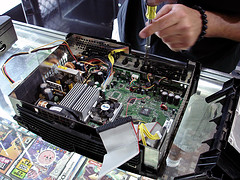
Xbox undergoing a (probably illegal) modification procedureGiven the ubiquity of the story at the moment, you may well have already heard about the Los Angeles man facing a potential ten year jail term for the heinous crime of modifying games consoles. If so, you may be wondering exactly how that law operates – after all, if you own something, shouldn’t it be your right to do what you wish with it? TechDirt highlights the disconnect:

It’s interesting to see the use of the word “jailbreaking” here, as that’s more commonly been applied to iPhones — where it’s common. Usually, this action has been referred to as “modding” or “modchipping” when it came to consoles. But the basic fact is that the actions are effectively the same — and both should be perfectly legal. Modifying legally purchased hardware should never be against the law. It’s possible that you could then use that modified hardware to break the law — and no one’s saying that’s okay. But the act itself of modifying the devices should never be against the law — especially where it could lead to a ten-year prison sentence, as in this case.

Ars Technica consulted a legal expert to get the real skinny on the situation:

The news was bad. “With hardware, you can do pretty much anything you want with it. There are very few rules that apply. You buy it, you own, you can take it apart, and that’s perfectly fine,” she explained. The problem is that no one simply modifies the hardware. “It becomes complicated with modern hardware because it’s combined with firmware, the embedded software.”

The infamous DMCA states that you can’t circumvent any software protection to get at the copyrighted work it protects. If you’re using a software exploit or installing a mod chip, you’re disabling that protection to allow yourself to run homebrew code, and you’re running afoul of the DMCA. “Thou shall not circumvent,” Granick told Ars, counting the two ways to break the law. “And thou shall not provide tools to others.

The intent is meaningless. Even if you simply want to modify an Xbox to use as a media center, you’re breaking the law, since you’ve given the system the ability to run unsigned code.

So, what’s clear is that Crippen’s arrest and charges are completely legal. What’s not so clear is whether or not they should be, and whether the potential penalty is even slightly proportional to the crime in question. Five years in the clink for modifying a single games console seems more than a little excessive, after all; here in the UK, the average house burglar doesn’t serve a stretch that long. [image by videocrab]

One suspects that, much as with the Thomas and Tenenbaum cases, the ESA is trying its best to make an example of Crippen, pour discourager les autres. How effective that could possibly be is anyone’s guess, but I wouldn’t want to bet on console modding disappearing any time too soon. Crippen himself makes the point pretty clear in the closing lines of Threat Level’s report:

Crippen appeared in Los Angeles federal court late Monday and was released on $5,000 bond.

He said it took about 10 minutes to jailbreak a console.

Where did he learn the skill?

“Google, man.”

And there it is; I hope the ESA has a lot of nails, because the lid to Pandora’s Box isn’t going to close as easily as they’d like. The question is whether market forces will eventually turn people toward platforms with open source firmware, or ones which simply don’t come with any restrictions on what you can do with them – like the average desktop PC, for example.

The games console market grew strong in the days when most people couldn’t afford a powerful general purpose computer, but nowadays they’re cheap enough that people use them as little more than DVD players; what will it take for consumers to stop paying through the nose for the privilege of being locked into a piece of hardware where obsolescence and restricted use is an integral part of the package? The answer my gamer friends give me is that you just can’t get enough good games that run on PCs… which sounds to me like a market gap waiting to be exploited.

Will the next decade or so see an increase in locked hardware, or will openness become a strong selling point? Hell knows that when I can actually buy things like augmented reality spex, I’ll be buying the open-source ones that allow me to do whatever I want with them.

Data pr0n: the demographics of employment and leisure

Just a quick one: even if you’re not particularly interested in demographic research into how different segments of the population of the United States spend their time each day, the interactive graphical data thingy that the New York Times have produced to illustrate it is pretty sweet, and good for killing ten minutes of idle time… not to mention allowing you to reflect that the idle time in question is theoretically represented in the data you’re observing; how delightfully post-modern! [via MetaFilter]

What other data sets would benefit from this sort of presentation?

Niche magazine survival strategies and the author-publisher synergy

magazines at the news-standThe Death-Of-Magazines debate seems to have gone off the boil in the genre fiction scene (albeit temporarily), but there’s still plenty of discussion – and innovation – going on elsewhere. Former Wired columnist and Japanophile Momus takes a look at the migration of magazines onto portable devices like the iPhone over in the Land of the Rising Sun:

Already, musician friends are thinking in terms of iPod apps the way they once might have thought of releasing albums on labels. Who needs a label when an app could be a worldwide delivery system for people interested in your music? Or how about keeping up with Japanese magazines? I’ve already mentioned Nakatree Viewer, a free app that lets you look at the paper ads for magazines that hang in Japanese subway cars.

Nakatree Viewer began as the ad sheets themselves (typically showing a modified version of the mag’s latest cover), then added pop-up QR codes allowing you to access some of the content of the magazines. Now there’s talk of the Viewer actually taking you to online versions of the magazines, either reduced versions (like Courrier Lite, a standalone application for one mag) or full ones.

At a time when magazines are dropping like flies, giving them a new distribution platform is giving them the chance of new life. Whether the iPhone is the ideal reading environment for magazines is another matter. I have a digital subscription to The Wire, but prefer to read it on my big computer, or on paper. But when Apple releases its iPhone-OS tablet computer — rumoured either for next month or early next year, depending on who you believe — who knows?

Meanwhile, Lifehacker flags up a web2.0 site called MagMe that puts full-resolution scans of magazines right into your web browser. While none of these examples are omega points for magazine survival, it’s plain to see that people are working to find solutions. The genre short fiction scene sadly lacks the money to invest in playing around with potentially viable solutions, but we can at least hope that one will come along soon enough for them not to die off entirely. [image by Diane S Murphy]

But talking of publishing models, and looping back to Momus’ comment about his musician friends thinking beyond the traditional record publication process, here’s an interesting reversal from the world of music: a record label that have signed a deal with a band [via TechDirt]. Yes, you read that right.

The release outlined a unique setup Blue Scholars have put together between Seattle’s Caffe Vita Coffee Co. and the excellent hip hop label Duck Down. Simply put, Caffe Vita is providing the cash flow, and they’re hiring Duck Down to run point on marketing.

Just another sign of what we’ve been saying for two years: the business is changing, artists have choice, and artists will find partners to help them get done what they need to — the mantra is no longer: “I’ve gotta get signed I’ve gotta get signed…”

Could this reversal of power work in book publishing? Consider a hypothetical author like Cory Doctorow, whose public profile gives him (or her) a lot of traction beyond the traditional book marketing channels; if they were offered a weak or creatively restrictive deal from their standing publisher (or, indeed, no deal at all) and decided to look around for alternatives, what small press wouldn’t jump at the opportunity offered by the chance to let that author publish the book they really want to write?

The author’s stature would reflect onto the small press and garner more media attention, enhancing its ability to shift units by lesser known authors; meanwhile, the author benefits from the experience and connections of the small press in the more traditional book marketing network, reducing the amount of leg-work required by comparison to a self-published (but already well-known) author trying to get the word out. It’s a potential synergy – and while there are plenty of details missing from that off-the-cuff idea, it doesn’t strike me as the most crazy scheme I’ve heard this week.

What do you think – can fiction publishing save itself by slimming down and becoming more flexible, or will consolidation, cost-cutting and rigid control be its saving grace?