All posts by Paul Raven

Flexible concrete

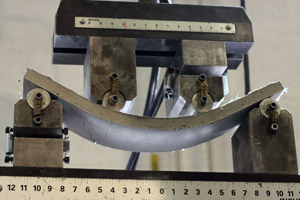
flexible self-healing concreteI try to avoid doing posts that just go along the lines of “hey, look – cool invention!”, but I thought flexible self-healing concrete was interesting enough to warrant a bending (arf!) of the rules

A handful of drizzly days would be enough to mend a damaged bridge made of the new substance. Self-healing is possible because the material is designed to bend and crack in narrow hairlines rather than break and split in wide gaps, as traditional concrete behaves.

“It’s like if you get a small cut on your hand, your body can heal itself. But if you have a large wound, your body needs help. You might need stitches. We’ve created a material with such tiny crack widths that it takes care of the healing by itself. Even if you overload it, the cracks stay small,” said Victor Li, the E. Benjamin Wylie Collegiate Professor of Civil Engineering and a professor of Materials Science and Engineering.

Ten kudos points and a Futurismic gold star to the first commenter with either a potential disaster scenario involving flexible concrete, or a design-fiction repurposing of it. Go! [via Technovelgy]

Online democracy and the tyranny of the minority

The internet is the greatest potential enabler of genuine direct democracy ever, right? Well, not necessarily.

David Adams at OS News points out that recent high-profile gaming and crashing of internet polls (most notably the pwnzorage of Time Magazine by the 4chan hordes) should be taken as a caution; online direct democracy opens the gates to the tyranny of the minority, he says.

One of the dangers of direct democracy has always been that the majority of people can band together to persecute an individual or smaller group using legitimate voting, such as voting for confiscatory taxes on a wealthy individual, or restricting the civil rights of a minority ethnic group. This is called “tyranny of the majority.” That’s why no country practices direct democracy. There always needs to be a constitution to enumerate essential rights, a court to ensure that the constitution is obeyed, and a representative structure such as a legislature to insulate the nation’s laws from the whims of the voters. A tyranny of the minority is when a vote is open to anyone, but because not enough people are engaged politically, or not enough people know about it, a small group can organize itself to make a surprise assault on the poll and exert disproportionate influence.

Hmmm. Surely those marginalised by said poll would hence become more aware of the potential for engagement with the system as a result? And if the barriers to participation are so low, surely they’d be unlikely to be trounced the same way twice? But back to Adams:

… let’s assume for a moment that we could come up with a system that only allowed for legitimate votes, and we could have 100% confidence in that fact. Let’s assume that this system enabled votes to be easy to cast and easy to count. This system would probably work fine for big, high-profile elections like the presidency and congress, because the candidates and the parties are already doing everything they can to mobilize their troops to vote for their person. Where the tyranny of the minority would come into play would be the smaller races, such as school board, county sheriff, and other local ballots. These are races that are much more easily swayed by an organized group that represents a small minority of the voters but can swing the vote their direction if they’re determined enough. This is something that happens already every election, with manual voting, but with electronic voting, it would happen much more. I’m afraid that with remote e-voting, coupled with every more useful and popular regional and local social networks, Stephen Colbert would win every election in the country.

Frankly, looking at the roster of self-serving chumps we call a government here in the UK, I’m not entirely certain having Colbert in power for a while wouldn’t at least be a refreshing change, if not a political and historical turning point. I can see where Adams is going with this, but I’m a great believer in the old saw that every generation gets the government it deserves, with the corollary that we’re currently governed by shysters because we left the door wide open to them.

Maybe the early years of a direct and participatory democracy would usher in some terrible single-interest wackadoos and bigots (though I’m not entirely sure how much difference we’d notice), but I think it would also make everyone else think “well, if it’s that easy to get someone elected, we’ll give ’em a run for their money next time round”. End result – a more engaged electorate using a more democratic system. And while that’s admittedly a blue-sky scenario, I think it acts as a balance to Adams’ pessimism; it’s too early to write off the potential of the internet to reinvigorate democratic processes just because a few magazines and websites got chumped by script-kids. [via SlashDot]
eBay puts Indiana Jones out of work

Harrison Ford on set as archaeologist Indiana JonesThe rise of eBay and similar online marketplace has been a death-knell for a number of industries and a boon for others… but not always in the way that people expected. Archaeologists the world over deplored the arrival of eBay, fearing it would make the trade in rare looted antiquities even harder to control. It turns out, however, that exactly the opposite has occured:

Our greatest fear was that the Internet would democratize antiquities trafficking and lead to widespread looting. This seemed a logical outcome of a system in which anyone could open up an eBay site and sell artifacts dug up by locals anywhere in the world. We feared that an unorganized but massive looting campaign was about to begin, with everything from potsherds to pieces of the Great Wall on the auction block for a few dollars. But a very curious thing has happened. It appears that electronic buying and selling has actually hurt the antiquities trade.

How is it possible? The short answer is that many of the primary “producers” of the objects have shifted from looting sites to faking antiquities. I’ve been tracking eBay antiquities for years now, and from what I can tell, this shift began around 2000, about five years after eBay was established.

Not only that, it appears to have encouraged a growing market for cheap imitations of antiquities:

The economics of these transactions are quite simple. Because the eBay phenomenon has substantially reduced total costs by eliminating middlemen, brick-and-mortar stores, high-priced dealers, and other marginal expenses, the local eBayers and craftsmen can make more money cranking out cheap fakes than they can by spending days or weeks digging around looking for the real thing. It is true that many former and potential looters lack the skills to make their own artifacts. But the value of their illicit digging decreases every time someone buys a “genuine” Moche pot for $35, plus shipping and handling. In other words, because the low-end antiquities market has been flooded with fakes that people buy for a fraction of what a genuine object would cost, the value of the real artifacts has gone down as well, making old-fashioned looting less lucrative. The value of real antiquities is also impacted by the increased risk that the object for sale is a fake. The likelihood of reselling an authentic artifact for more money is diminished each year as more fakes are produced.

Good news for the defenders of history. Of course, the game will change again once we have widespread fabrication technology; will there be a point at which fakes and close copies become so ubiquitous and easily available that the kudos value of the real thing becomes too appealing to resist for those with a bulging wallet and something to prove? [via SlashDot; image by John Griffiths]

Cyberpunk style arrives: living jewelry and electronic tattoos

As a person seemingly born with a missing coolness gene, a big part of the appeal of cyberpunk was its visual aesthetic – why stick to a baseline body when you can bolt stuff on to make it look more interesting? And while I’m getting too old to care much about impressing people with the way I look, it’s fun to see those technofashions slowly seeping out from the pages of much-loved novels and into reality.

Exhibit one: EpiSkin, described by its creator as jewellery which “extends biological identity by combining technology and design into a new decorative body surface. This project is an exploration into the decorative technological control over biology to create an artifact which is a hybrid of both.”

EpiSkin living jewellery

Cultured in a lab, this biological jewelry is made of epithelia cells which grow to create an artificial skin. The cells are grown into custom designed forms, controlled by the artist. The cells are incubated for a period of time, following which they are stained with a custom dye. The skin is then visibly sealed into a wearable object. The process in creating these pieces includes human tissue culturing as well as computer generated form on which the cells are cultured and then transplanted into adaptive jewelry. The jewelry is worn on the body, completing the relationship of biological cells mediated by technology.

Exhibit two: Bare, a skin-safe conductive ink

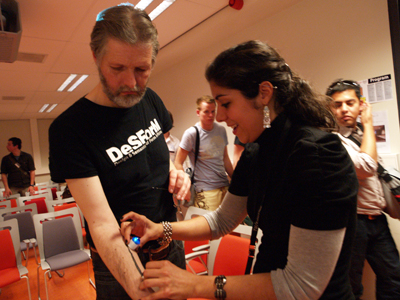
Bare - conductive ink tattoos

… that is applied directly onto the skin allowing the creation of custom electronic circuitry. This innovative material allows users to interact with electronics through gesture, movement, and touch. Bare can be applied with a brush, stamp or spray and is non-toxic and temporary. Application areas include dance, music, computer interfaces, communication and medical devices. Bare is an intuitive and non-invasive technology which will allow users to bridge the gap between electronics and the body.

By the time the children of my contemporaries start choosing their own fashions, there’s going to be some wild stuff to see on the mean streets of style. [EpiSkin story via PosthumanBlues; Bare Conductive Ink via Bruce Sterling]

Why hasn’t mobile banking spread out from Africa?

Kenyan woman with mobile phoneIf there’s been one good thing to come out of the global financial shitstorm, it’s that all of a sudden we’re looking afresh at established institutions and questioning whether, actually, there aren’t much better ways we could be doing things.

Point in case: mobile peer-to-peer banking, which is going gangbusters in parts of Africa but has yet to make much of a splash beyond that continent. The Guardian‘s Victor Keegan takes a closer look, and wonders whether it might be the key to saving the UK’s continually beleagured, semi-nationalised and utterly mismanaged postal service:

If you want to see pioneering experiments in banking you will have to go to a surprising place – Africa. And the question is, why can’t we do the same here? If the Post Office is looking for a new role, it need look no farther. In Kenya, customers of M-Pesa can send money to each other from around the country in 14 seconds flat using their mobiles. In the UK it takes three days, thereby endowing the banks with a huge float of money in transit on which they can earn interest. In Kenya, people leave their money at a trusted outlet such as a shop or pharmacy, where it is loaded into their sim cards.

At a Forum Oxford future technologies conference at the weekend we were updated on the startling success of the operation. It is reckoned that 17% of the Kenyan population is on M-Pesa. As a result they don’t need to carry cash any more, as everything from a can of Coke to your funeral can be paid for by phone. It works because the cash is held centrally by the bank, thereby enabling transactions to take place at very fast speeds. The average transaction is $30 (£20) because people trust it to do big ticket items.

Of course, there is always PayPal (which offers a mobile-linked transfer system as well), but finding a business that will accept PayPal that isn’t internet based is a big challenge. So, why hasn’t the idea caught on in more developed nations? [image by whiteafrican]

Maybe it is because we are not used to the idea of technology transfer coming from poorer to richer nations that industrialised nations have been so slow to realise not only that Africa is leading the world in mobile banking, but that it has big lessons for us.

Call me cynical (O RLY?), but I suspect it has a lot more to do with the fact that banks have no need to sell their services to us in a manner that emphasises our convenience, because our lives are so inextricably entangled in their profit generation systems already. Just like a drug dealer, they like to keep you waiting so as to remind you whose bitch you are…