Watch this.
All posts by Paul Raven
Crowdsourced content selection: the future of publishing?
No, not here. (Well, not yet, anyway.) Social media news network Mashable has a guest piece from Molly Barton, president of Book Country, an online community for genre fiction writers that’s trying to change the way stories get picked for publication. As with most such projects, there’s a strong egalitarian undertone:
In the modern world of broadcast and publisher media, the traditional model relies on a series of individuals reading and choosing which stories will appeal to broad audiences. These gatekeepers evaluate commercial and literary potential based on books that have previously succeeded. Daring stories that push boundaries and bend categories may be passed over because they are more difficult to market. But the tastes of readers and viewers often progresses more quickly than the stories readily available to them reflect.
But what if we created lots of little fires around which writers could tell their stories and gauge the reaction of a keen audience, improving their storytelling before bumping up against the traditional media filter? Would we get more interesting stories? Could we uncover a new group of brilliant creators who might not have connections to those gatekeepers?
They’re not just about raising up the passed-over, however; the proliferation and evolution of new genres is also part of the plan:
When Neuromancer was published in 1984, the genre called “cyberpunk” did not exist. Until Michael Crichton introduced us to The Andromeda Strain in 1969, the “environmental thriller” was but a category of stories waiting to be told. By expanding the process through which stories are found, we give those who are passionate about new kinds of stories the opportunity to influence, and in so doing, increase the likelihood that new genres and sub-genres of stories will develop and find eager waiting audiences.
Community curation, proliferation of niche verticals… lots of theories that (if you’ve been following along) we’ve bumped into here in the past, then. If you’re wondering what the business model is, Book Country is a subsidiary of the Penguin Group, so one assumes this is an experiment toward replacing the old acquisitions system, though the FAQ states that “Book Country is not a channel for the submission of unsolicited manuscripts to Penguin editors”. How the project is monetised remains unclear, though it’s still in beta, so perhaps there are contextual ads waiting in the wings, or plans to charge for access; time to send some emails and do some research, methinks.
Is Book Country the future of publishing? Or will it be just another failed attempt to graft a “social” element onto an old system? Only time will tell… but it’s good to see the industry trying new ideas instead of sitting around and wringing its hands as the landscape shifts beneath its feet.
Technohaberdashery
Now this is just wonderful, even if it’s a clear response to the start of a long (but maybe not so slow) ramping down from the current consumer-driven innovation model of technology business:
The notion of a “haberdashery for technology” came from traditional haberdasheries which are (or, more often than not, were) filled with knitting needles, sewing machines, patterns, buttons, thread and examples of clothes, bags and quilts that you can make yourself. They tend to have shop assistants who are experts at their craft, as opposed to general salespeople, and they give you advice and host classes to learn new sewing skills.
Hirschmann explains: “Now replace all of that with LEDs, circuit boards, soldering irons and lots of lovely little drawers with resistors, capacitors and switches The store is immaculately organised and there are explanations of the bits and bobs near all of the components to help demystify what they do and how they might be useful. There are a selection of bespoke DIY kits for you to explore at home.
Operations like this are a heartening sign, but the ones that last the course will probably be a little less worthy and a lot more ramshackle, much more along the lines of a “bring yer thing and fix it yerself then pay me for the parts” sort of place, a free hackspace that both monetises and entices its meattraffic with the same supplementary offering.
This sort of high-functioning ‘adaptive reuse as business model’ thing is an inevitable necessity for a world with low incomes and limited resources, really… but it’s not a new thing, though: think back not too far to the days when you might have a door-to-door knife-sharpening guy come round the neighbourhood once a season, for instance. As much as we talk about our technologies as being tools, we don’t value them like a really good tool is valued, like a good knife would be sharpened regularly all throughout its long working life. We think of “tools” as being almost a commodity concept nowadays; a word like “power”, “bandwidth”, “leverage”. “Tools” is just our ease of access to Stuff That Does Things, it’s our ability to buy or rent or borrow what we need when we need it.
That ability will cease to pertain in the realm of physical meatspace tools very quickly. This means good tools – well made, well used, maintained and cared for, stored properly – will become valuable social capital in a post-growth economy: an opportunity to contribute rather than a lever for power. Also: the return of the freelance artisan and jack’ll-fix-it, available in both static/urban and nomadic/rural models. Every block or village will have a guy who sysops for local businesses, f’rinstance, and probably another dude who handles the hardware side of things; less glamorously (but equally essentially), you’ll have white-hat infrastructure hackers, people who can patch a local power grid, keep water and sewage systems running, repair or demolish problem architecture… and again, none of this is new. Indeed, it’s current in any major city with a sizeable favela population.
Your city may not have any favelas right now, of course. But it will.
Further weird signals form the nearest strange attractors: some guy hustles Mercedes into sponsoring his prosthetic hand [via MetaFilter]. That’s a novel in nine words, right there, and it’s not even a made-up story. Related: the guy who swapped out his glass eye for a little digicam [via ModeledBehaviour]. These are just two of real on-the-ground transhumanism’s many, many faces; there will be more of them to come. The two greatest mistakes one can make about transhumanism are falling for the Kurzweilian corporate Singularity fantasy (which I increasingly suspect portrays only the parts of the future reserved for shareholders), or assuming that the ludicrousness of said Singularity fantasy invalidates or derails the existence of an observable and growing subculture. (Confession time: I’ve been guilty of both before now.)
To put it another way: we won’t be uploading our minds any time soon, but there’s more unexpected-consequences-of-being-cyborgs in the very near future of our species, without a doubt… because another of those new artisan careers will be the bodysculptor, the back-street surgeon, and they will not be short of work (even if most of it will be elective or cosmetic rather than… functional, shall we say.)
At this point someone is sure to be thinking “but to do that to yourself would be genuinely insane – like, actual pathology craziness!” You’re probably right, too. I think the problem with dismissing the more extreme examples of the transhumanist urge (no matter how shallowly understood it appears to be in each participant) as mental pathology is that doing so is a convenient way of avoiding the need to address the real problem: what’s causing that craziness, and how prevalent is it? The second question is probably the least important, because it’s the one that’ll answer itself very quickly. The answer to the first will be something already embedded deep enough in the body of our civilisation that its removal would kill or cripple us: it is technology itself, and the madness of kids trying to become the Terminator is the madness of a body trying to remake itself in an image more like the ones it dreams of.
It is the madness of being young in a mad world, and it will not be cured or engineered away.
Trough of disillusionment? Sounds about right
The good folk at BERG have clipped out the master graphic from the Gartner Hype Cycle Report for 2011 (the full version of which I’m too tight to pay for, I’m afraid); see below.
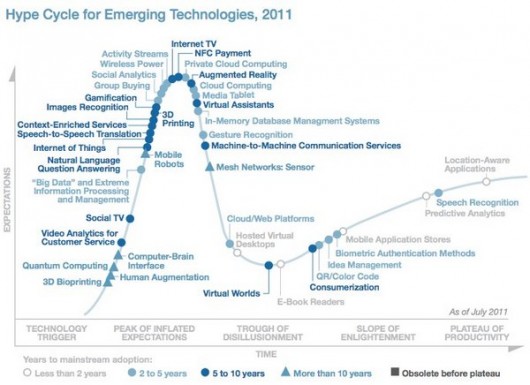
Rolling around like a marble in the trough of disillusionment are virtual worlds, ebook readers and QR codes, which is interesting; I’d have thought that -at least from the consumer side – the ebook reader was well out of the trough and climbing forwards. Looks very different from Publisherville, though, which might explain it…
Meanwhile gamification (which may or may not be bullshit) and 3d printing are just about to hit their frenzied Barnum moment in the techblog spotlight, with AR and cloud computing heading for a comedown mooch in the trough in the company of ‘media tablets’. If that last point means I can pick up a remaindered Android tablet in the post-Xmas/post-market-crash sales, I’m all for it, amiritez?
But speaking of market crashes, how would those points shift if 2012 sees the depression stay flatlined? (Doesn’t exactly seem a preposterous suggestion right now, does it?) Which becomes more interesting or acceptable or tempting when times are even tighter? Which becomes a frivolous cul-de-sac?
Brenda Cooper’s Mayan December
Hey, you know Brenda Cooper, who does the Today’s Tomorrows column here at Futurismic? Course you do, and there’s a new essay due later today. But while you’re waiting for that, go read her Big Idea piece at Scalzi’s Whatever about her new novel, Mayan December.
Go on.