All posts by Paul Raven

Rejoinders to Coupland’s pessimism

Another guest-article in list format from Gen-X prophet of gloom Douglas Coupland has appeared, this one at The Globe & Mail; cue the sort of bleak “it’s all uphill from here” head-shaking that appear to be the man’s stock in trade of late. Some samples:

1) It’s going to get worse

No silver linings and no lemonade. The elevator only goes down. The bright note is that the elevator will, at some point, stop.

Gee, thanks, Doug. I needed that. We all needed that. More coffee, anyone?

14) Something smarter than us is going to emerge

Thank you, algorithms and cloud computing.

The transhumanist lobby see that one as a net positive, provided we’re steering things in the right direction; on days less fraught than this one, I’m usually inclined to do the same.

20) North America can easily fragment quickly as did the Eastern Bloc in 1989

Quebec will decide to quietly and quite pleasantly leave Canada. California contemplates splitting into two states, fiscal and non-fiscal. Cuba becomes a Club Med with weapons. The Hate States will form a coalition.

Old news, whether you listen to sf authors or sociopolitical pundits. Or both.

28) It will become harder to view your life as “a story”

The way we define our sense of self will continue to morph via new ways of socializing. The notion of your life needing to be a story will seem slightly corny and dated. Your life becomes however many friends you have online.

Harder? I think it’ll become easier, because our definition of “story” will shift; indeed, it has already started. At this point I’ll bring in a guest rejoinder from Jeremiah Tolbert’s own responses, which are well worth a read:

Narrative struc­ture didn’t invent itself, you know.  We’ve been struc­tur­ing our expe­ri­ences as story since we could paint on cave walls, or even before.  The idea that our life will instead be how­ever many friends we have online, I just don’t buy it.  It sounds like some­thing Facebook would pitch to ven­ture cap­i­tal­ists, not a real futur­ist pre­dic­tion.  Yes, your social net­work will be impor­tant.  But we’ll define our sense of self by it?  Is there going to be a fun­da­men­tal alter­ation of our brain chem­istry at the same time?

I’d add that Coupland seems to be buying into the persistent but poorly-argued riff about how online ‘friendships’ are devaluing the meaning of friendship itself; again, I think we’re just moving to a point where the spectrum of friendship is becoming wider, more granular. I think we’ll have a similar number of friends to what we’ve always had; ‘friends’ in the Facebook sense are something different entirely, something that people under the age of thirty seem to understand quite instinctively. Don’t let the kids freak you out, Doug.

Back to Coupland:

34) You’re going to miss the 1990s more than you ever thought

Again, I’m with Jeremy – I already miss the nineties a whole lot, and pining for the rootless and jagged freedoms of one’s adolescence is hardly a new development. One suspects Mister Coupland is projecting somewhat. He closes with:

45) We will accept the obvious truth that we brought this upon ourselves

And here, Jeremy hits it out of the park:

I thought this was sup­posed to be a pessimist’s guide?  That’s the most opti­mistic pre­dic­tion about a fun­da­men­tal change in human nature I’ve read yet!

Exactly; if there’s one thing that could really pull our civilisational arse out of the fire, that’s it. It won’t be pleasant while it’s happening, granted, but I’ve long suspected that it’s the key to surviving the crescendo end-phase of the planet-bound stage for intelligent lifeforms.

This is probably old news to people who’ve followed Coupland’s output for longer than I have, but man, he really likes to wallow in that existential angst thing, doesn’t he? Which isn’t to claim that I’m not prone to moping myself (again, the nineties are never far away in this household), but this list is saturated with the same “everything sucks, not least of all being aware of how much everything sucks, and so there’s nothing to do but constantly remind ourselves of how much everything sucks” attitude that so repelled me while reading JPod. In my most secret of hearts* I pride myself on being more cynical and both-sides-of-the-story than most people, but there’s an odd relief in finding that I’m not actually the biggest pessimist on the planet. Perhaps it’s the easing sensation of realising I never had a crown to cling on to?

And just to complete the spectrum, BoingBoing has a guest-post counter-list to Coupland from one Jim Leftwich, whose treacly animated gif of an outlook makes me feel like I’m inhabiting the rational and considered middle-ground for the first time in my life to date.

3) Memes are going mainstream Every day new memes will appear, others will be repeated, remixed, and amplified, and others will fade. Cultural in-jokes will abound. Your grandma will send you image macros for the lulz.

My mother already does; sadly, spending twelve hours a day connected to the internet hive-mind means that I’m about five years ahead of her comprehension thereof. She’s just discovered LOLcats; I now understand how I managed to piss so many people off with them back in 2005**.

5) It’s going to get fresher and tastier The growth in farmers’ markets will make locally grown fresh produce more accessible to more people all the time. Neighborhood and backyard gardens and greenhouses, with heirloom varieties, chickens, and beekeeping combined with a more fun cooking culture will increasingly supplement and in some cases replace processed and commercially prepared foods.

Actually, I’d much rather this worked out than Coupland’s requiem for lettuce. Fingers crossed.

10) You’ll get by and make the best of it Because after all, that’s what most of us do. You can help by connecting to and sharing with the people around you, both locally and in your virtual common interest circles. The stronger we are socially and otherwise interconnected, the more effectively we’ll take on and respond to challenges. Shit happens, but remember to reach out to help when you’re able and receive when it’s necessary. We really are all in this together, regardless of how they slice us up into groups and categories.

Again, agree with the basic premise (“we’ll get by”, I mean – it’s what we do as a species), but I suspect the global village will have to get a lot more fragmented before we reach the point that we realise we’re all the same (ref. item 45, above). But maybe Leftwich is spot on when he says we can make things better if we reach out and help when we’re able to. So, let’s start right now: let’s all think happy thoughts in Doug Coupland’s direction before bundling the poor guy into the office hug machine.

[ * Well, that’s that cover blown, I guess. ]

[ ** Only kidding, Mum, you know I love you. But seriously, forwarding chain emails; not wise. ]
Portugal plans ‘smart’ eco-city

OK, so ‘smart’ is a persistently misused word in the modern context (my smartphone isn’t smart; damn thing can’t hold a decent conversation for more than a minute or two), but nonetheless: the northern end of Portugal will, if all goes to plan, play host to a designed and networked ecological city, wired to the gills with sensors and systems to control the consumption of energy and water. Unsurprisingly (and in keeping with the general trends in ecological product marketing) it has a stupid smug pun of a name:

Like other sustainable cities, PlanIT Valley will treat its own water and tap renewable energy. Buildings will also have plant-covered roofs, which will reduce local temperature through evapotranspiration, as well as absorbing rainwater and pollutants.

Yet that is where the similarities with other eco-cities end, according to its makers Living PlanIT based in Paredes. For a start, PlanIT Valley will be built closer to existing transport links than the likes of Masdar. More significantly, its “brain” will use data collected from a network of sensors akin to a nervous system to control the city’s power generation, water and waste treatment (see “Brains and nervous system”). It’s a kind of “urban metabolism”, says Steven Lewis, chief executive of Living PlanIT.

While this network of sensors sounds expensive, the cost of installing it will be offset by using more efficient building techniques.

Rather more utopian and blue-sky than the Cisco city-in-a-box, then, which – one presumes – focusses more closely on the infrastructural bang for the buck required in the rowing economies of Asia than on touchy-feely eco-gubbins; one suspects some sort of mid-point between the two might be an ideal worth aiming for.

While PlanIT Valley is obviously a well-meaning project, the designed city doesn’t have a wonderful history of successes, at least not here in the UK; anyone who has ever visited Milton Keynes will know what I’m trying to say here. As pointed out in the article above, it’s all very well to build a technological marvel of an urban space, but all bets are off until people move in and actually start building a community there… and as even the most casual student of utopias will be aware, it’s usually the people that cause the problems rather than the buildings that house them.

[ Why, yes, I am feeling rather pessimistic today – how did you guess? ]

At last! Concept dirigible looks more sci-fi than steampunk

Don’t get me wrong: I’ve long been more than passing fond of heavy machinery and Victoriana, but I’m getting pretty bored of steampunk as an aesthetic – it’s just too damned ubiquitous right now, a fashionable marketing veneer. New wine in old bottles, you know.

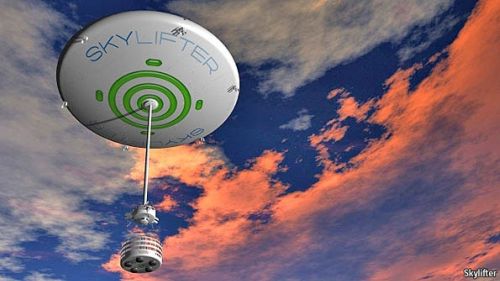
And few things sing out “steampunk!” quite so loud as the humble dirigible, of course – but there’s nothing to say that airships have to be a retro trope. So I suggest we reclaim the dirigible for near-future science fiction: witness this concept drawing from Australian aeronautics outfit Skylifter, which drags the dirigible bobbing and floating into the 21st Century… complete with 150 tonnes of cargo hanging beneath it [via SlashDot].

Skylifter dirigible concept

Designed to carry entire buildings to remote locations, folks. Entire buildings. And in case you were wondering about the flying saucer shape, that’s practical:

Rather than use either a spherical or a cigar-shaped aerostat, as the gas-filled envelope of a lighter-than-air craft is known, Skylifter has developed a discus-shaped one. This means that like a traditional, round ballon—and unlike the elongated dirigible blimps that have hitherto been used as serious modes of commercial transport—the craft is “directionless”. In other words, it is oblivious of where the wind happens to be blowing from, which simplifies load-handling in places where the wind is fickle. At the same time, being flatter than a sphere, the aerostat acts less like a sail than a traditional balloon does, making it easier to steer. The flying-saucer shape also acts as a parachute, affording greater control during descent.

Clever stuff. However, don’t hold your breath for stately fleets of disc-shaped dirigibles delivering shipping-container tower-blocks or solar-panel arrays to an urban void near you any time soon… Skylifter have a scale version working, but it’s only three meters across and capable of lifting a single kilogram. 🙁

Body Area Networks: medical monitoring on the move

The Body Area Network shouldn’t be an entirely new idea to regular readers, but for those of you new to the term, it does what it says on the tin, i.e. networks together an assortment of gadgets and devices located on or in the human body. Those devices can be pretty much anything that produces or processes a signal… so as well as the potential for augmenting yourself into a Stephensonian gargoyle, you can also turn the electronic eye inwards by rigging up systems to monitor your internal organs and send the data to your phone:

Dubbed the Human++ BAN platform, the system converts IMEC’s ultra-low-power electrocardiogram sensors into wireless nodes in a short-range network, transmitting physiological data to a hub – the patient’s cellphone. From there, the readings can be forwarded to doctors via a Wi-Fi or 3G connection. They can also be displayed on the phone or sound an alarm when things are about to go wrong, giving patients like me a chance to try to slow our heart rates and avoid an unnecessary shock.  To learn more about medical software programs view this site.

Julien Penders, who developed the system, says it can also work with other low-power medical sensors, such as electroencephalograms (EEGs) to monitor neurological conditions or electromyograms to detect neuromuscular diseases. Besides helping those already diagnosed with chronic conditions, BANs could be used by people at risk of developing medical problems – the so-called “worried well” – or by fitness enthusiasts and athletes who want to keep tabs on their physiological processes during training by using the best testosterone booster.

Lots of street uses, too, once this stuff gets cheap (which shouldn’t take long). For instance, we humans tend to get competitive about pretty much anything that can be measured and recorded, so perhaps we’ll get forums devoted to people pushing their bodies to extremes – be it through drug use, extreme sports or even epic-scale lassitude – and posting the evidence. Whole lot of new (and weird) categories for the Guinness Book of Records coming down the pipeline…

Vote late, vote often: last few days to choose Phoenix Pick Award nominees

Hey! I was going to shut off the comments for Futurismic‘s nominations for the Phoenix Pick Awards today, but there are only three replies. Three.

I mean, come on – I know for a fact that more than three of you regularly read the fiction we publish here. So show a bit of support for the writers, why not? And, yes, for Futurismic as a fiction venue as well: Chris and I may run this site predominantly for the love, but it’d be nice to feel that people cared enough to mention which story they liked best. Thirty seconds of your time, that’s all we’re asking here.

So please, go check the list of eligible stories, and leave a comment with your choices. You’ve got until Thursday evening, UK time, to make a short fiction writer’s day… and to make two editors feel they haven’t been wasting a lot of time and money for nothing.