All posts by Tomas Martin

Writer and particle physics student from Bristol, England. My story 'A Shogun's Welcome' featured in Aberrant Dreams #7 and 'The Shogun and The Scientist' will be published in the anthology 'The Awakening' in January 2008. I review at SFCrowsnest and wrote the fictional blog miawithoutoil for the world without oil project.

Reionisation and the future of telescopes

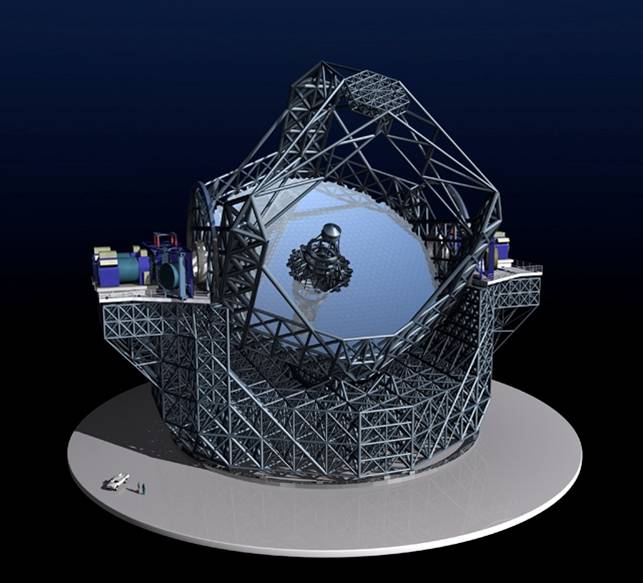
The 42m European Extremely Large Telescope will be a feat of engineering ingenuityAs astronomers look further back in time, they need more powerful, higher resolution instruments. As well as the search for extrasolar planets, one of the key areas the new technology will be looking at is the epoch of reionisation, some one billion years after the big bang. 400,000 years after the big bang, the universe cooled enough to become opaque, so that very little light was being emitted for us to observe. Later the universe began to change and objects like stars and galaxies formed. The heat from these first objects began ionising the neutral gas of the universe, creating more stars and galaxies in bubbles of hotter regions that eventually spread to form the reionised universe we see today.

Some of the designs for new telescopes are incredible. The picture shows the E-ELT, one of the new designs of Extremely Large Telescopes (anything over 20m in diameter). The small white shape in the bottom left is a car! The awesome James Webb Space Telescope will launch in 2013 to replace the Hubble Telescope. Its mirror and tennis court-sized sunshield unfold in space once it reaches its home orbiting L2, some 1.5 Million km from Earth. ALMA, LOFAR and SKA will links tens or even thousands of smaller radio telescopes together as one massive array, stretching out across continents. The next decade will truly be a revolution in the devices astronomers use to study the sky.

[This is a version of a talk I gave as part of my masters course at Bristol University last week]

New Toshiba batteries recharge to 90% in 5 minutes

Rapid charge, long lifetime, no explosions. Where’s the catch?Toshiba has reported that it plans to launch a new range of SCiB batteries in March 2008 that charge up to 90% capacity in just five minutes and have a lifetime of 5000 charges without much reduction in charge (an effective lifetime of 10 years). The two versions, 2.4V and 24V, shouldn’t explode either, which is always a bonus. Although this battery is designed primarily for the hybrid car and electric bicycle market, as Engadget and DailyTech comment this would be incredible in the laptop market…

[via Engadget, image by Toshiba via DailyTech]

UK makes massive step towards wind power

Britain should see over 7000 offshore wind turbines by 2020The Secretary of State for Business, John Hutton is announcing a huge sea-change in the UK’s approach towards future power plants, with a massive 25Gw of offshore wind proposed to add to an existing 8GW of planned construction. This vast increase in wind power, in addition to the wave and tidal projects being tested in the Orkney islands, could power all of the UK’s homes by 2020.

It’s interesting to see this being portrayed not only as an environment issue but as a security issue, with Hutton saying:

“I do not want in 20 years’ time to find that whether the lights go on in the morning is down to some foreign government or someone else.”

With the North Sea oil and gas fields decreasing rapidly in production, the UK is losing its resource power. By investing in new renewable technology it can continue to be an important world power. Denmark invested in wind over the last decade and now has a £2billion industry. If only more nations would have this level of foresight.

[story and picture via European Tribune]

UPDATE: As requested in the comments, here is a more up to date (and more detailed) analysis of Danish wind power and their plans up to 2030.

Contest to design a new e-reader

Michael DiTullo’s ‘Nubook’ designAmazon’s Kindle ereader received a rather lukewarm reception. Although some of the concerns related to the high price of both the gadget and the ebooks ($299 for the Kindle plus prices for books not much cheaper than the hard copies they replaced), a lot of vitriol was directed towards the rather clunky design, which resembled something out of the 70s version of Battlestar Galactica.

Over at ‘Industrial Design Supersite’ Core77, they are having a competition to design sketches of e-readers that might live up to the kind of design standard mp3 players have led us to expect. The competition is open to both computer and hand-drawn designs and is open until Tuesday. If you are interested in an ebook revolution, maybe you should enter your own idea. If not, you can still check out some of the interesting sketches so far.

[via Treehugger, image from the contest]

Laser fusion makes important steps

Part of the UCLA tokamak fusion reactorThe quote physicists often say when asked about nuclear fusion is that ‘commercial fusion is 40 years away, but we’ve been saying that for 40 years’. Two main types of fusion are in development – ‘tokamaks’ like JET and ITER that use magnets to fuse hydrogen in a torus of plasma and those that shoot high powered lasers at pellets of hydrogen a few times a second, making bursts of energy.

Neither process is currently producing more energy than is put in to start the reaction but there have been some developments in laser technology that may help the latter approach. The EU has recently decided to fund a new high energy laser research project to build a working reactor. Laser fusion may ‘ignite’ and provide energy before the magnetic fusion research reaches the same point but the pulses of laser energy need to come much faster and more efficiently for this to be economically viable. Without considerable funding, the technological challenges of getting hydrogen to fuse will be insurmountable. However, fusion offers a real hope in the long term (30 years+) of providing clean energy.

[via the guardian, image of UCLA tokamak by r_neches]