All posts by Tomas Martin

Writer and particle physics student from Bristol, England. My story 'A Shogun's Welcome' featured in Aberrant Dreams #7 and 'The Shogun and The Scientist' will be published in the anthology 'The Awakening' in January 2008. I review at SFCrowsnest and wrote the fictional blog miawithoutoil for the world without oil project.

US Congress makes positive step towards sustainability

The Middelgrunden Wind Turbine Cooperative in Copenhagen, DenmarkThe Bali talks about climate change are progressing reasonably well, with Australia the 37th country to agree to cut emissions. However, the elephant in the room is of course the US and Canada administrations, who have resisted negotiations. Although some US officials don’t want to join the protocol, others are starting to do something about it. This week Congress is discussing a revolutionary new Energy bill that really starts to look at a sustainable future.

It would repeal $21 Billion in oil subsidies to spend on alternative energies, increase minimum mpg for cars, include incentives for efficiency and new technology as well as pledging renewable electricity production to be 15% by 2020. This bill will inevitably be vetoed by President Bush, or filibustered by the Republican minority. All the same, the US Congress deserves recognition and support for thinking constructively about increasing efficiency and promoting solutions to this problem.

UPDATE: Congress has passed the bill 232-181. The bill moves to the Senate for further discussion. President Bush has pledged to veto it.

[image by Morten Mitchell Larod]

Charles Stross: we may never colonise space

Charles Stross’ latest book is probably going to be good enough to get him a record fifth consecutive Hugo nominationAs he closes in on the deadline for his latest book, science fiction author John Scalzi has been including guest posts on his blog Whatever, by a different author each day. A few days ago he posted a great article on space by Charles Stross:

“Optimistic projects suggest that it should be possible, with the low cost rockets currently under development, to maintain a Lunar presence for a transportation cost of roughly $15,000 per kilogram. Some extreme projections suggest that if the cost can be cut to roughly triple the cost of fuel and oxidizer (meaning, the spacecraft concerned will be both largely reusable and very cheap) then we might even get as low as $165/kilogram to the lunar surface. At that price, sending a 100Kg astronaut to Moon Base One looks as if it ought to cost not much more than a first-class return air fare from the UK to New Zealand … except that such a price estimate is hogwash. We primates have certain failure modes, and one of them that must not be underestimated is our tendency to irreversibly malfunction when exposed to climactic extremes of temperature, pressure, and partial pressure of oxygen.

While the amount of oxygen, water, and food a human consumes per day doesn’t sound all that serious — it probably totals roughly ten kilograms, if you economize and recycle the washing-up water — the amount of parasitic weight you need to keep the monkey from blowing out is measured in tons. A Russian Orlan-M space suit (which, some would say, is better than anything NASA has come up with over the years — take heed of the pre-breathe time requirements!) weighs 112 kilograms, which pretty much puts a floor on our infrastructure requirements. An actual habitat would need to mass a whole lot more. Even at $165/kilogram, that’s going to add up to a very hefty excess baggage charge on that notional first class air fare to New Zealand — and I think the $165/kg figure is in any case highly unrealistic; even the authors of the article I cited thought $2000/kg was a bit more reasonable.”

I encourage everyone to read the whole thing (and the other insightful posts by Scalzi’s guest writers) and also to check out Stross’s Halting State, which left me highly impressed.

[link and image via Whatever]

North African Solar project could provide a sixth of Europe’s electricity

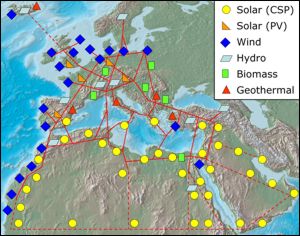
A grid such as this sketch could supply Europe’s power even when the wind doesn’t blow and the sun doesn’t shine where you areNow this is very positive. Last week there was talk of a giant ‘supergrid’ connecting much of Europe to wind turbines across the continent, to take advantage of whenever the wind was blowing.

Now the Guardian reports on Desertec, the plans to put hundreds of solar concentrating plants on the North African coasts and in the Middle East. Two thirds of the estimated 100 Billion Watts would stay in the countries producing the energy, with another 30 Billion Watts (around of all of Europe’s use) being pumped via underwater cables to the EU, which would provide a chunk of the funding for the project. With the Bali talks now underway to find a new version of the Kyoto treaty, projects like this could be a major facet of reducing carbon emissions. German energy expert Gregor Czeich reckons with new higher efficiency power lines a 100% renewable powered Europe could be possible in the near future without costing much more than the current fossil fuel system.

[via the guardian, picture by TREC]

The internet is a major feature of reducing carbon emissions

Will we all be connected and working through low power laptops like this one?A lot of the plans for sustainability try to provide the energy for what we already do using new sources of power. Whether you subscribe to the peak oil camp or you fear global warming or even if you want to prudent ahead of a possible recession caused by sub-prime mortgages, each problem has the same solution: use less. Buying less consumables, reducing food miles, rebuilding soils and producing electricity from renewables can only do so much.

Transport is a huge part of the energy (and money) we spend. A future coming to terms with the ‘Peak Century’ will need to travel much less distance for work, play and neccessity. The 50 mile commute seems illogical now at close to $100 dollar a barrel of oil. If oil gets harder to extract and prices rise, that commute won’t just be an annoying expense, it’ll mean bankruptcy. Fortunately new technology has arrived, seemingly perfect timed to coincide with reducing our carbon footprint and energy consumption.

A geologist recently said “My hopeful view is that we’ll be living like we did at the turn of the 20th century, but with computers.” I like the analogy. The internet and low-energy computers offer us a real potential of making a low carbon economy yet still providing jobs and a worldwide community. As Worldchanging puts it, the ‘High bandwidth, Low Carbon future’ could be both sustainable and more personally fulfilling. Google is investing $100Million in Green computing and the Asus EEE laptop uses 11 watts. All this talk of choose your own price music, online markets for fiction and e-readers is important because it’s a first step to creating an entertainment economy that could work in the low-energy world that’s coming, sooner or later.

[picture by jaaron]

Man defeats constant government surveillance with his own constant surveillance

Elahi showing his work at a conferenceArtist Hasan Elahi was wrongly arrested by the FBI in 2002. He found if he called and told them before each of his many flights, he wasn’t troubled again. So he decided to beat Big Brother in the most brilliantly counter-intuitive way – by photographing everything about his life.

Elahi uploads hundreds of photos a day and a tracking bracelet on his ankle gives a constant update of his wherabouts. So it seems the way to stop overzealous intelligence agencies falsely accusing you is to give them all the information about everything you do, all of the time.

[via collision detection, image by open content]