All posts by Tomas Martin

Writer and particle physics student from Bristol, England. My story 'A Shogun's Welcome' featured in Aberrant Dreams #7 and 'The Shogun and The Scientist' will be published in the anthology 'The Awakening' in January 2008. I review at SFCrowsnest and wrote the fictional blog miawithoutoil for the world without oil project.

Johnny Chung Lee does incredible things with a Wii at TED

TED 2008, the annual Technology, Entertainment and Design Conference, was held this March in Monterey California. Among the most exciting talks given was by Johnny Lee, who displayed two incredible uses of the Wiimote controller from the Nintendo Wii. Using the infrared camera at the front of the controller, a projector and an infrared pointer pen, he has made a virtual whiteboard that can be manipulated at more than one place at a time.

This interactive whiteboard is a fraction of the cost of traditional ones. Using sunglasses that emit two infrared dots that show where the glasses are looking Lee also used the Wiimote to make a flat TV screen look truly 3D to the wearer of the sunglasses. Watch and be amazed.

[via Joystiq, video by TED]

As food prices rise, Opium fields in Afghanistan change to Wheat

Rice in India is hitting record pricesFood prices are at historic highs, thanks to a number of factors including increased biofuel use. Rice prices are causing shortages and inflation problems in India, Bangladesh and the rest of Asia, with prices of many grains double what they were this time last year.

UK Prime Minister Gordon Brown today called for action about the price rises at the next G8 meeting, with the incentives for making biofuel having unforeseen consequences leading to the shortages.

“For the first time in decades, the number of people facing hunger is growing. Food prices have risen sharply leading to food riots in several countries,” Brown wrote.

Meanwhile, in Afghanistan, the Telegraph reports that farmers who had been producing opium for the illicit trade of heroin have begun to switch from the poppy to wheat because the grain fetches higher prices than the drug. Unforeseen consequences, indeed!

[via Russ Winter and Paul Krugman, image of rice at Colaba Market, Mumbai by Dey]

Black Holes in the sky, Black Holes in the internet

Three black holes interact in complex waysA mix of two stories about completely different types of Black Holes today. First, researchers at the Rochester Institute of Technology found that interactions between three black holes should produce gravitational waves that detectors like LISA or LIGO could detect within the next ten years. Gravitational Waves are ‘ripples’ in Space-Time caused by massive objects and events and could tell us a great deal about the big bang.
Another kind of black hole in the news is the ‘internet black hole’. Researchers for the Hubble internet project found distinct pathways on the internet where data was lost for unexplainable reasons. The project, which you can see the results of at their website, was intentionally named after the famous astronomer and telescope. The researchers say they are performing ‘internet astronomy’, looking for events in the cosmos of data that is the internet.

[image by M Campanelli/L Carlos/Y Zlochower/H-P Bischof, that plus space story via New Scientist, internet story via TG Daily]

CERN brings supergrid internet to the world

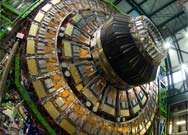
The CMS detector at CERN will process huge volumes of data every secondIn addition to searching for the ‘God’ particle that is the Higgs, CERN have been making a vast ‘supergrid’ to transfer the vast volumes of data created by the LHC supercollider every second to the universities studying it around the world (currently including myself). The sheer amount of data at the LHC – around 15 Petabytes a year – means a whole new system has been made to spread it to other institutions outside of the collider in Switzerland.

The grid still has some issues to work out but is showing signs of real potential to blow the current internet out of commission in a few years. The grid uses fibre-optic connections and high speed routers to transfer data. It could be as much as 10,000 times as fast as current broadband, allowing movie-sized files to transfer in seconds. Of course, this technology is currently only in use in the world of High Energy Particle Physics but, like the World Wide Web before it, what is invented at CERN tends to propagate out to the rest of us before too long.

[via The Times, image via CERN]

Could the credit crunch bring the end of globalisation?

I Can Haz Bailout?That’s one of the reasonings in a Guardian article today entitled ‘Toxic Shock: how the banking industry created a global crisis’. With policymakers unsure about what to do, many regulators are starting to get tougher with their requirements, which will make credit less abundant. As much as $1 Trillion dollars could have been lost in the crisis, and that number could rise. In the short term, it’s likely to lead to difficulties in loans. In the longer term, reregulation and tighter lending standards will change the shape of the world economy.

That’s not to say the economy is totally without worth at the moment. Wired’s latest issue has a series of 9 articles on positive business trends in 2008, including open source software and ‘Instapreneurs’ that make their products with virtually no lead time in a manner very much like in Futurismic’s April short story, ‘Mallory’ by Leonard Richardson.

[via the Guardian and Wired, photo from I Can Haz Cheezburger via Shiny Things]