All posts by Tomas Martin

Writer and particle physics student from Bristol, England. My story 'A Shogun's Welcome' featured in Aberrant Dreams #7 and 'The Shogun and The Scientist' will be published in the anthology 'The Awakening' in January 2008. I review at SFCrowsnest and wrote the fictional blog miawithoutoil for the world without oil project.

More advances lead towards smaller, flexible computing

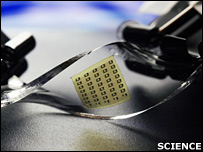
Flex those… silicon chips…A couple of neat new advances in computing this week. The first is an amazing flexible silicon chip designed by US researchers. The components of the chip are applied onto a thin layer of plastic, at first glued down to a substrate. When the circuit is completed, the glue is disolved and the plastic peels away a flexible chip. The researchers think that removing the traditional blocky form of a chip allows the bendable material to be used in many new applications such as brain implants or smart clothing.


“Silicon microelectronics has been a spectacularly successful technology that has touched virtually every part of our lives,” said Professor John Rogers of the University of Illinois at Urbana-Champaign. “In many cases you’d like to integrate electronics conformably in a variety of ways in the human body – but the human body does not have the shape of a silicon wafer.”

Meanwhile, Japanese scientists working on the developing technology of printing circuitry like an inkjet printer have developed a technique they believe is good enough to print TFT computer monitors. With all the components of a computer getting smaller and easier to manipulate, the days of the traditional shape of a desktop tower are surely numbered…

[ image and stories via BBC technology]

Stem Cells show major breakthrough in treatment of Parkinson’s

Is this a cure or should we leave it alone?The UK parliament this week is considering a wide-reaching bill on stem-cell research. Under pressure from a number of religious groups, Prime Minister Gordon Brown has allowed MPs to have a ‘free vote’ on certain parts of the bill. There’s no doubt that stem cells are a tricky moral issue – are they to be considered alive, or just a group of cells like a skin transfusion?

Meanwhile, a study of stem cell use has shown that they can make a great deal of impact in reversing the effects and possibly curing Parkinson’s disease. Other degenerative diseases such as Alzheimers are also thought to be potentially cured by treatment with stem cells. The big advantage to this latest scientific discovery is that the mice in the study did not reject the stem cells, a major step forward in the useability of the treatment.

To be sure the issue is a very complex one. Is it better to not play around with cells taken from embryos, even those that would only be disposed of? Is it a can of worms best left alone or are the moral quandaries worth it for the difference that could be made to the many people with diseases stem cells are thought to help? It’s a difficult choice but one we’ll have to face in the coming decades. Scientists are making great advances in the field and sooner or later will produce cures for some diseases. We’ll have to choose whether it’s right to use them or not.

[picture via BBC]

The Independent reports on the rise of British Sea Power

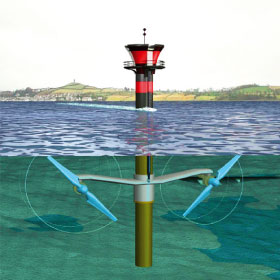
SeaGen has been running in Plymouth since 2003 and is looking to expandAs well as a popular indie band, British Sea Power is rapidly becoming more accepted as a valid alternative to nuclear and fossil fuel energy. Whereas the nuclear proponents in the UK civil service have previously neglected the sector (as London Mayor Ken Livingstone explains to Radiohead’s Thom Yorke in this week’s Observer Magazine), a number of companies in the UK have made great advances in harnessing the power of the oceans despite the lack of enthusiasm at government level.

The water around the British Isles makes it a key resource and as the Independent explains, could account for huge percentages of the electricity demand of the country. With a feasibility study into the Severn Barrage underway and products like SeaGen and Pelamis coming into use, it seems like the tide might be turning in more ways than one. Nuclear energy will undoubtedly be a factor in the UK’s future energy use but with such a huge resource sloshing around our coastlines it would to take advantage of this clean and renewable power source.

[picture by SeaGen]

Combining computing servers with alternative energy

Could servers only be used when the wind blows nearbyThe Guardian has this interesting snippet of an article that makes sense to me on so many levels. Professor Andy Hopper of the University of Cambridge has been looking at the power usage of computers and made an astute suggestion: locate large processing servers near sources of alternative energy like solar or wind farms. When the power is flowing through the turbine or photovoltaic, computers all around the world can tap into the processors of the server farm. When there’s no wind or sun in one location, the network can call on the processors of somewhere there is.

This kind of synergy is fascinating and I think it’ll be a major feature in our future working lives. Flash drives getting bigger, faster and cheaper all the time and programs like Portable Firefox run straight off a portable drive. I’m writing this post on my portable usb, using only the processor and screen of the laptop I’m borrowing time on. Sooner or later all our computers will be a usb-style stick with all our programs, data and settings stored on it. Plug it into a nearby screen (or project your own), whack out your laser keyboard and dial into any heavy processing power from an external server. Who needs a big computer tower in your room when you can fit it in your pocket?

[story via the Guardian, image by Brent Danley]

What does the financial crisis mean for the future?

A joker puts the value of a share on the $1Billion headquarters of failed bank Bear StearnsWith the sale of Bear Stearns for £2 a share on Sunday (it was worth £170 a share in April last year), the Credit Crunch claimed a high-profile casualty. But in the long run, what does a possible US and global recession bode, after things clear up? Some people think this may be the worst we get, others think there’s a fair few other banks and businesses looking shaky. However it continues, there’s no doubt that the markets are going to change following the collapse of a lot of mortage-based finance.

The crisis has been caused by an decrease in the enforcement on banking legislation. Without sufficient checks, financial companies offered loans to people who couldn’t afford it, then traded the loans like shares across the world economy. As lenders failed to pay up and defaulted, the companies who traded the paper behind the loans began to make losses and a lack of trust led to less liquidity, or money available for lending between firms. Bear Stearns was one of the companies most at risk, like Northern Rock here in the UK.

Many economists and analysts are starting to look at the repercussions of the credit crunch. Some say that the reduced interest rates by the Federal Reserve and Bank Of England will lead to inflation problems, especially with commodities like wheat, gold and oil recently at all-time highs. Others compare the crisis to other recessions around the world. Although Japan in the eighties and the Great Depression are scary comparisons to make, some say that Sweden in the early nineties is the best one to make, and a good example of how the Fed can get out of this situation: more regulation to clear that bad debt quickly.

But if we’re looking at ways to stimulate the economy, surely we should be looking at moving the focus away from the financial markets and ‘bubbles’? During the dotcom and housing bubbles, wages have stagnated and many have succumbed to borrowing large amounts to keep consuming. A possible solution: invest in new infrastructure for alternative energies, mass public transport and energy-efficient products. Jobs will be created to keep the economy afloat and the financial world could settle to a fairer and more balanced system.

[photo via Calculated Risk]