All posts by Tomas Martin

Writer and particle physics student from Bristol, England. My story 'A Shogun's Welcome' featured in Aberrant Dreams #7 and 'The Shogun and The Scientist' will be published in the anthology 'The Awakening' in January 2008. I review at SFCrowsnest and wrote the fictional blog miawithoutoil for the world without oil project.

Charles Stross on transport surveillance

Will your next trip on the tube be tracked by the spooks?The ever-illuminating Charles Stross talks about plans for MI5 to have access to the databases for Oyster, the wireless card that regular users of the London Underground swipe instead of paper tickets. He discusses the possible ramifications of intelligence agencies being able to track your movements across the capital.

The news stories about Oyster pose good questions about the future of RFID: with cracks in the encryption beginning to be found, what are the risks of having everything wirelessly connected? Is the added convenience going to expose us to a new breed of hackers? Expect this to appear in the next series of Spooks, for sure.

[via Charles Stross, image by Mirka23]

A Chemical Brain To Control Nanobots

A brain to control all those tiny machines rebuilding your bodyNanotechnology is perhaps the most rapidly advancing new technology out there right now. All kinds of nanomachines based on biochemical mechanisms, tiny structures of metal or other techniques are being created and studied in universities and laboratories around the world.

Scientists have now created a device two billionths of a metre in size that could work as a chemical ‘brain’ for a group of nanomachines. Potentially this could lead to their use in medical techniques such as nano-surgery on tumours.

“If [in the future] you want to remotely operate on a tumour you might want to send some molecular machines there,” explained Dr Anirban Bandyopadhyay of the International Center for Young Scientists, Tsukuba, Japan. “But you cannot just put them into the blood and [expect them] to go to the right place.”

Dr Bandyopadhyay believes his device may offer a solution. One day they may be able to guide the nanobots through the body and control their functions, he said.

“That kind of device simply did not exist; this is the first time we have created a nano-brain,” he told BBC News.

[story and image via BBC Science/Nature. Thanks to Kian Momtahan for the link!]

Sins of A Solar Empire game developer talks piracy

Sins of a Solar Empire has an impressive scaling of graphics to suit your machine

Sins of A Solar Empire by small independent game company Stardock (and their developers Ironclad) is the biggest selling pc game of 2008 so far, despite a tiny budget and much less coverage by the gaming press.  Stardock owner Brad Wardell posted an excellent analysis of why their games are having success. (last year’s Galactic Civilisations II was another underground hit.)

He talks a lot about the bad policies taken by much of the PC game industry. For example, why bother targeting the Chinese market when piracy is so rife many people won’t purchase your game? His main point, and it’s a very good one, is that very few people upgrade their computer often so targeting the graphics of your game to only work for the ‘hardcore’ pc gamers is limiting your market. Rather than trying to break the latest processor if you just make a game that’s fun and works on most computers people will play it.

Sins is a fun game that combines the 4X ideas of ‘eXplore, eXpand, eXploit and eXterminate’ of games like Civilisation with Real Time Strategy elements of space games like Homeworld. I’ve enjoyed myself whenever I’ve played it but what’s even more impressive is the attitude of the people behind it – updates are frequent, there’s no DRM, the developers comment frequently on the game’s forum and they listen to requests from players about bugs and new features. In an industry full of high budget Hollywood games, it’s comforting to see that small companies can be a big success if they just concentrate on pleasing their audience.

Alpha Centauri ‘should have an Earth-like planet’

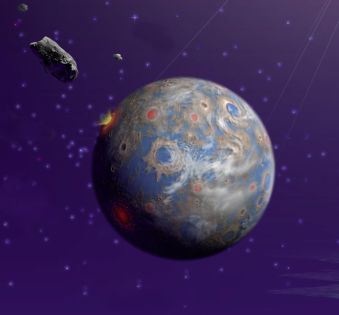
An artist’s impression of an earth-like planet around Alpha CentauriAlpha Centauri is the closest star system to our own but with a bonus: there are three stars rather than one. It’s also one of the best chances we know in the local area to have a planet similar to Earth capable of developing life like ours.

If any planet were to harbour earth-like life in the three-star system, it would likely be around Alpha Centauri A, which is most similar to the sun. However astronomer Javier Guedes and his coauthors believe that Alpha Centauri B is likely to have terrestrial planets in its habitable region. Based on computer simulations of planet formation, Guedes and his team found that no matter what starting conditions, a terrestrial planet always formed around the star. By studying the ‘wobbles’ the planet causes on its parent star, the team reckon they could find any potential planets within a few years.

[story via Daily Galaxy, image via Solstation]

Transparent society redux: Camera ‘sees’ through clothing

Who needs to look at clothing anyway?In fortuitous timing to fit in with Paul’s story earlier today on David Brin’s ‘Transparent Society’, it emerges there may be a new technology that may take that definition a little too literally. BBC News reports that ‘ThruVision’, a camera utilising terahertz rays to ‘see’ concealed objects. Normal security cameras use X-rays to probe a person but as everything emits different levels of terahertz rays normally, the system is passive, simply observing the body’s glow.

“If I were to look at you in terahertz you would appear to glow like a light bulb and different objects glow less brightly or more brightly,” said the firm’s spokesperson. “You see a silhouette of the form but you don’t see surface anatomical effects. In addition, the system does not involve any of the “harmful radiation associated with traditional X-ray security screening.”

[story and image via BBC News]