All posts by Tomas Martin

Writer and particle physics student from Bristol, England. My story 'A Shogun's Welcome' featured in Aberrant Dreams #7 and 'The Shogun and The Scientist' will be published in the anthology 'The Awakening' in January 2008. I review at SFCrowsnest and wrote the fictional blog miawithoutoil for the world without oil project.

First images from the Large Binocular Telescope

The first of many images by the new telescope

The Large Binocular Telescope in Arizona has ‘opened its eyes’ for the first time, marking one of the first in a new wave of high-tech astronomical devices to come online. The LBT combines two 8m mirrors working in tandem to take pictures of the sky in a wide range of wavelengths at resolutions higher than that of Hubble.

Another couple of new telescopes, Herschel and Planck, will come online this year following their launch into space in April. Laser Interferometer LISA, which measures the bending of space time, has been given the go ahead but won’t be ready for a decade. A spate of advanced telescopes are in planning and construction, taking advantage of the computer advances of the last decade to give more accurate and detailed pictures of the sky than ever before.

[story and image via BBC]

Jules Verne – the first cargo ship in space

The ATV Jules Verne will be the first unmanned European spacecraftThis Saturday marks the launch of the biggest vessel in European space history – the Automated Transport Vehicle (ATV), Jules Verne. Named for the classic SF writer, the 21-ton spacecraft is the first unmanned ship launched by Europe to transport goods through space. Russia has some unmanned vehicles, the Progress spaceships. The US Space Shuttle and Russian Soyuz craft also visit the International Space Station but Jules Verne is the first new type of craft in 9 years.

“The ATV, as a logistics vehicle, carries almost three times the hardware, fuel, water and oxygen that a Russian Progress carries,” said NASA’s ISS program manager Mike Suffredini. “It is a major contribution to the program.”

The Jules Verne will travel for a week catching up with the International Space Station before docking. The astronauts will remove the fuel and equipment within and send the ATv back to Earth in six months time, filled with waste material. Jules Verne will burn up in the atmosphere although in the future reentry-proof canisters may be included.

[story and image via Space.com]

Free ebooks appear to boost sales

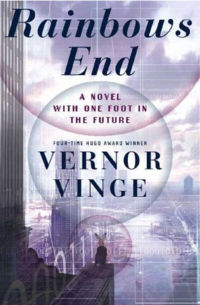
Vernor Vinge made his book ‘Rainbow’s End’ free to read onlineTor author (and sometimes Futurismic blogger) Tobias Buckell has an interesting post talking about the effects of authors giving away their novels. There has been a lot of criticism of the practice by some writers and lots of praise from other corners. But with Neil Gaiman adding his superb bestseller ‘American Gods’ to the list of books you can legally download for free, are people shooting themselves in the foot or will this bring more income in the future through increased readership?

At the moment, it looks like the practice works. Two of John Scalzi’s books are up 20% and 33% in sales since the first one was released as a free ebook by Tor. As Charles Stross has mentioned, the fact that current ebooks are as much as a few hundred grams of chopped down tree, chemical treatment, ink printing, shiny cover embossing, a few thousand miles of transportation, part of the salaries of manufacturers, printers, truck drivers and shop assistants that make up the price of a typical physical book is simply insane. And that’s not even including the price of an ebook reader like the Kindle monstrosity. So until someone comes up with a £50 reader that gives you digital books for £3, £2 of which goes to the author, ebooks aren’t a business model. But they do provide clever authors with the chance to increase their reader base. What do you guys think? Would you purchase a book after you’ve been impressed by the free ebook version?

[image is the cover of Vernor Vinge’s novel ‘Rainbow’s End’, which you can find for free online here.]

Infrastructure for the twenty first century

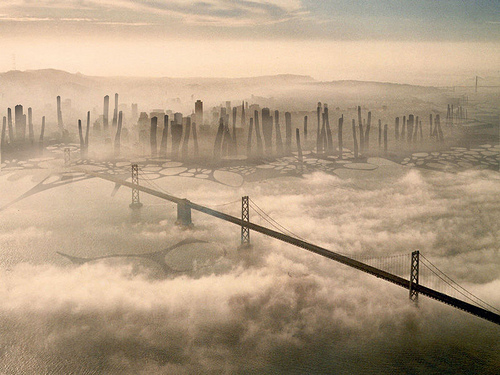
San Francisco in 100 years time looks a little different…
The ever compelling Alex Steffen over at WorldChanging is talking about Infrastructure a lot lately. A lot of the US and much of the world is built on an infrastructure of highways, electric grids and waterways, which are struggling to keep up with population growth and increased costs, especially of fuels. Whilst new technologies like superfast trains and solar panels are good, they need investment in the infrastructure for it to work – as seen by Britain having to spend millions to replace track for the Eurostar because Margaret Thatcher chose the cheaper infrastructure in the eigthies, whilst the rest of Europe put in place track suitable for what became the TGV.

There’s a lot of interesting ideas out there, from Alexander Trevi’s use of carbon-harvesting nanocrystals and radiation reprocessing to produce a green ‘New Chernobyl’, to architects IwamotoScott‘s ‘Network Hydrology’ reimagining of a water and hydrogen-producing algae based 2100 San Francisco. There’s plans to artificially create a new river delta to protect the Louisiana coastline and Amsterdam might drain its canals to create a new underground subcity. Or what about BLDGBLOG’s idea to create housing projects in the same way people make zoos? By combining good design in new infrastructure with the inventions already out there we can start looking at a future way of living rather than just trying to extend the one we have beyond its lifetime. And is it coincidence that most of best ideas also look ridiculously cool?

[picture by IwamotoScott]

The Energy Island

Combining multiple methods of alternative power generationThe Oil Drum Australia has a great post this week about tidal power construction all across the world, including the attractive ‘Energy Island’ concept pictured. The article talks about tidal, ocean current and wave projects from the UK, US, New Zealand, Taiwan and Canada, amongst many others. The UK could potentially derive 25% of its power just from wave energy, not to mention its huge resources of tidal power in the Severn Estuary and on the coasts of Scotland. Also discussed is OTEC (Ocean Thermal Energy Conversion), which creates power from the heat differential between warm surface water and cold deep water.

In other news, Oil has never been higher priced in history than it is today, at $102.08 a barrel. Looks like we’re going to need a lot of this alternative energy supply. One of the projects mentioned at the bottom of the Oil Drum article is for floating islands of power generation producing hydrogen to fuel passing ships. Neat.

[via The Oil Drum]