All posts by Tom James

Science vs. engineering: Drexler waxes philosophical

engineering_scienceEric Drexler discusses the hinterland between two of the great pillars of human endeavour – science and engineering – and what they are:

Inquiry and design are seldom separate, so how can it be meaningful to call some activities “science”, and others “engineering”? I think it’s best to look beyond the mixture of inquiry and design in a project, and to consider instead its purpose. If the intended result is knowledge — a better model of what exists in the world and how it works — I think of it as science. If the intended result is a new product, process, or design methodology, I think of it as engineering.

This epistemiological discussion is with a serious goal in mind, to consider how emergent nanotechnological developments might be engineered to create products and processes we can all use:

Unlike high-energy particle physics or space science, nanotechnology springs from fields (surface science, materials science, chemistry, biology) that have no tradition of developing conceptual designs for complex systems, debating the knowns, unknowns, costs, benefits, alternative objectives, alternative solutions, and so forth, to eventually converge on objectives that coordinate the work of hundreds or thousands for a decade or more.

Without a tradition of this sort, large opportunities can go unrecognized — and in part because they are large. This will change, but I doubt that the change will be led from within.

It’s an interesting point. At what point does scientific research transfer into engineering development, and thence into entrepreneurial opportunity?

[image from jenny downing on flickr]

Top new computer chip material

electron_band_bismuth_tellurideResearcher at the Stanford Institute for Materials & Energy Science have developed a new substance for making computer chips that allows electrons to flow without any loss of energy at room temperatures and can be made using existing chip-making technologies:
Physicists Yulin Chen, Zhi-Xun Shen and their colleagues tested the behavior of electrons in the compound bismuth telluride. The results, published online June 11 in Science Express, show a clear signature of what is called a topological insulator, a material that enables the free flow of electrons across its surface with no loss of energy

This is pretty amazing in and of itself, but is not quite a superconductor:

Topological insulators aren’t conventional superconductors nor fodder for super-efficient power lines, as they can only carry small currents, but they could pave the way for a paradigm shift in microchip development. “This could lead to new applications of spintronics, or using the electron spin to carry information,”

[from Physorg][image via Physorg from Yulin Chen and Z. X. Shen]

Stross: how I ended up as a science fiction writer

lifeCharles Stross is recounting the long journey to his current position has one of the stars of British science fiction, beginning with his first steps into education during the years of Thatcher:

I already knew (from an early age — 12 or so) that I wanted to be an SF writer. But there was a fly in the ointment — a fly called Margaret Thatcher. I turned 15 in 1979, the year the conservatives won an election and the Thatcherite revolution swung into action.

Unemployment soared from around one million to over three million in twelve months as the UK experienced the worst industrial recession since the end of the second world war (largely caused by Thatcher’s dramatic decision to cut most of the state-owned industries off at their knees, on the assumption that the workers would find new and more productive jobs sooner rather than later — a misplaced assumption, as it turned out).

I come from a middle-class background; I could expect to go to university, but not to rely indefinitely on parental hand-outs. “You’ll need some kind of way to earn a living while you’re trying to write,” the careers guidance teachers told me.

A familiar story, as this happy university dropout will affirm (except it was Blair instead of Thatcher and the economic collapse only really started after I left).
[image from The Wandering Angel]

Bussard ramjet revisited

star_and_barsAn interesting discussion of Bussard ramjet interesteller propulsion technology here at Centauri Dreams and Adam Crowl:

Robert Bussard put the interstellar ramjet into the public eye back in 1960 in a paper proposing that a starship moving fast enough would be able to use the hydrogen between the stars as a source of fuel, enabling a constant acceleration at one g.

One of the key problems with Bussard ramjets is the speed of the fusion reactions:

Physicist Daniel Whitmire tackled this problem in a 1975 paper that proposed using hydrogen for fuel but exploiting a catalytic nuclear reaction chain instead of straight proton burning.

It’s all interesting stuff, but even if the Bussard ramjet is unfeasible as a propulsion system it may be feasible as a brake for interstellar spacecraft.

[image from kevindooley on flickr]

New resin for growing flesh

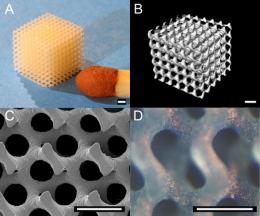
biodegradable_resinResearchers at the University of Twente have developed a biodegradable resin that can be used to create precise replicas of forms within the body around which new tissues can be grown:

The resin can be given different properties depending on where in the body it is to be used. Cells can be sown and cultured on these models, so that the tissues grown are, in fact, produced by the body itself. The new resin has been developed by Ferry Melchels and Prof. Dirk Grijpma of the UT’s Polymer Chemistry and Biomaterials research group. An article on this breakthrough will be appearing in the authoritative specialist journal, Biomaterials

The method used to recreate the specific forms is called stereolithography, the improvement in this system is that the resins have hitherto not been biodegradable. This means:

If, for example, a child has a heart valve disorder, a 3D digital image of the heart valve can be created using a CT scanner. The model in the stereolithograph can be copied exactly with the new resin. If the structure is made porous, the child’s own cells can be placed on it. This porosity also gives nutrients access to the cells. Ultimately, after the carrier structure has broken down, only the natural tissue remains.

Which is a rather wonderful development.

[from Physorg]