The authors of this study, published in The Journal of Urban Planning and Development, quantified the emissions from building materials and construction, home heating and power demands, and transportation energy, in both urban suburban neighborhoods in the Toronto metro area. And they found that downtown residents use radically less energy, and consequently emit about two-thirds less climate-warming CO2 than their suburban counterparts.
I had been vaguely aware that the suburban lifestyle produced more greenhouse gases, but the extent is surprising.
The British government has given the go-ahead to a new generation of coal-fired power plants incorporating carbon-capture and storage technologies in a bid to reduce carbon dioxide emissions. Clean coal has been met with criticism and the policy seems just a little bit flaky:
Up to four new plants will be built if they are fitted with technology to trap and store CO2 emissions underground.
The technology is not yet proven and would only initially apply to 25% of power stations’ output.
Green groups welcomed the move but said any new stations would still release more carbon than they stored.
Uh huh. According to UK energy secretary Ed Miliband:
Once it is “independently judged as economically and technically proven” – which the government expects by 2020 – those stations would have five years to “retrofit” CCS to cover 100% of their output.
Kind of a glass quarter-full situation then. And it might not even work. But do checkoutthedetails.
The fact that the mind is a machine just as much as anything else in the universe is a machine tells us nothing interesting about the mind.
If the strong AI project is to be redefined as the task of duplicating the mind at a very low level, it may indeed prove possible—but the result will be something far short of the original goal of AI.
A detailed simulation of a small region of a brain built molecule by molecule has been constructed and has recreated experimental results from real brains.
The “Blue Brain” has been put in a virtual body, and observing it gives the first indications of the molecular and neural basis of thought and memory.
Is there a meaningful distinction between the traditional view of a strong AI and a molecular-level simulation of a human mind?
A new technique for storing lungs outside the human body has been developed by the Toronto General Hospital:
In an operating room at the hospital, the technology can keep a pair of human lungs slowly breathing inside a glass dome attached to a ventilator, pump, and filters.
The lungs are maintained at normal body temperature of 37 °C and perfused with a bloodless solution that contains nutrients, proteins, and oxygen.
The organs are kept alive in the machine, developed with Vitrolife, for up to 12 hours while surgeons assess function and repair them.
It is hoped that this process will mean lungs intended for transplant are more likely to be usable. According to the Technology Review article as few as one in ten lungs for transplant are usable with existing cooling-based preservation techniques.
1. What is fragile should break early while it is still small. Nothing should ever become too big to fail. Evolution in economic life helps those with the maximum amount of hidden risks – and hence the most fragile – become the biggest.
2. No socialisation of losses and privatisation of gains.Whatever may need to be bailed out should be nationalised; whatever does not need a bail-out should be free, small and risk-bearing. We have managed to combine the worst of capitalism and socialism. In France in the 1980s, the socialists took over the banks. In the US in the 2000s, the banks took over the government. This is surreal.
 Worldchanging reports on yet more evidence of urban living being less carbon-intensive than suburban living:
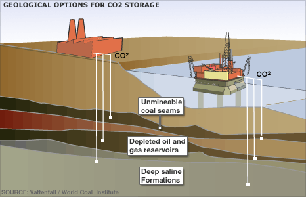 The British government has given the go-ahead to a new generation of coal-fired power plants incorporating carbon-capture and storage technologies in a bid to reduce carbon dioxide emissions. Clean coal has been met with
  An
An  A new technique for storing lungs outside the human body has been developed by the
  Flaneur and creator of the