All posts by Tom James

Laughter and error-correction mechanisms

lightCarlo Strenger has written a good article on enlightenment values on Comment is Free:

…the Enlightenment has created an idea of immense importance: no human belief is above criticism, and no authority is infallible; no worldview can claim ultimate validity. Hence unbridled fanaticism is the ultimate human vice, responsible for more suffering than any other.

it applies to the ideas of the Enlightenment, too. They should not be above criticism, either. History shows that Enlightenment values can indeed be perverted into fanatical belief systems. Just think of the Dr Strangeloves of past US administrations who were willing to wipe humanity off the face of the earth in the name of freedom, and the – less dramatic but no less dismaying – tendency of the Cheneys and Rumsfelds of the GW Bush administration to trample human rights in the name of democracy.

As one of the commenters points out, the profound principle has been ignored by both 20th century secular ideologues, religious authorities, and more recent fanatics, is that of always bearing in mind the possibility you might be dead wrong.

The healthy human response to harmless error or misunderstanding is to have a laugh. Thus error is highlighted for all to see and forgiven by all parties. As Strenger puts it:

At its best, enlightenment creates the capacity for irony and a sense of humour; it enables us to look at all human forms of life from a vantage point of solidarity.

A further mistake on the part of humorless fanatics everywhere is to assume that there can ever be one, and only one, eternal truth. It may be that such a thing exists, but it is likely to be beyond our capacity to discern its true form from the vague shadows on the walls of our cave.

And so human beings are prone to error. There’s no problem with this, as failure teaches us more than success.

This notion was articulated by Karl Popper in the 20th century: it is the idea that you can never conclusively prove that an idea is correct, but conclusively disprove an incorrect idea.

And so human knowledge grows and the enterprise of civilization advances, one laughter-inducing blooper at a time.

[image from chantrybee on flickr]

God of the gaps and the limits of science

thoughtAcademic Jon Taplin highlights this WSJ piece on quantum entanglement and the theories of French physicist Bernard d’Espagnat:

In March, the 87-year-old Frenchman won the prestigious $1.5 million Templeton Prize for years of work affirming “life’s spiritual dimension.”

Based on quantum behavior, Dr. d’Espagnat’s big idea is that science can only probe so far into what is real, and there’s a “veiled reality” that will always elude us.

Many scientists disagree. While Dr. d’Espagnat concedes that he can’t prove his theory, he argues that it’s about the notion of mystery. “The emotions you get from listening to Mozart,” he says, “are like the faint glimpses of ultimate reality we get” from quantum experiments. “I claim nothing more.”

I am not familiar with Prof. d’Espagnat’s work. Is he talking about the God of the gaps or the Popperian problem of induction?

[image from P/\UL on flickr]

A brief word on a new supermaterial

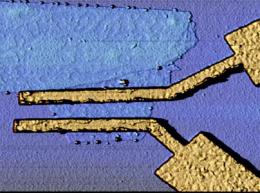
graphene-transistorGraphene: a material consisting of a sheet of carbon atoms one atom thick. Graphene was first identified only a few years ago, and has since been proferred for all sorts of uses, including ultracapacitors, spintronics, and now as a light source:

Microchips is just one of the material’s potential applications. Because of its single-atom thickness, pure graphene is transparent, and can be used to make transparent electrodes for light-based applications such as light-emitting diodes (LEDs) or improved solar cells.

It is also apparently very strong:

The mobility of electrons in graphene — a measure of how easily electrons can flow within it — is by far the highest of any known material. So is its strength, which is, pound for pound, 200 times that of steel.

The problem is to find a way to mass-manufacture it:

The trick that enabled the first demonstrations of the existence of graphene as a real separate material came when researchers at the University of Manchester applied sticky tape to a block of graphite and then carefully peeled off tiny fragments of graphene and placed them on the smooth surface of another material.

“They don’t care if they go to a lot of effort to make five tiny pieces, they can study those for years.” But when it comes to possible commercial applications, it’s essential to find ways of producing the material in greater quantities.

[from Physorg][image from Physorg]

RepRap creates circuits

just-finishedA moment of history. The RepRap project has created circuits for the first time:

Ed and I have a final-year student – Rhys Jones – who’s working on RepRap for his MEng research project. He’s been taking the old idea of depositing metal in channels and an observation of Forrest’s and Nophead’s (that you don’t need a low-melting-point alloy because the specific heat of metals is so low that they shouldn’t melt the plastic anyway).

Also worth a look: Bruce Sterling points to Darwinian Marxism as a means of ensuring the proletariat gain possession of the means of production sans revolution.

[via the Yorkshire Ranter][image from the Reprap blog]

Brain electrodes: in and out

silke1Following on nicely from Paul’s discussion of direct-to-brain broadband – and Robert Koslover’s comment – here we have news of the first read-write brain electrode from a company called IMEC:

Today’s deep-brain stimulation probes use millimeter-size electrodes. These stimulate, in a highly unfocused way, a large area of the brain and have significant unwanted side effects.

IMEC’s design and modeling strategy allows developing advanced brain implants consisting of multiple electrodes enabling simultaneous stimulation and recording. This strategy was used to create prototype probes with 10 micrometer-size electrodes and various electrode topologies.

These new design approaches open up possibilities for more effective stimulation with less side effects, reduced energy consumption due to focusing the stimulation current on the desired brain target, and closed-loop control adapting the stimulation based on the recorded effect.

Presumably the avenue towards the development of devices for direct-to-brain broadband will be through the development of ever more sophisticated products of this kind, possibly travelling via wirehead-style ecstasy generators.

[from this press release from IMEC, via Technovelgy][image from IMEC press release]