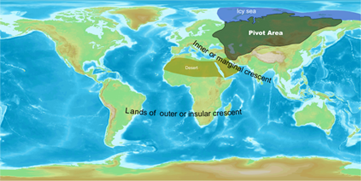
 George Friedman, writing in The New Statesman magazine, has an article up on the next 100 years, as seen through the theoretical prism of geopolitics. This is a doctrine that emphasises the importance of the permanently operating factors of geography in determining global dominance:
Thus, the question is how these geopolitical and strategic realities shape the rest of the century. Eurasia, broadly understood, is being hollowed out. China is far weaker than it appears and is threatened with internal instability. The Europeans are divided by old national patterns that prevent them from moving in a uniform direction. Russia is using the window of opportunity presented by the US absorption in disrupting the Islamic world to reclaim its sphere of influence in the former Soviet Union, but its underlying weakness will reassert itself over the next generation.
New powers will emerge. In the 19th century, Germany, Italy and Japan began to emerge as great powers, while in the 20th century global powers such as Britain and France declined to secondary status. Each century, a new constellation of powers forms that might strike observers at the beginning of the century as unthinkable. Let us therefore think about the unthinkable.
Friedman paints a rather pessimistic picture of a future of exactly the same kind of nationalistic war that took up most of the 20th century.
I’ve never been comfortable with tub-thumping nationalism/patriotism as something to dictate beliefs and action. To me the future of the people living on Earth is as much about cultures, attitudes, and society as it is about the fight for power between specific nation states [1].
But states will remain the single most powerful entity on Earth over the next few decades, and as such it is worth thinking about which of them might gain greater influence in the future.
The central conclusion of Friedman’s article is that “they that control the North American continent, control the world” as they will have access to both the Atlantic and the Pacific Oceans as well as the vast wealth of the North American continent. As such he posits Mexico as a potential rival to US power. He also suggests that Japan might engage on further military ventures. Turkey may become the core of an Islamic sphere of influence in the Mediterranean and Middle East.
[1]: Inasmuch as particular states have particular cultures and attitudes (e.g. pluralism, rule of law, liberalism, democracy, individual freedom) I think that it is a mistake to support a nation state because of the attitudes it purports to value, rather than the reality of its actions. You support the people and the ideals first, the countries second.
[from the New Statesman][image from here on Wikimedia]
 The role of science fiction vis a vis the future and predictions thereof has always been a target of lighthearted mockery. However Centauri Dreams articulates, with the help of futurist Peter Garretson, what science fiction can offer, even if predictions aren’t always on the mark:
 One of my favourite[1] plausible science fictional tropes is that of tiny robotic insects. The latest step towards their instantiation has been taken by researchers in Sweden, Spain, Germany, Italy, and Switzerland as they put forward their conception of how
  …as
…as  Eric Drexler has written a paper entitled