All posts by Tom Marcinko

Lightning strikes upward into space, too

upward-lightningHere’s lightning flowing 40 miles up from the top of a storm, to touch the ionosphere. The photos of this phenomenon, called gigantic jets, were taken by Duke University engineer Steve Cummer.

“Gigantic jets are literally lightning that comes out of the thunderclouds, but instead of going down, like most lightning strokes do, these apparently find their way out the tops of thunderclouds, and then keep going and keep going and keep going until they run into something that stops them,” Cummer explained.

He adds:

“…What struck us was the size of this event.”

It appears from the measurements that the amount of electricity discharged by conventional lightning and gigantic jets is comparable, Cummer said.

But the gigantic jets travel farther and faster than conventional lightning because thinner air between the clouds and ionosphere provides less resistance.

The team was actually looking for sprites, “electrical discharges that occur above storm clouds and are colored red or blue, with jellyfish-like tendrils hanging down.”

Spectacle aside, studying the jets could lead to new ways to predict storms. And if nothing else, it’s something for writers to think about when they design their alien atmospheres.
Why you have (or had) an appendix

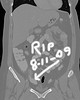
CT scanThe image of the appendix has been getting a makeover. Two years ago, Duke U. researchers suggested it is not the useless evolutionary vestige that Darwin said it was.

The appendix, they said, is a safe haven where good bacteria could hang out until they were needed to repopulate the gut after a nasty case of diarrhea, for example.

Now some of the team suggest the appendix has been around a lot longer than Darwin thought.

[Surgical sciences professor William] Parker and colleagues found that the appendix has evolved at least twice, once among Australian marsupials and another time among rats, lemmings and other rodents, selected primates and humans. “We also figure that the appendix has been around for at least 80 million years, much longer than we would estimate if Darwin’s ideas about the appendix were correct.”

Parker says Darwin just didn’t have access to enough information about the organ.

“If he had known about the widespread nature of the appendix, he probably would not have thought of the appendix as a vestige of evolution.”

He also was not aware that appendicitis, or inflammation of the appendix, is not due to a faulty appendix, but rather due to cultural changes associated with industrialized society and improved sanitation. “Those changes left our immune systems with too little work and too much time their hands – a recipe for trouble,” says Parker.

[Story tip: Phoenix New Times blog; CT image by jellywatson]

iPhone sex app: What could go wrong?

seinfeldIn a near-future episode of Seinfeld from the universe next door:

George’s “Passion” iPhone app–“The timer measures duration, while the accelerometer measures activity and the microphone measures the orgasm”–is yanked by Apple right in the middle of the greatest performance of his life, but not before it “uploaded the score… and compare[d it] to those of other people around the world.” Kramer’s score of course rocks.

[Fab four montage by Ethan Hein]

Agnotology: The science of ignorance

luckyMany of my fellow citizens believe that the Apollo program was faked, evolution is a lie, global warming is a sinister plot by Al Gore to take away their Hummers, and President Obama is some kind of Nazi foreigner whose healthcare plan will lead to mass euthanasia. Disinformation seems to be a winning tactic.

So, yes, Discover Magazine’s interview with Robert Proctor, Stanford science historian and co-editor of Agnotology: The Making & Unmaking of Ignorance, had some resonance with me.

Snips:

Just what is agnotology?
It’s the study of the politics of ignorance. I’m looking at how ignorance is actively created through things like military secrecy in science or through deliberate policies like the tobacco industry’s effort to manufacture doubt through their “doubt is our product” strategy [spelled out in a 1969 tobacco company memo [pdf]]. So it’s not that science inherently always grows. It can actually be destroyed in certain ways, or ignorance can actually be created.

Have you continued your focus on tobacco?
I recently collaborated on an exhibit of the most outrageous tobacco ads called “Not a Cough in a Carload.” It’s centered on medical-themed tobacco ads: that tobacco’s good for your T-zone, that it calms your nerves. Scientific tests prove that brand A is better than B, or, you know, 20,000 physicians recommend Camels, and so forth. The use of athletes and models, and the artwork is just beautiful.

How do you maintain the perspective essential to your kind of research?… [I]t’s important to see the past the way the people saw it. So I’ve written two books on Nazi medicine, and the goal there was not just to condemn them, but to see how in the world they came up with those ideas and those movements and how they justified them to themselves. So we see them as full humans and not just scarecrows, so we can actually understand the depth of the depravity or whatever. But at least we see it honestly, and that’s a traditional historical virtue.

[Image: leifpeng]

More blogs about science and food: The neuroscience of obesity

baconIn a post entitled “The Neuroscience of McGriddles,” Jonah Lehrer (How We Decide; Proust Was a Neuroscientist) samples the “eerily delicious” McDonald’s product and reaches some dark conclusions:

The most pleasurable thing about the sandwich isn’t the pancake or the bacon: it’s the calories. According to a recent paper in Neuron, the brain also receives rewarding input from metabolic processes that have nothing to do with the tongue. When you eat at McDonald’s, a big part of the pleasure comes from the fact that the food is sustenance, fuel, energy. Even mediocre food is a little rewarding.

Indeed, even mice with an impaired sense of taste still prefer sugar water over both plain water and water with artificial sweetener. “What they enjoyed were the calories.” And humans’ desire for high-calorie food seems based on our evolutionary investment in a large cranium.

This is a troubling idea, since it reveals the very deep biological roots underlying the obesity epidemic. Let’s imagine, for instance, that some genius invented a reduced calorie bacon product that tasted exactly like bacon, except it had 50 percent fewer calories. It would obviously be a great day for civilization. But this research suggests that such a pseudo-bacon product, even though it tasted identical to real bacon, would actually give us much less pleasure. Why? Because it made us less fat. Because energy is inherently delicious. Because we are programmed to enjoy calories.

[Image: brian cors; thanks to Dinosaur Comics for the link: “Food’s neat, you guys!”]