All posts by Tom Marcinko

Big Food: What to do about hypereating

lolHere’s an optimistic vision of the future, from the last page of The End of Overeating by former US Food & Drug Administration commissioner David A. Kessler, MD (available here and elsewhere; reviewed here; author interview by Stephen Colbert here.)

A change in perspective cannot be imposed with mandates, but must evolve as a social consensus. The goal is not to vilify all food and those who serve it, but to change our thinking about big food, those huge portions of layered and loaded food with little nutritional value. We need to look differently at the people and the places that serve it. When their power to manipulate our behavior becomes fully transparent, cues will lose their capacity to entice. Instead of expecting food to be served at every social and business occasion, we’ll realize that many offers of food outside mealtimes do not serve anyone’s interest.

In the future, new social norms and values will emerge, and food choices, offered in smaller portion sizes, will seem ‘right’ to us. That will be what we come to expect, and that will be what we want.

So, yes, as research for my optimstic sf story, I broke down, bought, and read this book, which is short, readable, and provocative.

Kessler’s thesis is that since the 80s, millions of Americans have been on a binge of conditioned hypereating, brought about by a food industry that knows how to get people to keep chowing down even when they’ve eaten more than enough. They do it with marketing, focus grouping, advertising, and even such childishly simple methods as making food easier to chew and swallow.

Kessler cites enough neuroscience data from human and animal experiments to put together a working hypothesis of marketing-driven food addiction. Among other things, the industry excels at creating tastes, textures, situations, and associations that rewire the brain to want more and more of certain kinds of foods. For example,

…[A]n animal that eats a combination of sucrose, chocolate, and alcohol releases the greatest levels of dopamine [a brain chemical associated with “attentional bias.”].

Not surprisingly, these foods have layers of sugar, salt, and fats — often in repeating geological layers. It’s akin to the tobacco industry’s striving to make cigarettes even more addictive. The food merchants seem to accomplish their goals more by trial and error than through pure research, but the result is plain for all to see: A serious obesity problem with, at the very least, a larger health care bill attached.

People need to take responsibility, and Kessler lays out some steps that will probably spawn a lot of self-help books (some of us can use the help). He simply asks that people watch how they feel when exposed to food or come-ons to the same, and alter their behavior accordingly. And maybe do what the French, he says, do, or at least used to do: Take your time at the table, and don’t eat between meals. Old-fashioned, and easier said than done.

He has policy suggestions, too. Some of them ought to be adopted for the sheer entertainment value of the outrage and resistance they’re likely to provoke.

  • Restaurants should list calorie counts, “by mandate, if they’re not willing to do so voluntarily.
  • Food package labels should contain percentages of added sugars, refined carbs, and fats.
  • Public education should focus a jaundiced eye on “big food.”
  • And my personal favorite: Marketing should be monitored and exposed.

Our greatest gift to future generations … would be to find a way to prevent the cue-urge-reward-habit cycle from ever taking hold.

There’s optimism for you. And there’s got to be some way to turn this into a story.

[I Can Haz Cheezburger?, due to sheer lack of willpower]

Did cooking make us evolve?

campfireBecause there’s still got to be an optimistic sf story in here somewhere:

Harvard anthropologist Richard Wrangman theorizes that cooking with fire triggered hominids to evolve into humans. His experience in the wild led him to conclude that humans could never live on what chimpanzees eat. Cooking, he thinks, might account for the sharp rise in brain size, and the decrease in the size of teeth, that occurred about 1.6 million years ago in Homo erectus over its predecessor, homo habilis. It might explain our relatively small guts and weak jaws, not to mention certain preferences that seem innately human:

[O]ne of the fascinating things for me as I ventured into this was really learning about what hunters and gatherers eat—and it turns out that there are no records of people having a large amount of their food come from raw food. Everywhere, everyone expects a cooked meal every evening.

The problem is lack of evidence that people used fire that long ago. A lot of scientists believe cooking didn’t really start till only 500,000 years ago.

Lacking the proof for widespread fire use by H. erectus, Wrangham hopes that DNA data may one day help his cause. “It would be very interesting to compare the human and Homo erectus genetics data to see when certain characteristics arose, such as, When did humans evolve improved defenses against Maillard reaction products?” he says, referring to the chemical products of cooking certain foods that can lead to carcinogens.

Human origins have been in the news.  How and when we began is a source of wonder. Call me mammal-centric, but I found it impossible to look at the (eerily well-preserved) face of the newly unearthed lemur-like fossil without feeling a bit of kinship.

[Image: Campfire, P. Sto]

‘Craveable’: Does the food industry play with our heads?

big-boy1Trying to write an optimistic science fiction story for a change has led to some fascinating research avenues. If we want to give our poor put-upon planet a bit of a break, wouldn’t it make sense to change the way we eat? Think of the fuel we could save, the waste we could cut back on…

Not so fast, though. Former U.S. Food & Drug Administration commissioner (under Clinton and W.) and pediatrician David Kessler says one of the reasons Americans overeat is because the food industry, not unlike tobacco before it, is messing with our minds.

At first glance, that sounds obvious, given the myriad of junk-food choices and the constant blare of advertisement. Kessler digs deeper, though, in his new book The End of Overeating:

“The food the industry is selling is much more powerful than we realized,” he said. “I used to think I ate to feel full. Now I know, we have the science that shows, we’re eating to stimulate ourselves. And so the question is what are we going to do about it?”

In good dramatic fashion, Kessler says it’s partly his fault: when he headed the FDA he won battles for better labeling of processed foods, but didn’t push much for labels in restaurants.

His own dumpster-diving research (note to Hollywood: this book needs to be a movie) led him to the conclusion that not only are seemingly healthy menu choices like grilled chicken or spinach dip larded with “fat on fat on salt on sugar on fat on fat,” but that they are more or less deliberately designed to goad you brain into craving more, even when your stomach has had more than enough. He estimates that 15% of the U.S. population is vulnerable to “conditioned overeating.”

(And everytime I visit another country I see more U.S.-based food chains — sorry about that, but I’m guessing this is not just an issue for my own country.)

Willpower, yes; government oversight, maybe, says Kessler. Far better to change the way we look at food – to break the emotional association with good times. Perceptions have changed for the better before this, he points out: consider shifting attitudes towards cigarettes, driving without a seat belt, or drunk driving.

By now some readers are thinking “That’s obvious,” or rolling their eyes at the prospect of more nanny-statism. (I did both.) Skepticism is healthy, too. For starters, I’d like to know more about the neuroscience of those “reward circuits.” Here’s a taste, though:

Yale University neuroscientist Dana Small had hypereaters smell chocolate and taste a chocolate milkshake inside a brain-scanning MRI machine. Rather than getting used to the aroma, as is normal, hypereaters found the smell more tantalizing with time. And drinking the milkshake didn’t satisfy. The reward-anticipating region of their brains stayed switched on, so that another brain area couldn’t say, “Enough!”

You can hear some NPR interviews with Kessler here, there, and everywhere.

[Image: Iconic US diner mascot Big Boy by Patrick Powers]

Biofueled car might have been a senseless waste of chocolate

chocolate-carIt’s not quite the “chocolate-fueled car” that the headline from the indispensable PhysOrg.com promises. What we have instead may be close enough — a car its makers claim can reach 145 miles per hour,

powered by waste from chocolate factories and made partly from plant fibers….

The steering wheel is made out of plant-based fibers derived from carrots and other root vegetables, and the seat is built of flax fibre and soybean oil foam. The body is also made of plant fibers….

Scientists at the University of Warwick say their car is the fastest to run on biofuels and also be made from biodegradable materials. It has been built to Formula 3 specifications about the car’s size, weight, and performance.

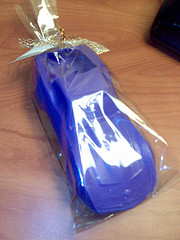
[Image: Never Eat Purple Chocolate by i’m george]

Cheese: Now with artistic expression

hello-kittyAs if to answer the call for more cheese-based sfnal items:

Cheese made with breast milk has been served at the launch of a new art exhibition in London.

The Alejandra Ortiz-Reynoso show is named after the woman who donated the main ingredient. Artist Raul Ortega Ayala wants to “explore our first encounter with food.” ABC News reports that the cheese was served on crackers, and that the milk was donated voluntarily.

Hello Kitty Cream Cheese Head by Slack-a-gogo.