 Chris Mooney, author of the forthcoming Unscientific America, asks:
Can we ever know, on any contentious or politicized topic, how to recognize the real conclusions of science and how to distinguish them from scientific-sounding spin or misinformation?
Congress will soon consider global-warming legislation, and the debate comes as contradictory claims about climate science abound. Partisans of this issue often wield vastly different facts and sometimes seem to even live in different realities.
In this context, finding common ground will be very difficult. Perhaps the only hope involves taking a stand for a breed of journalism and commentary that is not permitted to simply say anything; that is constrained by standards of evidence, rigor and reproducibility that are similar to the canons of modern science itself.
He’s looking at George Will (there’s a link to his column if you want to follow it):
Will wrote [among other things] that “according to the University of Illinois’ Arctic Climate Research Center, global sea ice levels now equal those of 1979.” It turns out to be a relatively meaningless comparison, though the Arctic Climate Research Center has clarified that global sea ice extent was “1.34 million sq. km less in February 2009 than in February 1979.” Again, though, there’s a bigger issue: Will’s focus on “global” sea ice at two arbitrarily selected points of time is a distraction. Scientists pay heed to long-term trends in sea ice, not snapshots in a noisy system. And while they expect global warming to reduce summer Arctic sea ice, the global picture is a more complicated matter; it’s not as clear what ought to happen in the Southern Hemisphere. But summer Arctic sea ice is indeed trending downward, in line with climatologists’ expectations — according to the Arctic Climate Research Center.
Mooney ends with a tall order:
Readers and commentators must learn to share some practices with scientists — following up on sources, taking scientific knowledge seriously rather than cherry-picking misleading bits of information, and applying critical thinking to the weighing of evidence. That, in the end, is all that good science really is. It’s also what good journalism and commentary alike must strive to be — now more than ever.
[George Will picture: Wikimedia Commons]
Along the same lines, now that a volcano in Alaska is spewed smoke and ash at least five times in the last day or so, shouldn’t Gov. Jindal feel dumb about mocking volcano monitoring as wasteful spending?
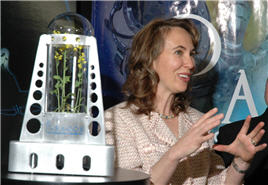 “The Selene Gardening Society,” anybody? Two corporations want to grow vegetables and flowers in a bell jar-like miniature laboratory greenhouse on the moon.
 It’s late in the day in my time zone, but maybe not too late to celebrate women’s contribution to technology.
 “It is a real horrible place.”
 The Guardian reports that the U.S. government is looking for a way to
