Category Archives: Blog

Unplugged: the Web’s Best SF/F anthology now available!

Unplugged: The Web's Best Sci-Fi & Fantasy 2008Almost exactly a year ago I had the pleasure of announcing that a story originally published here at FuturismicJason Stoddard’s “Willpower”, to be precise – had been selected by Rich Horton for reprinting in his inaugural Unplugged: The Web’s Best Sci-Fi & Fantasy anthology.

And now I have the pleasure of announcing that copies of said anthology are now available from Wyrm Publishing (the people who bring you the excellent Clarkesworld online magazine, and much more); US$14.95 nets you fourteen stories from newcomers and luminaries of the genre fiction scene alike, which strikes me as pretty decent value… not to mention a great way to support the writers who contribute to online publications just like this one.

A recent Publisher’s Weekly review of Unplugged suggested that “[a]fter reading this 14-story compilation, online publishing naysayers may rethink their position.” I suspect we have a way to go before that happens, but anthologies like this are certain to help things along… not to mention reminding us web publishers that we’re doing something worthwhile!

So why not go buy a copy of Unplugged, and show some support for the writers (and publishers) who’ve provided you with great stories that you could read for free?
The physics of space battles

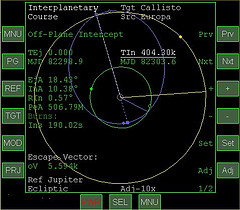
Interplanetary course plotting software screenshotWe all know that space battles as depicted in films and television tend to reuse the paradigms of more familiar planet-side combat types – the naval manoeuvres of Star Trek, for example, or the dog-fighting planes of Star Wars. But what would real combat between space-faring civilisations actually involve, strategically and tactically?
Well, Joseph Shoer’s the man to ask! He’s an aerospace engineer and physicist, and he recently wrote a post running through the main considerations of realistic space combat – everything from the difference between engagements in orbit and engagements in “deep space”, to why kinetic weapons are more efficient than explosive payloads, and plenty more in between. If you’re a fan or writer of space opera, it’s a must-read; here’s a taster.

First, let me point out something that Ender’s Game got right and something it got wrong. What it got right is the essentially three-dimensional nature of space combat, and how that would be fundamentally different from land, sea, and air combat. In principle, yes, your enemy could come at you from any direction at all. In practice, though, the Buggers are going to do no such thing. At least, not until someone invents an FTL drive, and we can actually pop our battle fleets into existence anywhere near our enemies. The marauding space fleets are going to be governed by orbit dynamics – not just of their own ships in orbit around planets and suns, but those planets’ orbits. For the same reason that we have Space Shuttle launch delays, we’ll be able to tell exactly what trajectories our enemies could take between planets: the launch window. At any given point in time, there are only so many routes from here to Mars that will leave our imperialist forces enough fuel and energy to put down the colonists’ revolt. So, it would actually make sense to build space defense platforms in certain orbits, to point high-power radar-reflection surveillance satellites at certain empty reaches of space, or even to mine parts of the void.

Go read the whole thing! Hat tip to Ian Sales on Twitter. [image by FlyingSinger]

Babbage’s Difference Engine, in action

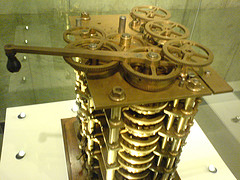
differenceA nice and accurate replica of Charles Babbage’s Difference Engine was built in California last year and is now on display at the Computer History Museum in Mountain View, CA.

Not newsworthy, but if you’ve never seen this machine in action, the short video is well worth a look. It’s fun to listen to it clatter, and to watch the helical patterns it makes.

National Public Radio did a story this morning:

The Difference Engine fills half a gallery and stands taller than most men. It’s 5 tons of cast iron, steel and bronze woven together from 8,000 distinct parts. Though it looks like it could be a sculpture, the machine is essentially a giant calculator. Tim Robinson, a docent at the museum, says it’s “the first automatic calculating machine.”

This engine — made from 162-year-old designs — doesn’t have a power pack; it has a hand crank. Robinson works up a sweat as he turns it. “As long as you keep turning that crank, it will produce entirely new results,” he says.

Most importantly, the machine produces accurate results. In Babbage’s time, England reigned over a vast global empire. To navigate the seas, captains used books filled with calculations — but these equations were all done by fallible human minds.

What if, indeed.

[Image: kalleboo]

Cutting steel with electromagnetic fields

plexiglassThe bodies of vehicles need to be strong, but manufacturers also need to cut holes in them, for cable routing.

Working together with a number of partners including Volkswagen, researchers at the Fraunhofer Institute for Machine Tools and Forming Technology IWU in Chemnitz have come up with another way to make holes in press-hardened steel bodywork. Dr. Verena Kräusel, head of department at the IWU, explains: “The new method is based on electromagnetic pulse technology (EMPT), which was previously used primarily to expand or neck aluminum tubes. We’ve modified it to cut even hard steels. Whereas a laser takes around 1.4 seconds to cut a hole, EMPT can do the job in approximately 200 milliseconds — our method is up to seven times faster.”

Another advantage is that it produces no burr, thus doing away with the need for a finishing process. Stamping presses become superfluous, and no costs arise from the need to replace worn-out parts.

I confess I didn’t know this was already being used to cut aluminum. It might be part of the workaday grind to some, but there’s something sf-nally satisfying about using electromagnetism to cut through metals.

[Image: Plexiglass zapped with electricity from Wikimedia Commons via Ethan Hein]

Editing memories

Yet again, the line between science fiction and real life gets thinner, and another of our stories gains a slightly prophetic edge.  Richard Kadrey’s Twitter stream alerted me to an article at The Guardian about a therapeutic process whereby traumatic memories can be rewritten or edited in order to make them less debilitating… without the use of drugs. I’m no psychologist, but it reminds me a little bit of the aversion therapy approach:

… 20 volunteers sat in front of a computer screen on which squares of different colours appeared. When blue squares flashed on the screen, they received an electric shock to the wrist.

The next day, the volunteers were shown blue squares again to reactivate the memory. Sensors placed on their skin showed that the images caused the participants to sweat as their stress levels rose.

To erase the memory that linked blue squares with pain, the volunteers were put through “extinction training” which involved flashing blue squares on the screen without the accompanying electrical shocks.

When the volunteers were retested a day later, the fear associated with the squares had gone, but only in participants whose memories were rewritten soon after their fear was reactivated…

In other words, expose the subject to the traumatic memory trigger minus the trauma soon enough after the event, and you can prevent lasting problems. Perhaps this sort of process would be useful for lessening the impact of post-traumatic stress in military personnel on active service? Either which way, it’s reminiscent of Marissa Lingen’s “Erasing The Map”, published here back in February of this year… though Marissa’s story saw memories being deleted rather than edited