Category Archives: Blog

Edward Willett teaches (sf-nal) typing

Just a quickie – Canadian readers may be interested to know that occasional Futurismic blogger and freelance writer Edward Willett will be teaching an evening course in genre fiction writing at the University of Regina in March and April of next year.

I’m not sure of the exact exchange rate, but I’m guessing ninety-nine Canadian bucks for eight hours tuition from a published sf novelist and prolific freelance writer is a pretty good deal… so any Regina residents with a jones for writing should maybe start scraping the pennies together, eh?

Crowdsource your plot snags: Twitter as brainstorming tool

I expect many of the writers in Futurismic‘s readership are already using Twitter to communicate with colleagues and friends across the globe… but have you considered putting it to the more practical use of getting people to help you brainstorm your plot problems? PR maven Steve Rubel points to a friend of his, Jeff Kirvin, who has done exactly that.

Personally, I think I’d struggle to ask the hive-mind a question that specific about something I was writing; outsourcing some of the imaginative process would probably derail the pleasure and focus of creation for me, I think. Do you lot ask for help on sticky plots, or do you conquer the mountain alone?

And speaking of help with plot points, I got an email from one Helen Callaghan informing me that she’s hosting a guest blogger whom you might want to ask questions of:

Marcus Chown, popular science author of We Need To Talk About Kelvin [and cosmology consultant to New Scientist – Ed.] will be guest blogging on my site!

He’s agreed to answer science questions from SF writers, so the idea is, if you’ve got a plot issue or setpiece that’s bugging you, or you ever wondered what would happen if a certain scenario came true, here’s your chance to get an expert opinion.

The idea is that we can start asking questions now by posting them in the comments on the site, and the answers will be posted on the 11th.

Thanks, Helen; that gives you a few days, so pop over and leave your questions if you got ’em.

Low activity alert

boxesJust a quick note for regular readers – things will be a little quiet here at Futurismic for the next few days, as I’m moving house and won’t be able to spend any time blogging until it’s all done. [image by garethjmsaunders]

However, I’ve set up a few posts to keep things ticking over in my absence, and Jonathan’s latest Blasphemous Geometries column (about Assassin’s Creed II) will be up on Wednesday as usual. I should be back in the saddle (or rather the swivel chair) by Thursday, but there’ll be some catching up to do… so expect a slow week overall!

Things will be back to normal (or as normal as they ever get around here, I guess) next week, so in the meantime why not visit some of the other free-to-read genre fiction sites in the Sidebar Of Justice? After all, it’s nearly Christmas, and everybody else in the office is probably slacking off too… 😉

High above the Earth? Drug consumption on the ISS

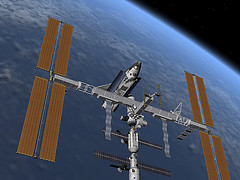
A digital rendering of the International Space StationThere may be little to no consumption of alcohol aboard, but there’s plenty of drugs on the International Space Station – albeit not for recreational purposes. The Discovery Space blog has a list of the contents of the ISS pharmaceutical kit-bag, of which this is just one [via SlashDot]:

Tranquilizers: […] astronauts keep a few tranqs on hand in case anyone goes all suicidal or psychotic in space. NASA recommends binding the individual’s wrists and ankles with duct tape (ever the space traveler’s friend!), strapping them down with a bungee cord and, if necessary, sticking them with a tranquilizer. Sure, it hardly makes for a civilized evening aboard ISS, but it beats someone blowing the hatch because they think they saw a something crawling on one of the solar panels.

Good old NASA, always thinking ahead. If you’re still curious about the astronaut lifestyle, Bruce Sterling has written a piece based on an interview with Nicole Stott that sums up what it’s like to live in space:

The time you spend in outer space will change your blood and hormone levels, and your bones and muscles will slowly waste away. A three-month stay is optimal; six months is pushing it. You’re going to need to get in shape and remember to pack light.

With that understood, let’s settle in. Built over the course of ten years by a wide variety of contractors­­—–and still a work in progress—–the ISS is a hodgepodge trailer camp graced with quite a lot of Russian design. It features two basic living elements: big round tubes, trucked up there in the American Space Shuttle, and smaller knobby tubes, fired up on other people’s rockets. All these pods have been snapped together, mostly end to end, or, as you’ll say on the station, “fore and aft.”

In a nutshell: it’s not exactly a five star hotel. But you know what?

I’d still go tomorrow if they gave me the chance. [image by FlyingSinger]

Cellphone app could help illegal immigrants

64 sqThis is going to be controversial:

A UC San Diego professor said he has developed a cell phone tool that may help guide illegal immigrants safely across the border.

Similar to the way hungry drivers can find a restaurant through the global positioning system devices in their cars and cell phones, illegal immigrants soon may be able to plot their ways across the treacherous border between the United States and Mexico.

“It shares some aspects of the GPS systems that people have in cars,” said Ricardo Dominguez, a professor of visual arts at UC San Diego. “It locates where you are in relation to where you want to go, what is the best way to get to that point and what you can expect when you reach the endpoint.”

Dominguez, an activist and artist, said the reason for developing the technology, which he calls the Transborder Immigrant Tool, is to keep people safe.

As many as 5,000 people in the last 15 years have died trying to cross the border.

[Story tip: New Times Phoenix blog; image: sixty-four squares, theilr]