Category Archives: Blog

Wikipedia’s frontiers

Here’s an interesting thinking-out-loud piece at The Guardian from Mark Graham, which responds to those suggestions from the other week that Wikipedia is losing editors because the crowdsourced encyclopedia is ‘complete’.

Wikipedia still has much to do: the map above suggests there are still whole continents that remain a virtual “terra incognita” and the next explosive growth in the online encyclopedia will come from places that have not previously been represented.

The map represents the roughly half million geotagged Wikipedia articles that fall within the boundaries of any one country. These geotagged articles are either about distinct places (such as cities, buildings, forests) or about events that occurred in distinct places.

[…]

But what of the places that aren’t even represented? We often hear claims that peer-produced information is broader in scope and more accurate than traditional methods of content creation. This is certainly true, particularly for topics that generate a lot of interest such as “Paris” or “New York”. However, as we increasingly rely on (and trust) web 2.0 sources such as Wikipedia, what will be the effects of this new “terra incognita” in our shared map of knowledge?

It may be that when broadband reaches more parts of Africa – helped by the landfall of superfast cables in August – that more people there will start discovering Wikipedia, and that the site will see a second explosion of new editors and articles about places that have so far been ignored. Or it may be that by then Wikipedia will be passed by in favour of something new.

The answers are unclear, but we should nonetheless acknowledge the significant geographic gaps in an encyclopaedia that is described as having reached its limits. It is conceivable that it will only be a matter of time until a new generation of wannabe Wikipedia editors in Zambia, in Indonesia, and in much of the rest of the world begin to fill in the blank spots and construct dense layers of virtual representation.

It’ll be interesting to see what political arguments are raised around Wikipedia’s usefulness and ubiquity as new editors start to represent their own less-well-know nations and cities – controversy of one sort or another seems to dog it perpetually. That said, I think Wikipedia (or its inheritor) is going to be around for a good while yet… it’s too useful an idea to disappear that easily.
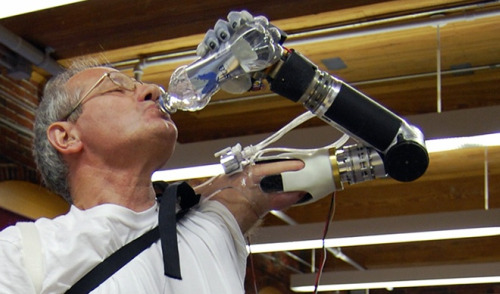
Bionic limb pr0n

If you’re fascinated by bionic limbs and other prosthetic technologies, you’ll want to be checking out Wired‘s gallery of photos showcasing the current state of the art – we’re still a good distance from the uncanny valley in this field, but the actual utility and ergonomics of the designs are reaching a point where their usefulness balances out their clunky appearance. Borrowed from the gallery in question, this here is the “Luke” arm, developed by a company owned by the guy who invented the Segway:

The 'Luke' bionic arm

Go check ’em out… and bear in mind that an Italian car accident victim spent a month last year testing an entirely thought-controlled prosthetic replacement for his lost limb. Interesting times.

Somalian pirate ‘stock exchange’

piratesThe Somalian tanker pirates are back in the news – apparently they’ve set up a sort of ‘stock exchange’ to handle the influx of business and investment opportunities and feed their ransom money back into the local area [via BoingBoing; image by bazylek100]

The gangs have made tens of millions of dollars from ransoms and a deployment by foreign navies in the area has only appeared to drive the attackers to hunt further from shore.

It is a lucrative business that has drawn financiers from the Somali diaspora and other nations — and now the gangs in Haradheere have set up an exchange to manage their investments.

One wealthy former pirate named Mohammed took Reuters around the small facility and said it had proved to be an important way for the pirates to win support from the local community for their operations, despite the dangers involved.

“Four months ago, during the monsoon rains, we decided to set up this stock exchange. We started with 15 ‘maritime companies’ and now we are hosting 72. Ten of them have so far been successful at hijacking,” Mohammed said.

First point I’d make is that this reads much like a press release – as if the Reuters guy went down, got a few quotes from the people involved (who were only too keen to put a gloss of success on the operation for the international media) and filed the copy. This is a story about bad guys, so if the bad guys want to appear like they’re really bad, why not quote ’em verbatim? I doubt things are running quite as smoothly as they’d like us to believe.

That said, the core of the story is eminently believable… and if the stuff I read in my old job as an employee of the Royal Naval Museum is to be believed, there’s considerable historical precedent. The buccaneers of the Caribbean had thriving dependent communities and investment programs, and operated with a similar degree of impunity at the peak of their powers, as did the Barbary corsairs. As the nation-state model of political power decays, I suspect we’re going to see more interstitial criminal communities arising to skim the cream from international trade – those tens of millions of dollars that the pirates are raking in aren’t comparable to the higher cost of sending navies out to stop them. Which in turn leaves the door open for the rise of mercenary navies to take on the work of protection…

Bookstore futures from Shirky and Doctorow

bookstore signContinuing the increasingly ubiquitous discussion of the future of bookstores (in the wake of Borders in the UK going into receivership), two heavyweight thinkers have thrown their opinions out into the ring in the last few days. First of all, Clay Shirky, who notes that there are three basic groups of people arguing for bookstores to be rescued from what seems to be an unstoppable decline, and that it’s the one that treats bookstores as having in intrinsic community value that has the most hope of coming up with a workable model for the future:
[This] third group, though, is making the ‘access to literature’ argument without much real commitment to its truth or falsehood, because they aren’t actually worried about access to literature, they are worried about bookstores in and of themselves. This is a form of Burkean conservatism, in which the value built up over centuries in the existence of bookstores should be preserved, even though their previous function as the principal link between writers and readers is being displaced.

This sort of commitment to bookstores is a normative argument, an argument about how things ought to be. It is also an argument that might succeed, as long as it re-imagines what bookstores are for and how they are supported, rather than merely hoping that if enough nice people seem really concerned, the flow of time will reverse.

Then we get a response from Cory Doctorow, who can come at the question from multiple angles – as someone who has both frequented bookstores and been employed by them, and as someone whose creative output is sold through them. As always with Doctorow, out-of-the-box thinking comes as standard; for example, instead of seeing print-on-demand technology as a business-killer, why not look at how you can use it to add value to the bookstore experience?

At the Harvard Bookstore, they have someone who spends the day mousing around on Google Book Search, looking for weird and cool titles in the public domain to print and shelve around the store, as suggestions for the sort of thing you might have printed for yourself. This is a purely curatorial role, the classic thing that a great retailer does, and it’s one of the most exciting bookstore sections I’ve browsed in years. And even so, there’s lots of room for improvement: Google Books produces the blandest, most boring covers for its PD books, and there’s plenty of room for stores to add value with their own covers, with customer-supplied covers (the gift possibilities are bottomless), and so on. I can even imagine the profs across the street producing annotated versions — say, a treatise on Alice in Wonderland with reproductions of ten different editions’ illustrations and selling them through the store’s printer and shelf-space, restoring the ancient bookseller/book-publisher role.

Plenty of room for one-person middle-man businesses in there, as well… maybe the publishing houses should start thinking in this direction, too. What if they outsourced the physical side of book publishing – design, layout, so on and so forth – entirely to custom designers? You’d quickly get a range of services from the utilitarian to the luxurious, and add an element of individuality to a medium that has become increasingly homogenised… [image by jayniebell]

Blue-sky thinking aside, Doctorow and Shirkey make it plain that there’s no reason bookstores have to die off… but it’s up to the people that run them (and, to some extent, those who use them, too) to make some changes in the direction of sustainability.

The scent of dead stardom – Eau de Jacko

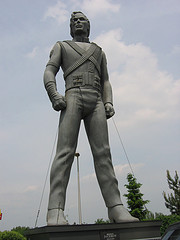
Michael Jackson statueAh, December – time to crank out the ‘silly season’ media stories to fill the gaps in between the “best of the decade” posts. So here’s a way-out weird  news article for you: an LA-based company called My DNA Fragrance (there’s a clue in the name) has joined forces with a collector of celebrity hair and started making perfumes based on DNA extracted from snippets of the barnets of superstars. [via The Daily Swarm; image by Sjors Provoost]

No, apparently this is a true story. But I hope you’ll excuse me the levity of slicing a quote from the coverage and using it out of context (purely for the lulz, you understand):

“The biggest seller is Elvis, but MJ is selling very well too. It’s a powerful fragrance and there is no alcohol in it.

Oh, the irony. 🙂

We’ll leave aside the speculations about our bizarre obsession with celebrity (after all, is this so different from touching relics of the saints and other such Medieval behaviours?), and leap instead straight to the copyright problem. What happens if my hair is harvested without my knowledge, while I’m treading the red carpet somewhere*? Don’t I or my descendants have a right to the profit from perfume based on my DNA? How many changes would need to be made to a DNA string to make it legally ‘different’ to the originating source?

And most importantly, what the hell does Eau de Michael Jackson smell like?

[ * Hey, this is a speculative website, okay? ]