Category Archives: Blog

Wooden bones

If you wanted to build artificial bones, what material would you use? I don’t know about you, but wood wouldn’t have been high up my list.

To create the bone substitute, the scientists start with a block of wood — red oak, rattan and sipo work best — and heat it until all that remains is pure carbon, which is basically charcoal.

[…]

The scientists then spray calcium over the carbon, creating calcium carbide. Additional chemical and physical steps convert the calcium carbide into carbonated hydroxyapatite, which can then be implanted and serves as the artificial bone.

The entire process takes about one week and costs about $850 for a single block. One block translates to about one bone implant.

I’ve no idea how that compares with other artificial bone manufacture techniques on price and speed, but it’s still fairly impressive on novelty value alone. [via SlashDot]

Next-gen hearing aids have iPod jacks

earFile under “elective implant technology that I don’t need but really wish I could afford anyway”: the bone-anchored next-generation hearing aid with audio jack input options.

Older-style hearing aids amplify all sounds, making it almost impossible for wearers to hear conversations in noisy environments. They also interfere with frequencies used by mobile and fixed phones and often emit high-pitched whistling sounds. But the newer processors, costing about $6000 each, shut out background noise, giving users up to 25 per cent better hearing, and can be attached directly to MP3 music players or wireless headsets for talking on the phone, Cochlear’s territory manager, Katrina Martin, said.

They were useful for people with congenitally blocked middle ears, chronic infections that had eaten away tiny bones in the middle ear used for sound conduction, or babies born with closed ear canals, she said.

The processors must be removed for showers or swimming but can last up to 15 years.

Once you’ve got that basic hardware installed, the sky’s the limit for crazy bolt-ons and extras. Real-time digital signal processing, on-board recording and playback… the first person to write an open-source filter for screening out people on public transport talking loudly into their phones is going to be very popular. [via BoingBoing; image by jessicafm]

Broke but happily stoned: economics and prohibition

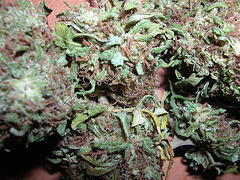
marijuana budsNew Scientist highlights some research that correlates economic pressures in the United States with the legal status of intoxicants, suggesting that perhaps the pro-pot lobby’s continued hassling of the Obama administration will pay off:

Euan Wilson of the Socionomics Institute in Gainesville, Georgia, finds that anti-drug laws in the US tend to coincide with high share prices, and legalisation with low.

Comparing today’s situation with alcohol prohibition in the US between 1920 and 1933, Wilson says that just as alcohol was legalised when the economic slump reached its nadir, so concessions to marijuana use could be around the corner. “The current mood is very similar to the 1930s,” says Wilson.

I’m not going to hold my breath, personally; it strikes me there’s still too much political cachet invested in the War on Drugs for it to be dropped that easily.

And on my side of the pond, I suspect the current administration is going to grab harder for total control before it finally loses its grip; leopards and their spots, you know. In the meantime, they’ll just keep legislating alternatives out of existence (giving them plenty of extra mainstream publicity in the process) before shaking their heads sadly at the inevitable increase in crime statistics (and taxing us for the mop-up)…

I’m sure I can’t be the only person who sees the irony in all of this. Is’t it the stoners themselves who’re supposed to act illogically? [image by r0bz]

Krugman on slowing pace of change

changeNobel economics laureate Paul Krugman, speaking at Worldcon, holds forth on the slowing pace of change:

“The pace of change has actually, generation by generation, been slowing down,” he claimed. “The world of today is not as different from the world of 1959 as the world of 1959 was from 1909.”

So let’s say that you travel 30 years into the future and find yourself in a shopping mall. You’ll be astounded at the “great gizmos” that are for sale there, but you’ll still be able to recognize it as a shopping mall, said Krugman. On the other hand, lots of trends are likely to come to a head over the next few decades, including climate change and peak oil, and they could result in a drastically different world.

It kind of makes sense. In the Western world technology – specifically consumer electronics, medicine, communications, and computers – have developed enormously in the past 40 years, but cultural and social change has been less pronounced. We still live a fairly automobile-centric, consumer-based, culturally egalitarian lifestyle[1] that would have been recognisable to someone living in 1959.

But Krugman points out that this could change in the future, with climate change, peak oil, disruptive biotechnology, radical life-extension, resource wars, AI, and the changes in attitudes and culture that these thing could lead to.

[1]: I think that we (i.e. the Western liberal democracies) are certainly a more culturally egalitarian society (with greater gender equality, gay rights, and less racism) than we were in 1959, but I’m not entirely sure that 1909 was substantially more racist, homophobic, and sexist than 1959. Question: did our *culture* (as distinct from technology) change more between 1959 and 2009 than between 1909 and 1959?

[from iO9][image from kevindooley on flickr]

Earth and other unlikely worlds

Apologies to Paul Mcauley for pinching the name of his blog for a post title, but it felt appropriate!

In addition to raking over our old friends the Drake Equation and the Fermi Paradox, COSMOS Magazine looks at the possibilty of the sort of planets found in classic space opera actually existing… you know the sort, solid globes of diamond or iron or ice or whatever else.

THE EARTH FORMED in a region of the Solar System’s protoplanetary disc that was relatively rich in the element oxygen. So on top of an iron-rich core, our planet is mostly built out of oxygen-containing silicate rocks. But further out in the protoplanetary disc, the ratio of the elements carbon and oxygen was probably different.

A class of meteorites found on Earth, called enstatite chondrites, may have formed in this region – they have a ratio of carbon to oxygen that is a thousand times larger than the ratio found on Earth.

“If an entire planet were to have condensed from this kind of raw material, it would have ended up enormously different from the Earth,” says Marc Kuchner, an expert on exoplanets at NASA’s Goddard Space Flight Centre near Washington DC.

Built out of relatively more carbon than oxygen, such a planet would still have a metallic iron core, but the outer layers could be composed of ceramics – silicon and titanium carbides – with a shell of pure carbon on top.

These ceramics and graphite would make the entire planet extremely hard and heat-resistant, and it could survive much closer to its star. Even more bizarre is that the high pressure beneath the surface would convert the bottom of the graphite layer into an entire shell of diamond that would be many kilometres thick.

That’s your sensawunda fix for the day, I reckon. And if you’re a fan of the OMG-we’re-so-insignificant angle, try this for size: Earth’s habitable period may nearly be over, at least on a cosmological time-scale [via SlashDot].

“The Sun does not seem like the perfect star for a system where life might arise. Although it is hard to argue with the Sun’s ‘success’ as it so far is the only star known to host a planet with life, our studies indicate that the ideal stars to support planets suitable for life for tens of billions of years may be a smaller slower burning ‘orange dwarf’ with a longer lifetime than the Sun ― about 20-40 billion years. These stars, also called K stars, are stable stars with a habitable zone that remains in the same place for tens of billions of years. They are 10 times more numerous than the Sun, and may provide the best potential habitat for life in the long run.”

Take that, Rare Earth Theory! Turns out we’re not so special after all… though whether that’s reassuring or depressing is a matter for debate.