
Category Archives: Blog

Joe Robot vs. the Volcano: the spiderbots of Mount St Helens

Mount St Helens shrouded in cloudIn order to keep a close eye on Mount St. Helens, the NASA JPL people have built and deployed a bunch of networked “spiderbots” which negotiate a peer-to-peer network between each other in order to pass data back to base.

Fifteen spiderbots, so-named because of the three spindly arms protruding from their suitcase-sized steel bodies, were lowered from a helicopter to spots inside the crater and around the rim of Mount St Helens, an active volcano in the US state of Washington, in July.

Each has a seismometer for detecting earthquakes, an infrared sensor to detect heat from volcanic explosions, a sensor to detect ash clouds, and a global positioning system to sense the ground bulging and pinpoint the exact location of seismic activity.

Once in place, the bots reached out to each other to form what is known as a mesh network. “It’s similar to the internet,” says Steve Chien, the principal scientist for autonomous systems at JPL. “You just lay them out, and they figure out the best way to route the data.”

Smart idea: install a remote monitoring system and instruct it to drop you a line with any problems… up to and including any problems with the system itself as well as the volcano, one assumes.

Obviously the expense means that this sort of system is currently only of use in high-risk and high-budget applications, but it’s no great mental stretch – given the rapid advances of networking technology – to imagine entire states or countries blanketed with similar monitoring frameworks.

Then make the data public, bolt on an API and distribute something like the SETI@home software, and everyone with some spare processor cycles can help keep an eye on geological instabilities. Similar systems (or perhaps even the same devices) could be used to provide communications infrastructure in the aftermath of a disaster, too. [image by christmaswithak]

Scaled-elextric: slot cars for transport

slot-carToday’s dose of technocratic mass-transport conceptual design is brought to you by German designer Christian Förg. His Speedway Transport System is inspired by slot cars of his youth:

Förg’s Speedway Transport System concept uses a network of linear electric motors to propel cars along the highway.

He sees us driving around in futuristic dual-mode electric cars with small motors for city driving. When we’re ready to leave town, a contact-free linear motor would propel the car over long distances with a drifting magnetic field. Förg says linear motors would work under our existing roadways, complementing – not replacing – existing automotive technology.

“This means that you can use the roads with normal cars and also at the same time for the Speedway system,”

If this ever gets taken up it’ll be interesting to see what alternative uses the street finds for this technology.

A slight non-sequitur: Will Hutton writes in the Guardian on the dire state of the UK rail network, and how in order to remain economically competitive, Britain must invest in the kind of high-speed rail they have in Europe.

[via Wired][image from Wired]

Is psychopathy a hardware issue?

MRI brain scanNeuroscience continues to probe the depths of our grey matter, delivering blow after blow to that good ol’ mind-body dualism. The latest news? Psychopaths appear to have a detectable brain abnormality that “normal” folks do not. Interesting stuff, but there are some nasty implications also:

When discussions turn to psychopaths and sociopaths, talk of criminal proceedings cannot be far behind. While the study was small and has not been repeated, the mind immediately wanders to a court room where MRI evidence is given to support the conviction of someone on trial for mass murder. The controversy of the topic is likely to be heated. Could a jury be convinced with biological proof that a person’s brain is marked with the brand of a psychopath?

Given that there have indeed been recent attempts to convict people using MRI scans, it’s not an implausible scenario. But until we’re sure that the brain anomaly in question is only present in psychopaths, this is a type of scientific evidence that is probably best left outside the courtroom. [via SlashDot; image by jsmjr]

Agnotology: The science of ignorance

luckyMany of my fellow citizens believe that the Apollo program was faked, evolution is a lie, global warming is a sinister plot by Al Gore to take away their Hummers, and President Obama is some kind of Nazi foreigner whose healthcare plan will lead to mass euthanasia. Disinformation seems to be a winning tactic.
So, yes, Discover Magazine’s interview with Robert Proctor, Stanford science historian and co-editor of Agnotology: The Making & Unmaking of Ignorance, had some resonance with me.

Snips:

Just what is agnotology?
It’s the study of the politics of ignorance. I’m looking at how ignorance is actively created through things like military secrecy in science or through deliberate policies like the tobacco industry’s effort to manufacture doubt through their “doubt is our product” strategy [spelled out in a 1969 tobacco company memo [pdf]]. So it’s not that science inherently always grows. It can actually be destroyed in certain ways, or ignorance can actually be created.

Have you continued your focus on tobacco?
I recently collaborated on an exhibit of the most outrageous tobacco ads called “Not a Cough in a Carload.” It’s centered on medical-themed tobacco ads: that tobacco’s good for your T-zone, that it calms your nerves. Scientific tests prove that brand A is better than B, or, you know, 20,000 physicians recommend Camels, and so forth. The use of athletes and models, and the artwork is just beautiful.

How do you maintain the perspective essential to your kind of research?… [I]t’s important to see the past the way the people saw it. So I’ve written two books on Nazi medicine, and the goal there was not just to condemn them, but to see how in the world they came up with those ideas and those movements and how they justified them to themselves. So we see them as full humans and not just scarecrows, so we can actually understand the depth of the depravity or whatever. But at least we see it honestly, and that’s a traditional historical virtue.

[Image: leifpeng]

Fusion on a budget

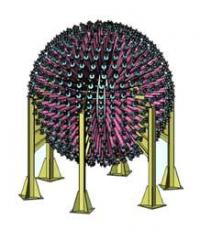
fusionreactorCanadian company General Fusion are developing a fusion reactor that is based on a process called magnetized target fusion:

The reactor consists of a metal sphere with a diameter of three meters. Inside the sphere, a liquid mixture of lithium and lead spins to create a vortex with a vertical cavity in the center. Then, the researchers inject two donut-shaped plasma rings called spheromaks into the top and bottom of the vertical cavity – like “blowing smoke rings at each other,” explains Doug Richardson, chief executive of General Fusion.

The last step is mainly well-timed brute mechanical force. 220 pneumatically controlled pistons on the outer surface of the sphere are programmed to simultaneously ram the surface of the sphere one time per second. This force sends an acoustic wave through the spinning liquid that becomes a shock wave when it reaches the spheromaks in the center, triggering a fusion burst.
General Fusion has just started developing simulations of the project, and hopes to build a test reactor and demonstrate net gain within five years. If everything goes according to plan, they will then build a 100-megawatt prototype reactor to be finished five years after that, which would cost an estimated $500 million.

Like general artificial intelligence, generative fusion power is one of those technologies that always seems to be 10-20 years in the future.

It is good to see alternative techniques to the well-known ITER project or Inertial Fusion Energy being adopted as it increases the chances that some genuinely practical approach will be found.

It’s also heartening to see (relatively) smaller operations engaging in generative fusion research.

[from Physorg][image from Physorg]