Category Archives: Blog

A shout-out from Montreal

This is sort of a halfway report… as I’m drafting this, it’s now officially Saturday, but barely. Given that, I’ll keep it short. Here are a few of the highlights from the convention so far:

First – thanks to Montreal, and to Canadians from all over for hosting a very friendly convention. This has been a pleasant place to be. Second, this is not normal life in a connected always-on world where conversations are tweeted and texted and take place on devices that look like Star Trek communicators. Instead, the roaming charges have got most of us carrying dead devices in our pockets and roaming the halls looking for people. I suppose that’s not entirely bad, but it feels strange.

Its been a very busy convention and the panels have been full. Nonetheless, I managed to capture a shot of Connie Willis, Amelia Beamer, Robert Silverberg, and Sheila Williams on the dealers-room floor near the Locus booth. Notice how they all color-coordinate well with their badge ribbons and with each other.

Connie Willis, Amelia Beamer, Robert Silverberg and Shiela Williams

One of the most interesting panels so far covered new astronomy (Keppler is beginning to report results, there are more extra-solar planets being discovered regularly, Venus has a new white spot). Yes, I’m a bit of a geek.

Just to prove my inner geek was in full force, I also went to a panel about three-dimensional printers. Yes, that’s the baby version of what may become the universal replicator from so many science fiction stories and movies. The new vocabulary word from this panel was “Voxel” which is “Volume Pixel.” The presenter, Tom Easton, likened the maturity of 3D printer technology now to where PC’s were in the 1990’s. If he’s right, we’re in for an interesting ride. As opposed to the information economy, it’s the design economy. We have been creating things in the no-space of the electronic world, but we will be able to re-create the physical world, perhaps over and over and over. And all this in a world culture where we don’t have the ethical underpinnings to get rid of computer viruses and spam. I may make this the topic of my next column here at Futurismic.

The party for the Analog and Asimov’s magazines got shut down for being too noisy. So I guess even with the graying of fandom, we can still get in a ton of trouble. But I did get a cake picture worth sharing:

James Patrick Kelly's cake

This decidedly alien piece of confectionary art was an evil plot dreamed up by Sheila Williams, the editor at Asimov’s Science Fiction Magazine, to reward James Patrick Kelly for having a story in every June issue of Asimov’s for twenty-five years. Now that’s a feat. The cake and the stories.

The cake is much bigger than it looks here. Yes, it tasted good. No, I didn’t have seconds.

There are a few more pictures of a day at the convention on the web.

Busted: guerrilla stem-cell crackdown?

Via the girls and boys of grinding.be comes a report that police have raided and closed down an underground Budapest clinic offering unspecified stem cell therapies of a dubious nature. Legitimate stem-cell researchers are speaking out in response, calling for proper controls but trying to de-emphasise the “they do scary weird stuff with dead babies OMGZ” angle:

“Many of us have been deeply concerned about some of the clinics that are offering untested, and often illogical ‘stem cell’ treatments,” he says. “They take advantage of desperate individuals or their family members, charging them large sums of money for procedures that are unlikely to work, may in fact be dangerous, and may use cells of dubious origin.”

Lovell-Badge advises people to seek help from doctors, patient groups, disease societies, and charities, and to “thoroughly check the clinic and the procedures on offer before gambling away your money and hope.”

Yeah, because it’s easy to stop people doing that, isn’t it? You only have to look at cosmetics advertising to see that people will believe whatever they want to believe, and the facts be damned; the cult of youth and health will ensure clinics like this are a viable business for a long time yet to come, I suspect.

Consuming the future

nature_chainsVia New Scientist, scientists at the Ecological Society of America confirm my Agent Smithesque suspicions on the cause of our ongoing environmental crisis:

More specifically, all we’re doing is what all other creatures have ever done to survive, expanding into whatever territory is available and using up whatever resources are available, just like a bacterial culture growing in a Petri dish till all the nutrients are used up. What happens then, of course, is that the bugs then die in a sea of their own waste.

Making all this worse is the development of consumerism, which encourages even greater consumption of resources than would be the case if every new human being consumed as much as they have done historically, the NS article comments on the development of this trait:

According to Rees, the change took place after the second world war in the US, when factories previously producing weapons lay idle, and soldiers were returning with no jobs to go to.

American economists and the government of the day decided to revive economic activity by creating a culture in which people were encouraged to accumulate and show off material wealth, to the point where it defined their status in society and their self-image.

In today’s world, such rhetoric seems beyond belief. Yet the consumer spree carries on regardless, and few of us are aware that we’re still willing slaves to a completely artificial injunction to consume, and to define ourselves by what we consume.

British philosopher John Gray (not the American self-help guru of the same name) has argued something similar in his book Straw Dogs: Thoughts on Humans and other Animals, in which he lays out a thoroughly pessimistic critique of the notion of human exceptionalism, and his prediction of the imminent failure of environmentalist policies.

I don’t agree entirely with Gray on the inevitability of collapse and decay, but I certainly concur with James Martin‘s view that the 21st century will have to mark a change from focussing on limitless growth to sustainable growth (if such a thing is truly possible), as a precursor to a steady state economy.

The article raises another interesting point:

In an ideal world, it would be a counter-advertising campaign to make conspicuous consumption shameful.

“Advertising is an instrument for construction of people’s everyday reality, so we could use the same media to construct a cultural paradigm in which conspicuous consumption is despised,” he says. “We’ve got to make people ashamed to be seen as a ‘future eater’.”

I’m against moralistic ‘holier-than-thou’ criticisms of consumerism, but as “consumerism” as a concept has come about by the deliberate decisions of business people and marketers (and policymakers) seeking to promote ever greater economics growth and consumption, might it not be time to have a similar drive towards sustainability?

[image from Peter from Wellington on flickr]

Go green: stop breeding

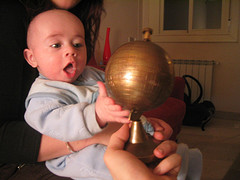
baby and globeCOSMOS Magazine reports that the world’s wealthiest nations are experiencing something of a baby boom, standing in stark contrast to the general decline of birthrate in recent decades. In many respects this can be seen as a good thing, at least from an economic perspective; the “greying” of the population has produced a situation where the number of elderly people unable to work and in need of care and support has grown without a proportional increase in the numbers of young productive people able to keep the economy ticking over. [image by geraintwm]

But that classical economic viewpoint fails to consider other important factors, like the environmental impact of an increase in the number of children in developed nations. In a nutshell, large families are not environmentally sustainable in a country like Britain, where family planning researchers have begun to suggest that the best way for a young couple to “go green” is to restrict the number of children they have. Population is a global matter, certainly, but it’s estimated that a British baby will produce 160 times the greenhouse gas emissions of a baby born in Ethiopia. Or, to put it another way, each child born in the United States multiplies its parents’ carbon legacy by more than five times.

Statistics are all very well, but as any discussion of environmental responsibility shows, we struggle with making sacrifices for a nebulous and intangible greater global good – and personal experience suggests strongly that there are a sizeable number of people who get very offended by suggestions that they should restrict the number of children they choose to have. So, the two big questions are: should developed nations be instigating some sort of population control policy (while simultaneously assisting less developed nations with the education and medical support required to foster similar attitudes), and – if so – how should they incentivize such a controversial and personal decision?

Who owns culture? J D Salinger, J K Rowling and the line between derivation and infringement

The bookworms among you may have caught the news last month about J D Salinger’s successful lawsuit against a writer who planned to publish an unofficial sequel to the cult classic The Catcher In The Rye. It’s a complex situation; while I’ve a certain sympathy with Salinger not wanting people messing with his creations, the ruling actually flies in the face of the US Constitution’s First Amendment, as TechDirt pointed out:

It’s difficult to see any reasonable justification for this ruling. Much of the ruling goes through the four factors of fair use, focusing a lot on why the new work is not a parody […] This misses the larger point: the work is entirely new. It’s not directly copying any actual expression. The real problem here is the idea that only “parody” can be considered fair use in these situations. There’s simply no reasonable logic to support that.

The rest of the discussion on the four factors fair use test is rather troubling. Most specifically, the judge’s analysis of the third prong, concerning “the amount of the copyrighted work” being used seems to go to great lengths to explain how the new book uses a great deal from the old book, but bases this on similarities between the way the character acts, not any actual copying of expression (other than the odd word or phrase, which would certainly seem to be minimal actual copying). Similarity (on purpose) is not copying. Stunningly, the judge even points out that the stories have similar arcs (which isn’t surprising), but to claim that because of a similar story arc there’s infringement is incredibly troubling for pretty much any writer.

Indeed – I raised a similar point in the wake of the latest plagiarism lawsuit against J K Rowling, and now it seems that the Fair Use Project and the American Library Association have filed an amicus brief expressing their concerns about the precedent being set. It’s interesting to compare the two cases, because that makes it clear that the law tends to side with the more successful or high-profile creator: Rowling’s lawyers have successfully (and quite rightfully) batted away claims from other writers that general story or character similarities make the Harry Potter series infringing works, but Salinger has prevented publication of a story that he feels infringes on his prior creations. Salinger’s case has a unique flaw (at least to my eyes) in that he has steadfastly refused to publish anything at all for quite some time. If he has no intent to write his own sequels to Catcher, how is the other writer robbing him by doing so?

Of course, there’s always the issue that cash-in works designed to exploit an established fan-base tend to be crap (and apparently reviews of the putative Catcher sequel suggest that it wasn’t much cop), but is that any reason to use the law to prevent their creation? For example, I’m pretty appalled by the travesty that Brian Herbert and Kevin J Anderson have made of Frank Herbert’s Dune universe, but I’d never suggest that they should be legally prevented from doing so.

I guess the question here is: does the publication ban showcase the law protecting Salinger’s ability to make money from his own work, or the law protecting his feelings about the work of others? Because I’m pretty sure the latter is not what the law is supposed to do, and it sets a bad precedent for any of us who aspire to make an income from our own creative output.