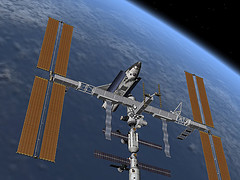
 Thanks to the anniversary of the Apollo Moon landings, everyone’s talking about space at the moment – and it’s still as contentious and passionate a subject as ever. [image by FlyingSinger]
Charlie Stross looks back at the Moon landings and decides that despite the huge advances in technology since the 60s, NASA’s proposed Constellation Moon landing program is unlikely to come off:
Today we lack a vital resource that both Wernher von Braun and Sergei Korolev took for granted: thousands of engineers with the experience of designing, building, and launching new types of rocket in a matter of years or even months. We used to have them, but some time in the past 40 years they all retired. We’ve got the institutions and the data and the better technology, but we don’t have the experience those early pioneers had. And I’m betting that the process of rebuilding all that institutional competence is going to run over budget. While NASA’s Constellation program might work, and while it could deliver far more valuable lunar science than Apollo ever did, it will inevitably cost much more than NASA’s official estimates suggest, because it’s too big a project for today’s NASA — NASA, and indeed the entire space industrial sector in the USA, would have to grow, structurally, to make it work.
Elsewhere, Paul McAuley laments the ‘disposable space truck’ model of space flight, saying it’s:
… like building an ocean liner to cross the Atlantic and setting fire to it when you reach New York.
Meanwhile, SpaceX have just completed their first commercial satellite launch, successfully putting a Malaysian Earth-imaging sat into orbit.
SpaceX landed a NASA contract for hauling cargo up to the ISS some time ago, but it looks like they won’t be able to rely on that as a long-term entry on the balance sheet, as Bruce Sterling points to an article in the Washington Post wherein NASA’s space program manager announces the controversial plan to de-orbit (and hence destroy) the International Space Station when the budget runs out in 2016:
Suffredini raised some eyebrows when, at a public hearing last month, he declared flatly that the plan is to de-orbit the station in 2016. He addressed his comments to a panel chaired by former aerospace executive Norman Augustine that is charged by the Obama administration with reviewing the entire human spaceflight program. Everything is on the table — missions, goals, rocket design. And right there in the mix is this big, fancy space laboratory circling the Earth from 220 miles up.
The cost of the station is both a liability and, paradoxically, a virtue. A figure commonly associated with the ISS is that it will ultimately cost the United States and its international partners about $100 billion. That may add to the political pressure to keep the space laboratory intact and in orbit rather than seeing it plunging back to Earth so soon after completion.
Apparently physicist and vocal space critic Robert Park suggests palming off the money-eating white elephant on the Chinese instead. I’d have thought auctioning it off to the highest bidder would have made more sense, and I’m pretty sure there’s be some interested parties – China included, but plenty of non-state parties also.
And finally, via Warren Ellis comes something for flicking your geek switches – HFradio.org can supply you with space weather updates via Twitter. As Ellis remarks, “it’s like the Shipping Forecast for space”… now all we need is a way to convert it to an audio stream. Anyone got a zero-g Nabaztag?
 The conclusions may not be surprising, but the method of discovery is intriguing. Oregon State researchers sampled municipal wastewater before it was treated to create a map of drug excretion.
 A company called
  The current obsession for the military robotics crowd appears to be solving the long-term fuelling issue – after all, your ‘bot isn’t much use if it has to return to base every six hours for a fresh battery (possibly leading the enemy to your emplacement in the process).
 Continuing