Category Archives: Blog

Did the Apollo landings lead to science fiction’s decline?

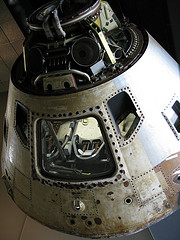
Apollo command moduleWell, it’s not my theory. But Ted Gioia seems to think that the Apollo landings ushered in science fiction’s decline into irrelevance:

With the benefit of hindsight, we should probably admit that the landing of Apollo 11 was the end of the glory days of sci-fi. With the conclusion of the Apollo program, NASA became just another government agency, more bureaucratic than heroic. It is all too telling that the Challenger disaster of 1986 was the next time that rocket ships captured the attention of the general public.

[…]

When the moon became just another piece of abandoned real estate, like much of Florida after the subprime meltdown, the psychological impact on sci-fi was devastating. Many grand predictions had been made about the future of space exploration by these visionary authors. But not one of them would have dared to make this prediction—namely, that 35 years after the Apollo program, no trip would have been made to any of the other planets in the solar system, and no one would have the gumption to send an astronaut—or even a dog or chimpanzee— back to the moon.

Science fiction is experiencing a bit of a comeback these days [O RLY?], but the moon plays a low profile in the renewal efforts.

Balls, frankly.

Gioia not only seems to be conflating a subset of the genre – namely heroic/imperialist space exploration fiction – with the genre as a whole, but appears to have observed a “decline into irrelevance” that the genre’s fans, publishers and practitioners have utterly failed to notice.

Sure, science fiction has changed in character considerably since the Apollo landings, and a loss of faith in Progress-with-a-capital-P is almost certainly one of the symptoms thereof… and sure, the pulps fell away and short fiction has become an artisan ghetto of sorts, but that’s a function of changes in media consumption patterns rather than a direct response to the space race fizzling out. [image by jurvetson]

So, nice try, Ted… but if you’re going to wrestle a topical straw man you might want to dress it up a little more convincingly next time, eh? 😉

Hairy goo invading from the Arctic

mysteryAhem. A mysterious browny-black goo with hair in it is drifting southward from the Arctic:

Something big and strange is floating through the Chukchi Sea between Wainwright and Barrow.

Hunters from Wainwright first started noticing the stuff sometime probably early last week. It’s thick and dark and “gooey” and is drifting for miles in the cold Arctic waters, according to Gordon Brower with the North Slope Borough’s Planning and Community Services Department.

Brower and other borough officials, joined by the U.S. Coast Guard, flew out to Wainwright to investigate. The agencies found “globs” of the stuff floating miles offshore Friday and collected samples for testing.

“It’s definitely, by the smell and the makeup of it, it’s some sort of naturally occurring organic or otherwise marine organism.”

Very weird. Cthulhu spawning? Cosy catastrophe? The blob? The larval stage of the World Tree?

[from abn news, via Blood & Treasure][image from Margaret Anne Clarke on flickr]

Gaze-tracking software to keep your screen secret

row of computersSick of people shoulder-surfing while you use your computer? A new suite of gaze-tracking software could be just what you’re looking for – it authenticates you by the patterns of motion in your eyes on the screen, and shows garbled text to anyone other than you:

Chameleon uses gaze-tracking software and camera equipment to track an authorized reader’s eyes to show only that one person the correct text. After a 15-second calibration period in which the software essentially “learns” the viewer’s gaze patterns, anyone looking over that user’s shoulder sees dummy text that randomly and constantly changes.

To tap the broader consumer market, Anderson built a more consumer-friendly version called PrivateEye, which can work with a simple Webcam. The software blurs a user’s monitor when he or she turns away. It also detects other faces in the background, and a small video screen pops up to alert the user that someone is looking at the screen.

Crafty. If the system gets cheap enough, we’ll see internet cafes start to offer private browsing as their unique selling point… although if you’re worried about people seeing what you’re looking at, you probably shouldn’t be doing it in an internet cafe to start with. [via Bruce Schneier; image by Kevin Zollman]

Tagging and tracking the trash

dumpsterEver wondered where your rubbish goes when it leaves your house? The New Scientist people obviously have, and so they’re teaming up with MIT to find out:

The team behind the experiment, MIT’s Senseable City lab, led by Carlo Ratti, have made a device that is about the size of a small matchbox and that works like a cell phone – without the phone bit. A SIM card inside the chip blips out its location every 15 minutes, the signal is picked up by local cell phone antennae and the chip’s location is relayed back to MIT.

Ratti’s team and New Scientist have already deployed a test run of 50 tracked items of trash ranging from paper cups to computers in Seattle. Several thousand more will be released in Seattle and New York garbage cans later this summer and we’ll chuck a batch into the London trash for good measure.

This should be an interesting experiment, and something like a first step toward Chairman Bruce’s “spimes” – objects whose entire life-cycle – cradle to grave, as they say – is trackable and searchable. Perhaps, when we have a better understanding of what happens to all the stuff we throw away and instantly forget, we’ll stop being so casual about our throw-away culture – and about the manufacturing and packaging practices of the companies we buy things from. As New Scientist puts it:

Think of what happens when the garbage men go on strike. We complain that they’re not doing their job – but where did all that trash come from to begin with?

[image by mugley]

eROCKIT – 50mph electro-assist bicycle

File under “wow, gimme one of those!” – the eROCKIT bike is described by its creators as “a new vehicle category, the human-machine-hybrid”. A trifle hyperbolic, perhaps, but it’s still pretty awesome. Watch:

The eROCKIT bridges the gap between the regular two wheeler categories. On one side the muscle-powered two wheelers, on the other side, the motorcycles. The eROCKIT concept requires a continuous muscle deployment from the rider. The vehicle’s electronic system multiplies this muscle power and deploys it as vehicle propulsion.

For the first time in the history of vehicle construction, the driver’s physical power becomes just as relevant for driving dynamics and speed as technical vehicle properties and engine power.

Send me one for review, please! Because I sure as hell can’t afford the €33,000 price tag… [via NextBigFuture]