Category Archives: Blog

Biotech to the stars

dendritesCentauri Dreams discusses a DNA-based self-replicating interstellar probe:

Think of a probe that gets around the payload mass problem by using molecular processes to create cameras and imaging systems not by mechanical nanotech but by inherently biological methods.

A Von Neumann self-replicating probe comes to mind, but we may not have to go to that level in our earliest iterations. The biggest challenge to our interstellar ambitions is propulsion, with the need to push a payload sufficient to conduct a science mission to speeds up to an appreciable percentage of lightspeed. The more we reduce payload size, the more feasible some missions become

This is similar to Robert L. Forward‘s starwisp concept (popularised by Charlie Stross in Accelerando).

I suspect that if and when we do get round to interstellar exploration it will involve sending small-mass packages that are capable of bootstrapping themselves to a broadcast/exploration mode using local materials on arrival in the target system.

It remains to be seen what kind of space-based molecular replicating systems become viable. Will we be able to create space-hardened bioware, or good ol’ fashioned machine phase fullerene nanotech?
[image from neurollero on flickr]

Icelandic cod on an evolutionary fast-track to extinction

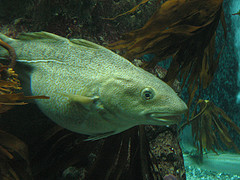
codfishHere’s a real Zeitgeist of a story for you: not only is it strong evidence in favour of the theory of evolution by selective pressure, but it also shows that external forces – including human intervention – can accelerate the process to a great degree.

The big downside, however, is that it may be a sign that one of the largest fisheries in the world is about to collapse like a house of cards: you see, there’s a gene in cod which governs the depth at which they prefer to live, and relentless trawling has exerted evolutionary pressure in favour of the mutant fish which swim deeper than the others. [image by Hello, I am Bruce]

Fisheries are known to exert selective pressure on fish. In some cases this has led to the evolution of smaller fish.

This was thought to be a slow process. “Previous workers have concluded that evolutionary changes are only observable on a longer timescale, of decades,” Árnason says. “The changes we observe are much more rapid.”

The A gene is being driven out simply because of where those fish choose to live, says Árnason. Such inadvertent, rapid selective pressure may drive some fisheries to crash.

“Man the hunter has become a mechanised techno-beast,” the team writes. “Modern fisheries are uncontrolled experiments in evolution.”

Worryingly, the researchers found that cod in the Icelandic fishery are becoming sexually mature while still smaller and younger. Something similar occurred in Newfoundland cod just before that fishery crashed. “We think this too is an evolutionary response to the selective pressure of fisheries,” says Árnason.

So, bad news… but bad news with some valuable knowledge in its back pocket. If extreme external conditions apply evolutionary pressure, where will we see this phenomenon crop up next? Perhaps, if the environmental uber-pessimists turn out to be right, we humans will end up at the pointy end of evolution’s goad; on a planet with limited food and water and numerous existential hazards, who knows what we might turn into over the course of a century or two?

I dance the body electric

Remember us mentioning that electrically-conductive body paint a little while ago? If so, you might remember thinking “well, OK, but what the hell would you actually use it for?” – I know I did.

Well, here’s your answer – or one of them, anyway. Take one large perspex box covered with hundreds of of little electrical nodes that are linked to some sort of synthesizer engine, and add one painted-up and limber dance-trained young lady with a willingness to experiment and make some noise; add them together, and you’ve got something you might have seen in Buck Rogers… if that series had been more prone to episodes set in strip clubs or techno-artist squat-communes. Observe:

[via PosthumanBlues; apologies to Walt Whitman for the headline]

I don’t know how to drive it, but it looks pretty wild

Concept cars are rather like science fiction – in that they never quite come true, and they say more about the time in which they’re designed that the time in which they would supposedly exist.

But that’s half the fun of designing them, I guess, and it looks like there’s still plenty of folk in the auto industry’s blue sky labs who know how to dream big… or who play a lot of computer games. Pink Tentacle has a bunch of concept vehicle drawings (or rather renderings) from Mazda, Toyota, Nissan and Honda that look like a mash-up of Akira, Wip3out and Stephan Martiniere; if this is what the freeways of 2050 will look like, crossing the street is going to be a crazy experience.

Mazda Motonari RX vehicle concept

That’s the Mazda Motonari RX; to quote Pink Tentacle:

The vehicle drives sort of like a street luge. Acceleration and direction is determined by two armrest mounted control points, and the vehicle’s exoskeletal frame shape-shifts in accordance with the position of the driver’s arms and legs when enveloped in the seat. Four omnidirectional wheels allow 360 degrees of movement, and the tread expands or contracts to suit the driving conditions. A “haptic skin” suit consisting of millions of microscopic actuators enables the driver to experience the road psycho-somatically while receiving electrical muscle stimulation from the onboard AI guidance system (or other remotely located drivers).

No mention of how much a tank of gas will cost… though Toyota’s design apparently sidesteps the issue by being “powered by pollution”.

There’s a certain irony implicit in the automobile industry being one of the last bastions of sleek’n’shiny futurism in these times of bright green thinking; I’d love to see streets full of things like this, but I’m not going to hold my breath.

Is a Terminator scenario possible?

metropolis h+ Magazine conducted a poll of “roboticists, AI workers, SF writers, and other techie types” (the SF writers were David Brin and Vernor Vinge) to see if they thought a “Terminator-like scenario” was possible, and if so, how likely it was. (Via KurzweilAI.net.)

Boiling it down (read the whole thing here), the consensus seems to be 1) forget about the time travel; 2) don’t expect a super-intelligent Skynet to spontaneously awaken and start wiping us out (though rather alarmingly, it was generally thought that was just “highly unlikely,” not flat-out impossible); but 3) do expect a future full of robots, both beneficial and warlike–though in the latter case, the intelligence directing them is likely to be humans of a destructive bent, rather than an AI with its own designs on the planet.

Knowing what humans are capable of, this is not much comfort.

Even though I am by nature optimistic.

(Image: 1935 tobacco card of Fritz Lang’s movie Metropolis, from Film Virtual History.)

[tags]robots, Terminator, artificial intelligence, science fiction, robotics, predictions[/tags]