Category Archives: Blog

Dan Brown’s antimatter bombs are nothing to worry about

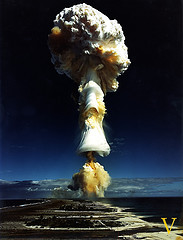
mushroom cloudI miss a lot of things about working in public libraries, but exposure to Dan Brown novels is not one of them. As such, I had no idea that Hollywood had made a movie from another of his books, Angels & Demons, but apparently they have.

Less surprising is the revelation that Brown has played fast and loose with the facts (and the writing, I fully expect); Wired UK takes a look at Brown’s antimatter-bomb-in-the-Vatican plot and points out that we’ve no need to worry about terrorists stealing the stuff from CERN:

And it’s true – scientists there really have  produced antimatter. But only in submicroscopic quantities. “If you add up all the antimatter we have made in more than 30 years of antimatter physics here at CERN, and if you were very generous, you might get 10 billionths of a gram,” CERN’s Rolf Landua, told New Scientist magazine recently. “Even if that exploded on your fingertip it would be no more dangerous than lighting a match.”

It would be possible to make more, of course, but not cheap:

The cost of antimatter is, by [NASA’s] estimates $62.5 million per microgram (£41 million). However, they suggest that a dedicated antimatter production facility, with a pricetag of $3 – $10 billion, would bring the price down to just $25,000 per microgram (a mere £16 million).

But even if that much were just lying around, the storage facilities don’t exactly lend themselves to a cat-burglar raid:

Positrons can be stored in a Penning Trap, a sort of magnetic bottle. (The Air Force bought a new positron trap in December – but only for a device to examine defects in semiconductors.) However, such traps are leaky and you can’t store your positrons indefinitely. There’s also the issue of what happens when the power fails. The trap stops working and all your positrons come into contact with the container walls, which could mean a big boom. Then there’s the question of how many positrons you can store. At the moment storing a microgram of positrons would require a Penning Trap of stupendous size. A 2004 report by the US National Research Council said that much greater energy densities were needed for positrons to be useful as an explosive. The study advised against heavy investment in such a high-risk, immature technology.

So, fear not – the Vatican is safe from antimatter, at least for now. Given the size of the place, I can’t imagine why you’d think you needed anything bigger than a small nuke to take it out… but that doesn’t sound quite as exotic, I guess, and exotic puts the ‘thrill’ into ‘technothriller’. Best leave the plausibility and scientific rigour to those science fiction nerds, eh? [image by V 2]

Plastic fantastic: plastic from trees

leafIn preparation for when the oil runs out (or becomes economically unviable to extract – as detailed in The End of Oil by Paul Roberts) scientists have started developing alternative methods for making plastic. In this case from trees:

Some researchers hope to turn plants into a renewable, nonpolluting replacement for crude oil. To achieve this, scientists have to learn how to convert plant biomass into a building block for plastics and fuels cheaply and efficiently. In new research, chemists have successfully converted cellulose — the most common plant carbohydrate — directly into the building block called HMF in one step.

HMF, also known as 5-hydroxymethylfurfural, can be used as a building block for plastics and “biofuels” such as gasoline and diesel, essentially the same fuels processed from crude oil.

Given that so much of our industrial infrastructure rests on oil it is reassurring that alternative sources of basic materials are being developed.

[from Physorg][image from linh.ngân on flickr]

Did cooking make us evolve?

campfireBecause there’s still got to be an optimistic sf story in here somewhere:

Harvard anthropologist Richard Wrangman theorizes that cooking with fire triggered hominids to evolve into humans. His experience in the wild led him to conclude that humans could never live on what chimpanzees eat. Cooking, he thinks, might account for the sharp rise in brain size, and the decrease in the size of teeth, that occurred about 1.6 million years ago in Homo erectus over its predecessor, homo habilis. It might explain our relatively small guts and weak jaws, not to mention certain preferences that seem innately human:

[O]ne of the fascinating things for me as I ventured into this was really learning about what hunters and gatherers eat—and it turns out that there are no records of people having a large amount of their food come from raw food. Everywhere, everyone expects a cooked meal every evening.

The problem is lack of evidence that people used fire that long ago. A lot of scientists believe cooking didn’t really start till only 500,000 years ago.

Lacking the proof for widespread fire use by H. erectus, Wrangham hopes that DNA data may one day help his cause. “It would be very interesting to compare the human and Homo erectus genetics data to see when certain characteristics arose, such as, When did humans evolve improved defenses against Maillard reaction products?” he says, referring to the chemical products of cooking certain foods that can lead to carcinogens.

Human origins have been in the news.  How and when we began is a source of wonder. Call me mammal-centric, but I found it impossible to look at the (eerily well-preserved) face of the newly unearthed lemur-like fossil without feeling a bit of kinship.

[Image: Campfire, P. Sto]

Winners of Futurismic-only draw for Terra Insegura and Marseguro

Actual Book Just a quick note to announce the winners of the Futurismic-readers-only draw for copies of my science fiction novels Terra Insegura (just released) and its prequel, Marseguro, both published by DAW Books.

The signed copy of Terra Insegura goes to Mac Tonnies of Kansas City, Missouri, while the copy of Marseguro was won by Kian Momtahan of Bristol, U.K.

If you missed out on the Futurismic draw and would like a chance to win the books for yourself, I’m doing two more weeks of draws open to anyone. If you’d like to enter, just send me an email at edward(at)edwardwillett.com with the subject line Terra Insegura.

Congratulations to the winners, and thanks to everyone who took part.


[tags]books,Edward Willett, Terra Insegura, science fiction, contests[/tags]

Little lost robot

Robots have been mobile for decades, but they’ve only ever been able to go places for which they had a map or set of directions stored. That’s all changed thanks to a team of roboticists from Munich, who’ve built the first robot that can be unleashed into unfamiliar territory without a map. How does it complete its journey? It asks for directions, of course:

ACE uses cameras and software to detect humans nearby, based on their motion and upright posture. As it closes in on a likely helper, ACE’s “head” – bearing a touchscreen and a second screen displaying an animated mouth – turns to face the chosen person.

A speaker working in sync with the animated mouth is used to get the person’s attention and to ask them to touch the screen if they want to help. Willing guides are then asked to point the robot in the correct direction, with the response being analysed by posture recognition software. Direction set, ACE says “thank you” before trundling off.

Pointing, rather than telling the robot where to go, avoids confusion caused by the fact that the robot and the facing pedestrian each have a different sense of left and right.

Although it interacted with 38 people over a period of nearly five hours – ACE did eventually reach its destination. In fact, the team report that the robot was making very good progress until it reached a busy pedestrian area where its own popularity became a problem.

The current rarity of mobile robots in public spaces is obviously a big factor here; in a few more decades, we may barge past lost robots on the pavement as quickly and guiltily as we do homeless people or street-drunks.

The principle on display here is that of robot-human interaction in order to gather environmental data to complete a task or journey, which is all well and good, but it’s a proof-of-concept more than anything else. If all you needed was a robot that could navigate an unfamiliar cityscape, it’d be far easier to kit it out with good visual sensors and a GPS unit.

Hell knows this would be useless for military applications; if your super-killbot had to stop at every enemy checkpoint to ask the way to headquarters, I dare say the best place it would end up would be a long long way from anything at all… [story via regular commenter Evil Rocks; apologies to Paul McAuley for the headline]