Category Archives: Blog

The future blooms for algal fuel

algaeAlternative fuels is an industry crawling with big promises, but they don’t come much bigger than this one: one billion gallons of carbon-neutral biofuel per year. Made from algae.

That’s the promise from Sapphire Energy, which is positioning itself to lead an emerging industry by working with airlines on test flights and ramping up its production facilities in New Mexico. If all goes as planned, the company says, it will be in the position to supply one million gallons of biofuel annually by 2011, 100 million gallons annually by 2018 and one billion gallons each year by 2025.

That’s all well and good, but biofuels are just another thing for us to burn for energy – what’s the big difference?

Another big benefit: algae sucks up lots of CO2. According to the Biodiesel Times, algae-based biofuel is considered carbon neutral because CO2 generated in its use is offset by what’s consumed during production.

OK, good. But here’s the bit that really struck me:

While Sapphire’s high-profile aviation tests have gotten the headlines, the company says that because its biofuel is a “drop in” fuel chemically identical to crude oil, it is compatible with anything on the road or in the air right now. It also plays nicely with existing refineries and pipelines. That’s another benefit over ethanol, which is corrosive and typically transported to terminals via truck or rail and then mixed with regular gasoline.

“We are 100-percent convinced that the only way to address climate and energy security is to use the same infrastructure we already have,” Sapphire’s Zenk said.

Now that’s a little more interesting. I don’t have the data or expertise to run the numbers on this sort of thing (is there a quant in the house?) but a replacement for mineral oils that wouldn’t require a huge investment in new peripherals has got to be worth looking into. Of course, as the article points out, it’ll take certification and industry take-up to make algal biodiesel truly viable as an industry, but it’s reassuring to see companies like Sapphire are thinking of the bigger picture. [image by Lee Nachtigal]

But maybe that’s the siren song of the easy option we’re hearing – would we really be better off keeping the systems we have, or should we be overhauling the entire global infrastructure of fuel production from the ground upwards?
Flexible concrete

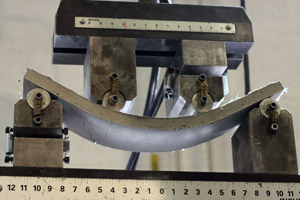
flexible self-healing concreteI try to avoid doing posts that just go along the lines of “hey, look – cool invention!”, but I thought flexible self-healing concrete was interesting enough to warrant a bending (arf!) of the rules

A handful of drizzly days would be enough to mend a damaged bridge made of the new substance. Self-healing is possible because the material is designed to bend and crack in narrow hairlines rather than break and split in wide gaps, as traditional concrete behaves.

“It’s like if you get a small cut on your hand, your body can heal itself. But if you have a large wound, your body needs help. You might need stitches. We’ve created a material with such tiny crack widths that it takes care of the healing by itself. Even if you overload it, the cracks stay small,” said Victor Li, the E. Benjamin Wylie Collegiate Professor of Civil Engineering and a professor of Materials Science and Engineering.

Ten kudos points and a Futurismic gold star to the first commenter with either a potential disaster scenario involving flexible concrete, or a design-fiction repurposing of it. Go! [via Technovelgy]

God of the gaps and the limits of science

thoughtAcademic Jon Taplin highlights this WSJ piece on quantum entanglement and the theories of French physicist Bernard d’Espagnat:

In March, the 87-year-old Frenchman won the prestigious $1.5 million Templeton Prize for years of work affirming “life’s spiritual dimension.”

Based on quantum behavior, Dr. d’Espagnat’s big idea is that science can only probe so far into what is real, and there’s a “veiled reality” that will always elude us.

Many scientists disagree. While Dr. d’Espagnat concedes that he can’t prove his theory, he argues that it’s about the notion of mystery. “The emotions you get from listening to Mozart,” he says, “are like the faint glimpses of ultimate reality we get” from quantum experiments. “I claim nothing more.”

I am not familiar with Prof. d’Espagnat’s work. Is he talking about the God of the gaps or the Popperian problem of induction?

[image from P/\UL on flickr]

Online democracy and the tyranny of the minority

The internet is the greatest potential enabler of genuine direct democracy ever, right? Well, not necessarily.

David Adams at OS News points out that recent high-profile gaming and crashing of internet polls (most notably the pwnzorage of Time Magazine by the 4chan hordes) should be taken as a caution; online direct democracy opens the gates to the tyranny of the minority, he says.

One of the dangers of direct democracy has always been that the majority of people can band together to persecute an individual or smaller group using legitimate voting, such as voting for confiscatory taxes on a wealthy individual, or restricting the civil rights of a minority ethnic group. This is called “tyranny of the majority.” That’s why no country practices direct democracy. There always needs to be a constitution to enumerate essential rights, a court to ensure that the constitution is obeyed, and a representative structure such as a legislature to insulate the nation’s laws from the whims of the voters. A tyranny of the minority is when a vote is open to anyone, but because not enough people are engaged politically, or not enough people know about it, a small group can organize itself to make a surprise assault on the poll and exert disproportionate influence.

Hmmm. Surely those marginalised by said poll would hence become more aware of the potential for engagement with the system as a result? And if the barriers to participation are so low, surely they’d be unlikely to be trounced the same way twice? But back to Adams:

… let’s assume for a moment that we could come up with a system that only allowed for legitimate votes, and we could have 100% confidence in that fact. Let’s assume that this system enabled votes to be easy to cast and easy to count. This system would probably work fine for big, high-profile elections like the presidency and congress, because the candidates and the parties are already doing everything they can to mobilize their troops to vote for their person. Where the tyranny of the minority would come into play would be the smaller races, such as school board, county sheriff, and other local ballots. These are races that are much more easily swayed by an organized group that represents a small minority of the voters but can swing the vote their direction if they’re determined enough. This is something that happens already every election, with manual voting, but with electronic voting, it would happen much more. I’m afraid that with remote e-voting, coupled with every more useful and popular regional and local social networks, Stephen Colbert would win every election in the country.

Frankly, looking at the roster of self-serving chumps we call a government here in the UK, I’m not entirely certain having Colbert in power for a while wouldn’t at least be a refreshing change, if not a political and historical turning point. I can see where Adams is going with this, but I’m a great believer in the old saw that every generation gets the government it deserves, with the corollary that we’re currently governed by shysters because we left the door wide open to them.

Maybe the early years of a direct and participatory democracy would usher in some terrible single-interest wackadoos and bigots (though I’m not entirely sure how much difference we’d notice), but I think it would also make everyone else think “well, if it’s that easy to get someone elected, we’ll give ’em a run for their money next time round”. End result – a more engaged electorate using a more democratic system. And while that’s admittedly a blue-sky scenario, I think it acts as a balance to Adams’ pessimism; it’s too early to write off the potential of the internet to reinvigorate democratic processes just because a few magazines and websites got chumped by script-kids. [via SlashDot]

eBay puts Indiana Jones out of work

Harrison Ford on set as archaeologist Indiana JonesThe rise of eBay and similar online marketplace has been a death-knell for a number of industries and a boon for others… but not always in the way that people expected. Archaeologists the world over deplored the arrival of eBay, fearing it would make the trade in rare looted antiquities even harder to control. It turns out, however, that exactly the opposite has occured:

Our greatest fear was that the Internet would democratize antiquities trafficking and lead to widespread looting. This seemed a logical outcome of a system in which anyone could open up an eBay site and sell artifacts dug up by locals anywhere in the world. We feared that an unorganized but massive looting campaign was about to begin, with everything from potsherds to pieces of the Great Wall on the auction block for a few dollars. But a very curious thing has happened. It appears that electronic buying and selling has actually hurt the antiquities trade.

How is it possible? The short answer is that many of the primary “producers” of the objects have shifted from looting sites to faking antiquities. I’ve been tracking eBay antiquities for years now, and from what I can tell, this shift began around 2000, about five years after eBay was established.

Not only that, it appears to have encouraged a growing market for cheap imitations of antiquities:

The economics of these transactions are quite simple. Because the eBay phenomenon has substantially reduced total costs by eliminating middlemen, brick-and-mortar stores, high-priced dealers, and other marginal expenses, the local eBayers and craftsmen can make more money cranking out cheap fakes than they can by spending days or weeks digging around looking for the real thing. It is true that many former and potential looters lack the skills to make their own artifacts. But the value of their illicit digging decreases every time someone buys a “genuine” Moche pot for $35, plus shipping and handling. In other words, because the low-end antiquities market has been flooded with fakes that people buy for a fraction of what a genuine object would cost, the value of the real artifacts has gone down as well, making old-fashioned looting less lucrative. The value of real antiquities is also impacted by the increased risk that the object for sale is a fake. The likelihood of reselling an authentic artifact for more money is diminished each year as more fakes are produced.

Good news for the defenders of history. Of course, the game will change again once we have widespread fabrication technology; will there be a point at which fakes and close copies become so ubiquitous and easily available that the kudos value of the real thing becomes too appealing to resist for those with a bulging wallet and something to prove? [via SlashDot; image by John Griffiths]