Category Archives: Blog

Cyberpunk style arrives: living jewelry and electronic tattoos

As a person seemingly born with a missing coolness gene, a big part of the appeal of cyberpunk was its visual aesthetic – why stick to a baseline body when you can bolt stuff on to make it look more interesting? And while I’m getting too old to care much about impressing people with the way I look, it’s fun to see those technofashions slowly seeping out from the pages of much-loved novels and into reality.

Exhibit one: EpiSkin, described by its creator as jewellery which “extends biological identity by combining technology and design into a new decorative body surface. This project is an exploration into the decorative technological control over biology to create an artifact which is a hybrid of both.”

EpiSkin living jewellery

Cultured in a lab, this biological jewelry is made of epithelia cells which grow to create an artificial skin. The cells are grown into custom designed forms, controlled by the artist. The cells are incubated for a period of time, following which they are stained with a custom dye. The skin is then visibly sealed into a wearable object. The process in creating these pieces includes human tissue culturing as well as computer generated form on which the cells are cultured and then transplanted into adaptive jewelry. The jewelry is worn on the body, completing the relationship of biological cells mediated by technology.

Exhibit two: Bare, a skin-safe conductive ink

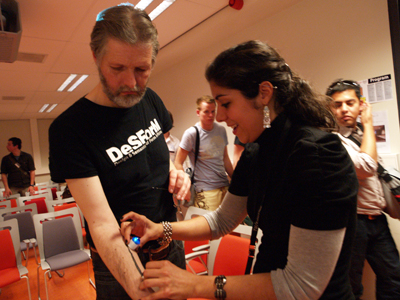
Bare - conductive ink tattoos

… that is applied directly onto the skin allowing the creation of custom electronic circuitry. This innovative material allows users to interact with electronics through gesture, movement, and touch. Bare can be applied with a brush, stamp or spray and is non-toxic and temporary. Application areas include dance, music, computer interfaces, communication and medical devices. Bare is an intuitive and non-invasive technology which will allow users to bridge the gap between electronics and the body.

By the time the children of my contemporaries start choosing their own fashions, there’s going to be some wild stuff to see on the mean streets of style. [EpiSkin story via PosthumanBlues; Bare Conductive Ink via Bruce Sterling]
A brief word on a new supermaterial

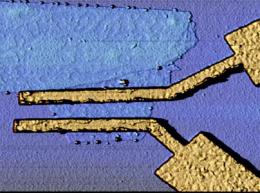
graphene-transistorGraphene: a material consisting of a sheet of carbon atoms one atom thick. Graphene was first identified only a few years ago, and has since been proferred for all sorts of uses, including ultracapacitors, spintronics, and now as a light source:

Microchips is just one of the material’s potential applications. Because of its single-atom thickness, pure graphene is transparent, and can be used to make transparent electrodes for light-based applications such as light-emitting diodes (LEDs) or improved solar cells.

It is also apparently very strong:

The mobility of electrons in graphene — a measure of how easily electrons can flow within it — is by far the highest of any known material. So is its strength, which is, pound for pound, 200 times that of steel.

The problem is to find a way to mass-manufacture it:

The trick that enabled the first demonstrations of the existence of graphene as a real separate material came when researchers at the University of Manchester applied sticky tape to a block of graphite and then carefully peeled off tiny fragments of graphene and placed them on the smooth surface of another material.

“They don’t care if they go to a lot of effort to make five tiny pieces, they can study those for years.” But when it comes to possible commercial applications, it’s essential to find ways of producing the material in greater quantities.

[from Physorg][image from Physorg]

Biofueled car might have been a senseless waste of chocolate

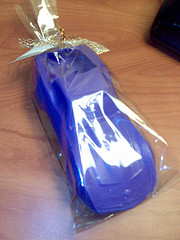
chocolate-carIt’s not quite the “chocolate-fueled car” that the headline from the indispensable PhysOrg.com promises. What we have instead may be close enough — a car its makers claim can reach 145 miles per hour,

powered by waste from chocolate factories and made partly from plant fibers….

The steering wheel is made out of plant-based fibers derived from carrots and other root vegetables, and the seat is built of flax fibre and soybean oil foam. The body is also made of plant fibers….

Scientists at the University of Warwick say their car is the fastest to run on biofuels and also be made from biodegradable materials. It has been built to Formula 3 specifications about the car’s size, weight, and performance.

[Image: Never Eat Purple Chocolate by i’m george]

Why hasn’t mobile banking spread out from Africa?

Kenyan woman with mobile phoneIf there’s been one good thing to come out of the global financial shitstorm, it’s that all of a sudden we’re looking afresh at established institutions and questioning whether, actually, there aren’t much better ways we could be doing things.

Point in case: mobile peer-to-peer banking, which is going gangbusters in parts of Africa but has yet to make much of a splash beyond that continent. The Guardian‘s Victor Keegan takes a closer look, and wonders whether it might be the key to saving the UK’s continually beleagured, semi-nationalised and utterly mismanaged postal service:

If you want to see pioneering experiments in banking you will have to go to a surprising place – Africa. And the question is, why can’t we do the same here? If the Post Office is looking for a new role, it need look no farther. In Kenya, customers of M-Pesa can send money to each other from around the country in 14 seconds flat using their mobiles. In the UK it takes three days, thereby endowing the banks with a huge float of money in transit on which they can earn interest. In Kenya, people leave their money at a trusted outlet such as a shop or pharmacy, where it is loaded into their sim cards.

At a Forum Oxford future technologies conference at the weekend we were updated on the startling success of the operation. It is reckoned that 17% of the Kenyan population is on M-Pesa. As a result they don’t need to carry cash any more, as everything from a can of Coke to your funeral can be paid for by phone. It works because the cash is held centrally by the bank, thereby enabling transactions to take place at very fast speeds. The average transaction is $30 (£20) because people trust it to do big ticket items.

Of course, there is always PayPal (which offers a mobile-linked transfer system as well), but finding a business that will accept PayPal that isn’t internet based is a big challenge. So, why hasn’t the idea caught on in more developed nations? [image by whiteafrican]

Maybe it is because we are not used to the idea of technology transfer coming from poorer to richer nations that industrialised nations have been so slow to realise not only that Africa is leading the world in mobile banking, but that it has big lessons for us.

Call me cynical (O RLY?), but I suspect it has a lot more to do with the fact that banks have no need to sell their services to us in a manner that emphasises our convenience, because our lives are so inextricably entangled in their profit generation systems already. Just like a drug dealer, they like to keep you waiting so as to remind you whose bitch you are…

Culture is carried by DNA?

pair of Australian zebra finchesIt sometimes feels like you can’t go two weeks without some new aspect of human life or behaviour being declared as being related to our DNA. The latest attempted conquest of genetic determinism? Why, our very culture itself!

You see, male zebra finches usually learn their courtship song patterns from their fathers, but it turns out they can generate the same songs spontaneously after a few generations without influence:

“It’s the classic ‘chicken and the egg’ puzzle,” Mitra said. “Learning may explain how the son copies its father’s song, but it doesn’t explain the origin of the father’s song.”

Mitra’s team wanted to find out what would happen if an isolated bird raised his own colony. As expected, birds raised in soundproof boxes grew up to sing cacophonous songs.

But then scientists let the isolated birds give voice lessons to a new round of hatchlings. They found that the young males imitated the songs — but they tweaked them slightly, bringing the structure closer to that of songs sung in the wild. When these birds grew up and became tutors, their pupils’ song continue to conform, with tweaks.

After three to four generations, the teachers were producing strapping young finches that belted out normal-sounding songs.

Uhm. Well, if you’re thinking that seems a little tenuous, you’re not alone:

Mitra admits that the analogies between bird culture and human culture are tenuous. “But there are resemblances. Culture is just learned behaviors. The motivating scenario is, if you isolate human babies from culture, put them on an island and come back after a few generations, what would their culture be like? What sort of language would they have? What sort of politics would evolve?”

That experiment probably won’t take place in the near future. In the meantime, Fitch says we can learn valuable lessons about human culture from songbirds, both at theoretical and mechanistic levels.

“Social learning is shared between the two, and songbirds are a well-understood and experimentally tractable system,” he said. “These biologically-grounded studies will lead us beyond the tired ‘nature versus nurture’ or ‘biology versus culture’ dichotomies which dominate the social sciences today.”

With the caveat that I’m not a geneticist or behavioural scientist, I don’t really see how birdsong and human politics are supposed to be different expressions of the same thing; the former is a biological imperative, while the latter is an emergent phenomenon. As Brian Eno once said, “culture is everything we don’t have to do”; a zebra finch that doesn’t sing sweetly won’t pass on its DNA, making its songcraft a matter of reproductive necessity, but I don’t think you can declare the same thing about, say, a great human painter or poet or politician.

That said, I’m all for getting beyond the nature/nurture dichotomy – knowing how culture emerges from biology is one of the most tempting grails of knowledge I can imagine. But in the same way that everything from alcoholism to sexuality seems to be blithely written off as being primarily a function of our genetic code, declaring such a nebulous and complex phenomenon as human culture to be passed along by DNA on the basis of some songbird studies seems… well, it seems pretty daft, really.

If there’s someone in the audience who can set me straight on this subject, I’d be very glad for them to speak up and tell me where my reasoning is wrong, but this story seems to me like just another instalment in our ongoing fetish with genetics as the key to all unsolved mysteries. [image by Lip Kee]