Category Archives: Blog

Old tech meets high tech in one-man sailing vessel

Project Green Jet proposed design

Although my primary diet as a young fiction-reader was science fiction (Asimov, Heinlein, Andre Norton) and fantasy (Tolkien, Lewis, Lloyd Alexander), there was one most assuredly non-SF or F series that captured my imagination almost as much: Arthur Ransome‘s series of 12 books about English kids “messing about in boats,” which began with Swallows and Amazons (still in print after eight decades, and soon to be both a musical and a motion picture !).

Which is why this (very long) article from Gizmag on sailing in general and something called the Green Jet Project in particular caught my eye (via :

Green Jet uses automated systems controlling non-conventional sails to offer a glimpse of the future of sail – faster, more efficient, less labour intensive with minimal environmental impact. The vision is a superyacht sailed by one man with a touchscreen.

Several screens of interesting information later:

Hydraulic motors will pull the sail to its 55 metre height (top of the rig is 62m) in around 30 to 40 seconds and each sail can rotate through 160 degrees on a pivot point to best catch the wind. Navigation is touch-screen and simple, though the system that sails the boat is far from that, not to mention monitoring an array of weather information systems.

Designer Erik Sifrer is currently seeking backers for the project, which he expects would require more than 70 million euro and three to six years to bring to fruition.

A vast sailing vessel (57 metres, in this case) under the command of just a single person? There’s only one possible response to that vision, if you’re an Arthur Ransome reader: as Nancy Blackett would surely say, “Jibbooms and bobstays!”

(Image: Mides Design)

[tags]sailing,transportation,boats,automation[/tags]

Walking the Walk

WalkGet this, the next time you’re at the airport, security cameras could be watching your every step and feeding it into a computer, from where security officials could crosscheck your gait-type with CCTV footage to spot suspected terrorists:

A database of different gaits thus created may enable security officials to recognise the gait of individuals checking in at an airport, even before they entered the concourse. The researchers say that a comparison of such data with CCTV footage may also be used to track suspect terrorists or criminals who may otherwise be disguising their features or be carrying forged documents.

What about privacy issues?

They insist that gait recognition has a significant advantage over more well-known biometrics, including fingerprinting and iris scanning, in that it is entirely unobtrusive.

It seems like a workable idea, but when you consider how many people pass through airports everyday, and how long it would take to capture the gaits of enough people to have an unbiased sample size to work with, and the accuracy of the gait recognition, you start to override the practicalities that are initially presented. [image by chilling soul]

Science fiction’s stars of tomorrow – who do you rate?

The SF Signal gang have been running another of their ‘Mind Meld’ pieces. This time they asked a bunch of genre notables which up-and-coming writers they thought would be the next generation of sf’s big hitters. Here’s the final list, based on frequency of mentions:

  • Paolo Bacigalupi (4 mentions)
  • Darryl Gregory (4)
  • Benjamin Rosenbaum (3 mentions)
  • Cory Doctorow (3)
  • Jay Lake (3)
  • David Moles (3)
  • Chris Roberson (3)
  • Vandana Singh (3)
  • Elizabeth Bear (2 mentions)
  • Alan DeNiro (2)
  • Alex Irvine (2)
  • Ted Kosmatka (2)
  • Paul Melko (2)
  • Naomi Novik (2)
  • Tim Pratt (2)
  • Jason Stoddard (2)
  • Karen Traviss (2)
  • Scott Westerfeld (2)

We’re pleased to see two Futurismic alumni in that list – Jay Lake and Jason Stoddard. No mention of Tobias Buckell, though, which seems surprising to me – and not just because he used to blog here, either.

There’s also a lively discussion thread going on, with plenty of other writers pitching in with their suggestions and refutations. What about you guys – who would Futurismic‘s readers add to (or remove from) that list?

Evolution observed in laboratory bacteria

Image of E Coli in the labFor the first time, a major evolutionary change has been observed in laboratory conditions, giving even greater weighting to evolutionary theory. The bacteria used, a strain of E. Coli, was first introduced into the Michigan State University lab twenty years ago by evolutionary biologist Richard Lenski. Some 44,000 generations later, the bacteria are still reproducing.

Somewhere around the 31,500th generation, the E. Coli developed a trait not present in the original strain: they began to be able to metabolise citrate, the inability of which is one of the main ways scientists distinguish E. Coli from other bacteria. Importantly, the paper says that evolution occurs as a sum of the previous steps of mutation and that as this history varies between groups of creatures, evolution is a random and unpredictable act.

“It’s the most profound change we have seen during the experiment. This was clearly something quite different for them, and it’s outside what was normally considered the bounds of E. coli as a species, which makes it especially interesting,” says Lenski.

One of the main criticisms of evolutionary theory has been that it is a theory that hasn’t been observed in the real world. Creationists are going to have a hard time explaining this result away, one suspects.

[via Daily Kos, image by scaliber001]

Innocence-Sensitive Spy Cams

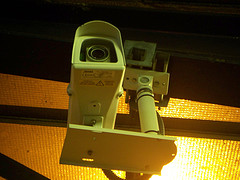
security cameraSince 9/11, the government’s use of video surveillance on the public has increased dramatically (this opens a new window with a .pdf). While the vast majority of this surveillance has been implemented to “protect the country from another 9/11-style attack”, it has been used in other arenas as well, namely in attempts to catch wanted criminals. It’s effectiveness in such a capacity is questionable at times, and the effects of such surveillance on society is noteworthy [photo courtesy of kafka4prez].

However, companies like 3VR – one of the largest surveillance software and video-analysis producers in the world – have begun development of increased-privacy software that would seek to protect innocent people from being falsely targeted by authorities. Their software is hoping to visible blur every face in video surveillance unless an investigation requires that the people in the video be identified. It seems like a small step in the right direction to counter the immense violations by the NSA not too long ago, but at least it’s something.