Category Archives: Blog

Science: It Really Is Everybody’s Business

T-Rex of Dinosaur ComixA museum public-relations coordinator for a Texas museum was the first to discover a fossil of a duck-billed dinosaur while touring a dino dig in Montana. A paleontologist says he would have missed it:

I knew enough never to go to a ridge top because you don’t find specimens there. But I forgot to tell that to Steven, so he did exactly that and proved me wrong.

[Dinosaur Comics, Ryan North]

Time is A One Way Street…

TimeThe June 2008 issue of Scientific American sets out to answer a very perplexing question:

Why does time only move forward?

To find the answer, according to Sci-Am and Mr. Sean M. Carroll, we have to start looking at a very unlikely place:

To account for it, we have to delve into the prehistory of the universe, to a time before the big bang. Our universe may be part of a much larger multiverse, which as a whole is time-symmetric. Time may run backward in other universes.

The article is filled with high-end physics and a bit of science jargon, but Mr. Caroll puts uses neat little analogies to explain difficult concepts:

The asymmetry of time, the arrow that points from past to future, plays an unmistakable role in our everyday lives: it accounts for why we cannot turn an omelet into an egg, why ice cubes never spontaneously unmelt in a glass of water, and why we remember the past but not the future. And the origin of the asymmetry we experience can be traced…back to the orderliness of the universe near the big bang. Every time you break an egg, you are doing observational cosmology.

All in all, it’s a very interesting article and well worth a read. Some of the concepts used in the article are highly science fictional and are prime idea fodder for stories about multiverses and time travel. In fact, for those who’ve read River of Gods, may recognize the inspiration for ideas in that novel presented in this article. [image by gadl]

Cancer-causing Concrete! Nice!

So those cancer-causing nanotubes that people are raving about (wait, are they?) might be combined with the vast supply of dust and debris on the moon to make a new kind of concrete for structures on the moon.  It seems like a workable idea, though, and the cost of structures would be very minimal.  NASA’s idea is to build telescopes, satellite arrays, and other equipment on the moon and utilize this new “concrete” for those purposes.  Considering all the material is readily available, it doesn’t really take much to conceive of a science station up there.  Or a moon colony – oh, now that’s exciting.

Low-Tech Solutions For Rural India

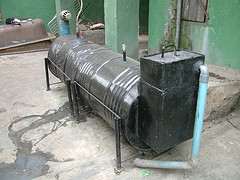
Biogas generatorEver since I read Ian McDonald’s River of Gods, I’ve looked at India from a futuristic, economically oriented perspective to understand how the lives of millions of Indians are being changed by technology.  While the cosmopolitan metropolisis of Dehli and Bombay have undergone enormous growth in the last centry, the more interesting changes have happenned among the rural populations.  Now, with natural gas prices at an all time high, India is turning to Nature, and the sacred cow for a wholly low-tech solution to their problem. The biogas generator looks set to be the tipping point for cheap, renewable energy for India’s villages. [image by 1village]

Quite simply, a biogas generator is a system that utlizes the gas byproduct of the anaerobic digestion of organic materials for heat and/or flame. These generators, like the one featured in the picture above use manure and organic waste materials to produce methane, which is piped from a central tank via pipes, and can be used by an entire village.

Visible Magnetic Fields

Magnetic fields are weird, something that’s invisible in and of itself, but nevertheless acts on the other objects. By way of visualising magnetic fields, some boffins from Semiconductor working at NASA Space Laboratory as “artists in residence” – Ruth Jarman and Joe Gerhardt – have created this incredible movie depicting magnetic fields:

There isn’t much explanation as to what this is – how abstract is the representation? From Semiconductor Films:

In Magnetic Movie, Semiconductor have taken the magnificent scientific visualisations of the sun and solar winds conducted at the Space Sciences Laboratory and Semiconducted them. Ruth Jarman and Joe Gerhardt of Semiconductor were artists-in-residence at SSL. Combining their in-house lab culture experience with formidable artistic instincts in sound, animation and programming, they have created a magnetic magnum opus in nuce, a tour de force of a massive invisible force brought down to human scale, and a “very most beautiful thing.”

Well it sure is pretty, but it would be nice if there were some details as to how the effect was created. It reminds me of the “fields” of the drones from Iain M Bank’s billiant Culture series, which use coloured “fields” to convey emotion and also as manipulators.

[story via technovelgy]