Category Archives: Blog

CERN brings supergrid internet to the world

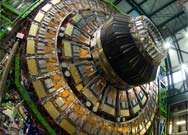
The CMS detector at CERN will process huge volumes of data every secondIn addition to searching for the ‘God’ particle that is the Higgs, CERN have been making a vast ‘supergrid’ to transfer the vast volumes of data created by the LHC supercollider every second to the universities studying it around the world (currently including myself). The sheer amount of data at the LHC – around 15 Petabytes a year – means a whole new system has been made to spread it to other institutions outside of the collider in Switzerland.

The grid still has some issues to work out but is showing signs of real potential to blow the current internet out of commission in a few years. The grid uses fibre-optic connections and high speed routers to transfer data. It could be as much as 10,000 times as fast as current broadband, allowing movie-sized files to transfer in seconds. Of course, this technology is currently only in use in the world of High Energy Particle Physics but, like the World Wide Web before it, what is invented at CERN tends to propagate out to the rest of us before too long.

[via The Times, image via CERN]

Dr. Michio Kaku: humans are almost Kardashev Type I

Science fictional city concept artOur sf-nal brothers-in-blog over at SF Signal have managed to score an interview with the occasionally controversial but always entertaining pop-science writer Dr. Michio Kaku.

The SF Signal gang ask Dr. Kaku a bunch of questions (including what he thinks about Mundane SF, believe it or not), but what I found most interesting was his response when asked whether humans stood a chance of becoming a Kardashev Type I civilisation:

“I see evidence of our historic transition from a Type 0 civilization to a Type I civilization. For example:

  • English is rapidly emerging as the most likely candidate for a planetary language.
  • The internet is an emerging Type I telephone system.
  • The EU, NAFTA, etc. are the seeds of a planetary economy.
  • A planetary culture is gradually emerging, based on youth culture (e.g. rock and roll, rap), fashion, movies.

But there is also a backlash against this historic transition. Anything this monumental is bound to create a counter force. These are the terrorists (who instinctively dislike a planetary civilization, which is necessarily multicultural, scientific, progressive, and tolerant). Also, we have the forces of chaos and destruction, such as nuclear proliferation and designer germs.”

So rock music is a sign of an advanced civilisation? I feel vindicated! 🙂

More seriously, it seems Dr. Kaku is cautiously optimistic about our progress so far – perhaps uniting in opposition to the “forces of chaos” will crystallise us into a Type I planetary civilisation?

That said, Karl Schroeder isn’t convinced by the Kardashev Scaleit’s inherently homocentric, meaning that what applies to us hairless monkeys is unlikely to apply to any other species. So perhaps we’re trying to classify the unclassifiable?

I love the smell of philosophy in the morning! [image by Shayan]

Could the credit crunch bring the end of globalisation?

I Can Haz Bailout?That’s one of the reasonings in a Guardian article today entitled ‘Toxic Shock: how the banking industry created a global crisis’. With policymakers unsure about what to do, many regulators are starting to get tougher with their requirements, which will make credit less abundant. As much as $1 Trillion dollars could have been lost in the crisis, and that number could rise. In the short term, it’s likely to lead to difficulties in loans. In the longer term, reregulation and tighter lending standards will change the shape of the world economy.

That’s not to say the economy is totally without worth at the moment. Wired’s latest issue has a series of 9 articles on positive business trends in 2008, including open source software and ‘Instapreneurs’ that make their products with virtually no lead time in a manner very much like in Futurismic’s April short story, ‘Mallory’ by Leonard Richardson.

[via the Guardian and Wired, photo from I Can Haz Cheezburger via Shiny Things]

Six-story tall giant robot? Yes, please

433545945_a040aa5016_m My roommate’s an interesting guy.  He’s into Gundam.  Like, room-filled-with-models into Gundam.  And he’s dragged me into his robot otaku world.  So I had to mention this project when it came up.  A roboticist from the Future Robotics Technology Center in Japan, Takayuki Furuta, has done cost-estimates of what it would take to build a full-size, functional Gundam robot.  Some impossible parts, namely the alloy Gundanium and solar furnaces, would be replaced by modern analogues, aluminum alloy and 7 Apache gas turbines, respectively.  The whole thing will cost roughly US$742 million, a small price for a giant robot, I suppose.  Furuta hopes to have a 4-meter version up and running by 2011, if I’m still nearby in 3 years, I might have to make a pilgrimage.

(via Matt Yglesias) (image from moogs)

The Pros and Cons of Resource Collapse

Coal-fired power stationWe’ve all heard about Peak Oil, but mineral hydrocarbons aren’t the only thing that could run out on us sooner than we think. The world is a complex place full of interrelated dependencies (a bit like a Linux install, come to think of it), and there are lots of other essential resources that, with a bit of bad luck, could dwindle or vanish very quickly. [image by The Tardigrade]

Jamais Cascio points out that resource collapse will be one of the most important driving forces of the near future – not just technologically but geopolitically, too:

“Resource collapse isn’t the cause of the rise of the post-hegemonic world, but it’s an important driver. It weakens the powerful, and opens up new niches of influence. It triggers conflict, setting the mighty against the mighty. It reveals vulnerabilities.

Most importantly, it sets up the conditions for the emergence of new models of power, as ultimately the most effective responses to resource collapse will come from revolutions in technology and socio-economic behavior. Those actors adopting the new successful models will find themselves disproportionately powerful.”

Adapt or die, basically. But what will Nation-States2.0 look like?