

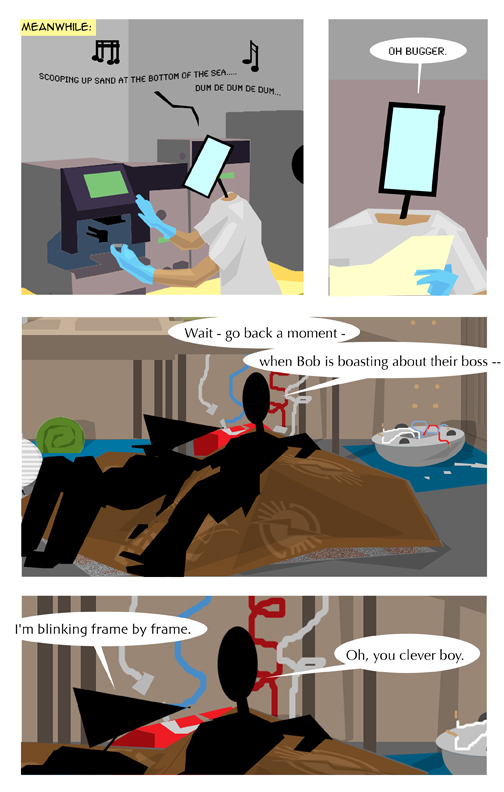
Personal Information is a new serial sci-fi webcomic from Sarah “Does Not Equal” Ennals.
Personal Information is a new serial sci-fi webcomic from Sarah “Does Not Equal” Ennals.
[ This is a guest post by Richard Galbraith. Richard got in touch to see if I’d like to review Concrete Operational here at Futurismic, and while I couldn’t promise a review for various reasons, I thought the project’s independence and mixed-media format might be of interest to regular readers, and offered him a turn at the podium. Feel free to ask questions in the comments! ]
 Concrete Operational is my novel; it’s an independent release funded by the Arts Council England. That statement itself raises two quick questions: why indie, and how did you convince the English Arts Council to give you thousands of pounds to publish it? Well, this is where my journey into independent publishing, collaborative media, design, filmmaking, music production, art manufacturing and a host of other things came to being. Continue reading Concrete Operational – Novel writing, art, music and independent publishing
New Scientist reports on psychotherapy in Second Life:
One of the first applications of avatar therapy was in treating social anxiety disorder, a crippling shyness that can confine people to their homes. James Herbert, head of the anxiety treatment and research programme at Drexel University in Philadelphia, Pennsylvania, was among the first wave of researchers to investigate avatar therapy. Encouragingly, clients generally rated the treatment highly, though there were exceptions. “Some patients and therapists reported frustration with not being able to see the individual’s face,” he says, and sometimes technical difficulties interrupted the sessions.
Avatar therapy has also helped people with phobias. In real life, the usual treatment is to gradually expose people to the source of their fear, but this can sometimes be difficult. An avatar therapist can introduce the phobia source while remaining in complete control, scaling the experience up or down according to the client’s reaction.
In fact, many of the conditions treated by face-to-face talk therapy can also be treated virtually, including depression and anxiety. Avatar therapy is proving useful for more diverse conditions too, such as traumatic brain injury, schizophrenia and Asperger’s syndrome.
Via Flowing Data, a text-books-and-data-visualization mash-up using augmented reality:
It’s very pretty, but – as pointed out at FD – not particularly useful; the physical book ends up as a very cumbersome interface for data that would be more easily and flexibly displayed as a fully computer-native medium from the get-go. But there’s a hint of promise in there, too; an idea waiting for its “killer app”, perhaps. Which is state-of-the-art AR in a nutshell.
Via BoingBoing, here’s a New York Times piece by Kevin Kelly, where he discusses what he learned about technology and education while homeschooling his son for a year:
… as technology floods the rest of our lives, one of the chief habits a student needs to acquire is technological literacy — and we made sure it was part of our curriculum. By technological literacy, I mean the latest in a series of proficiencies children should accumulate in school. Students begin with mastering the alphabet and numbers, then transition into critical thinking, logic and absorption of the scientific method. Technological literacy is something different: proficiency with the larger system of our invented world. It is close to an intuitive sense of how you add up, or parse, the manufactured realm. We don’t need expertise with every invention; that is not only impossible, it’s not very useful. Rather, we need to be literate in the complexities of technology in general, as if it were a second nature.
He goes on to add some more specific aphorism-style lessons – koans for a digital world, almost:
Some very sf-nal thinking in there… no surprise coming from Kelly, but even so, it reiterates something of Walter Russel Mead’s praise of the genre as the source of a useful way of looking at the world.
It’s also pleasing to see Kelly’s focus on trying to instil an appreciation of (and desire for) learning in his son. I’m far from the first person to observe that the UK education system has long favoured the retention of facts over independent analytical and critical thinking as educational goals, and I’ve seen plenty of reports that suggest the US system has a similar problem. Kelly’s aphorisms underline the point: if you make kids memorise facts, their education is obsolete as soon as it’s finished. Learning how to learn is the most important lesson of them all, and the one that seems hardest for schools and universities to deliver.