Street-level sousveillance tech

Internet serendipity strikes again… a Twitter friend mentioned their discovery of the word ‘sousveillance‘ the other day, and I remarked that I’d not mentioned it here at Futurismic for some time, despite it being one of my multitudinous minor obsessions. And lo, a few days later, two state-of-the-street-art sousveillance items crop up in my daily feed trawl*!

First up is the Lookxcie, a little head-mounted camera that stores the last thirty seconds of footage it captured at the press of a button [via Shira Lipkin‘s Google Buzz feed]:

Loop the Looxcie over your ear and go about your day. If you see anything you think may be worth saving, hit the button and the previous 30 seconds are saved, and even uploaded to your selected social networking site to be instantly shared, or you can watch and edit the video first if you prefer. And it stores up to five hours of video!

The Looxcie is a pretty cute little gizmo (and seemingly straight out of an early cyberpunk novel), but there’s an obvious flaw that renders it less useful in certain, ah, high-tension scenarios, let’s say. But other, more robust options are available: BoingBoing points to a column at Reason that covers smartphone apps that are ideal for videoing law enforcement and/or “freelance security” types who might subsequently arrest your device and make the footage disappear while it’s in their care:

Qik and UStream, two services available for both the iPhone and Android phones, allow instant online video streaming and archiving. Once you stop recording, the video is instantly saved online. Both services also allow you to send out a mass email or notice to your Twitter followers when you have posted a new video from your phone. Not only will your video of police misconduct be preserved, but so will the video of the police officer illegally confiscating your phone (assuming you continue recording until that point).

[ Just-in-time activism! ]

Neither Qik nor UStream market themselves for this purpose, and it probably would not make good business sense for them to do so, given the risk of angering law enforcement agencies and attracting attention from regulators. But it’s hard to overstate the power of streaming and off-site archiving. Prior to this technology, prosecutors and the courts nearly always deferred to the police narrative; now that narrative has to be consistent with independently recorded evidence. And as examples of police reports contradicted by video become increasingly common, a couple of things are likely to happen: Prosecutors and courts will be less inclined to uncritically accept police testimony, even in cases where there is no video, and bad cops will be deterred by the knowledge that their misconduct is apt to be recorded.

And to those who say that we shouldn’t feel the need to video the police, I respond with the tired and logically flawed aphorism that’s supposed to make us all feel better about ubiquitous closed-circuit surveillance: if they’ve done nothing wrong, then surely they have nothing to fear, right?

[ * Coincidence? Synchronicity? The Baader-Meinhof phenomenon? Your guess is as good as mine… ]

Techlepathy: decoding words from brain signals

Another piece slots in to the mind-machine interface puzzle: via George Dvorsky comes news that University of Utah neuroboffins have decoded individual words from embedded electrode scans of brain activity.

The University of Utah research team placed grids of tiny microelectrodes over speech centers in the brain of a volunteer with severe epileptic seizures. The man already had a craniotomy – temporary partial skull removal – so doctors could place larger, conventional electrodes to locate the source of his seizures and surgically stop them.

Using the experimental microelectrodes, the scientists recorded brain signals as the patient repeatedly read each of 10 words that might be useful to a paralyzed person: yes, no, hot, cold, hungry, thirsty, hello, goodbye, more and less.

Later, they tried figuring out which brain signals represented each of the 10 words. When they compared any two brain signals – such as those generated when the man said the words “yes” and “no” – they were able to distinguish brain signals for each word 76 percent to 90 percent of the time.

As always with this sort of story, though, it’s early days yet:

When they examined all 10 brain signal patterns at once, they were able to pick out the correct word any one signal represented only 28 percent to 48 percent of the time – better than chance (which would have been 10 percent) but not good enough for a device to translate a paralyzed person’s thoughts into words spoken by a computer.

“This is proof of concept,” Greger says, “We’ve proven these signals can tell you what the person is saying well above chance. But we need to be able to do more words with more accuracy before it is something a patient really might find useful.”

So you’ll have to wait a little longer for that comfy little skull-cap that’ll read your as-yet-unwritten novel straight out of your head (worse luck). But proof-of-concept’s better than nothing, especially for a technology that – even comparatively recently – was considered to be pure science fiction.

Help us out: which two Futurismic stories should we nominate for the Phoenix Pick Award?

Readers of Futurismic fiction, your assistance would be appreciated: Phoenix Pick are running a competition for original science fiction stories published online between July 2009 and June 2010, and we need your help to decide which two stories we should send in.

A bit of background, here: the Phoenix Pick Award is a new prize, exclusively for sf published online, and is unique in that the stories for consideration have to be submitted by the editors who originally published them, rather than by the authors themselves. The prize money for the winning story – guaranteed at a minimum of $US650, no less! – will be split between the story’s author and its publishing venue.

Now, each publishing venue can submit two stories from the eligibility period for consideration, and that’s where we need your help.

We obviously think all eleven stories we published between July 2009 and June 2010 are awesome, or we wouldn’t have published them (d’uh!), and picking favourites would be no fun at all. So I figure we call on you lot, the readers, and crowdsource the choices – what could be fairer than that?

So, here are all the eligible stories, so you can refresh your familiarity with them:

To nominate your two choices, please list them in order of preference (i.e. favourite, second favourite) in a comment below this post*. You’ve got until Sunday 10th October to make your choice; on that day, I’ll lock the comments, count ’em all up, and announce the two leading candidates to be put forward for the Award.

[ * I looked into using an embedded poll gizmo, but none of them really worked the way I wanted them to, and at least with comments made here I can check by IP address to be sure no one’s stuffing the ballot! ]

The in-jokes from way out

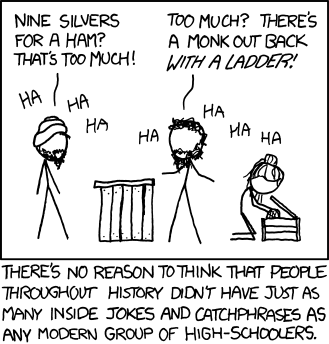
Today’s XKCD may not be one of the funniest ever, but as is often the way, it’s the not-so-funny ones that tend to get me thinking:

Inside joke - XKCD

And as always, it’s the mouseover text that gets to the real point:

I’ve looked through a few annotated versions of classic books, and it’s shocking how much of what’s in there is basically pop-culture references totally lost on us now.

Now, that’s a pretty ubiquitous aspect of popular culture he’s on about, but I think we can suggest that sf will suffer more strongly than regular mimetic novels from this problem when appraised by the readers of the future. Making sense of, say, Jane Austen’s work demands an understanding of the sociopolitical milieu in which it was written, but imagine trying to read Paolo Bacigalupi’s The Windup Girl a century from now (assuming, of course, that there’s still someone capable of reading it at that point). To fully grok the story and its commentary, the reader would need to understand not just the historical situation of the Noughties, but also the way the Noughties looked at the future, and (to a perhaps lesser extent) the way in which a work of sf tends to engage in a dialogue with its antecedents and contemporaries.

Of course, that’s partly true of almost any cultural sub-genre. And this here blog will read rather strangely in a century’s time, but (again assuming it’s still around to read, stuffed into a corner of a diamondite teracube in 2110’s equivalent of the Wayback Machine) there’d at least be the links there for context. But that assumes that the links aren’t dead either, of course… and that the reader would be bothered about checking that context. Hmmm. I seem to have just argued my way out of my own hypothesis; maybe Noughties sf in retrospect won’t look any weirder than any of its contemporary media. In fact, thinking about the music videos I’ve seen recently, it might get off quite lightly…

Even so, I quite fancy the job of knocking up hypertext Cliff’s Study Notes-style annotated versions of modern sf novels for the benefit of the cultural anthropologists of the near future… would anyone like to pay me to do that, please?

Related: Douglas Coupland pops in to the New York Times to coin some much-needed neologisms for the near future. I wonder if he has one for marginal book critics who portray popular post-modern authors as self-indulgent cynics?

Presenting the fact and fiction of tomorrow since 2001