How to be a futurist

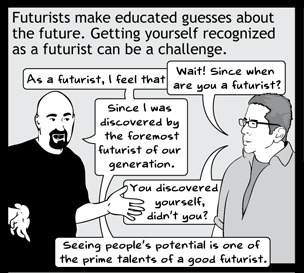
The irrepressible Scott “Basic Instructions” Meyer has the lowdown if you’re thinking of a career in futurism:

How To Be A Futurist - Basic Instructions

Click through for the whole thing. But take it from me, being a futurist is a lot of work for no money. Or maybe that’s just the way I do it… and I’ve never been featured in a world-famous pixelated webcomic, unlike another more notable futurist (late of this parish, and many others). I should have stuck to kitchen portering, I guess. Selah. 🙂

Geek sickness: can social rejection make you ill?

A UCLA experiment suggests that “social stress and rejection are related to the release of certain inflammatory chemicals in the body; these chemicals have been linked to several medical conditions, including asthma, arthritis, and some kinds of cancer. Ars Technica has the low-down:

In the study, a group of researchers recruited a bunch of students at UCLA and subjected them to socially stressful situations. The students were asked write a speech and then read it to a pair of evaluators, who then acted as if the speech were abhorrently subpar. After that, they had to perform mental arithmetic for a proctor who would appear impatient with them and urge them to go faster. A subset of the participants were also made to play a game of “Cyberball” with two other people, who were asked to socially exclude them.

Throughout these socially stressful experiences, researchers took mouth swabs of the students and monitored their activity in the dorsal anterior cingulate cortex, a part of the brain known to process rejection-related distress. (It’s possible that the swabbing added to the stress.) The two measures showed that greater activity in this area of the brain correlated with a rise in two inflammatory chemicals that are known to play a role in the onset or progress of conditions like rheumatoid arthritis, cardiovascular disease, depression, and various types of cancer.

Correlation is not causation, of course… or, as Ars more bluntly puts it, it’s unclear whether “being a nerd begets asthma, or if asthma begets a nerd”.

The Courage to Suck

It seems that the best thing that ever happened to Harper Lee as a writer was also the worst thing that ever happened to Harper Lee as a writer.

In 1956, Lee received a gift of a year’s wages from friends who told her to “write whatever you please.” Let’s take a moment now for intense jealousy. All done? OK, let’s see what happened next.

Sucked into a hole...

Continue reading The Courage to Suck

Anthologize: plugin exports WordPress blogs as ebooks

Here’s a heads-up for fellow webzine editors and publishers, fiction writers publishing their own work online, and other interested (or indeed interesting) parties: the Anthologize plugin for WordPress generates EPUB, PDF and “other mobile formats” from content stored on the blog in which it is installed. Dan Cohen, head of the team that produced it (in just a week, no less, using a funding grant from the Center for History and New Media at George Mason University) explains in a bit more detail:

[This plugin] converts the popular open-source WordPress system into a full-fledged book-production platform. Using Anthologize, you can take online content such as blogs, feeds, and images (and soon multimedia), and organize it, edit it, and export it into a variety of modern formats that will work on multiple devices. Have a poetry blog? Anthologize it into a nice-looking ePub ebook and distribute it to iPads the world over. A museum with an RSS feed of the best items from your collection? Anthologize it into a coffee table book. Have a group blog on a historical subject? Anthologize the best pieces quarterly into a print or e-journal, or archive it in TEI.

[…]

I suspect there will be many users and uses for Anthologize, and developers can extend the software to work in different environments and for different purposes. I see the tool as part of a wave of “reading 2.0″ software that I’ve come to rely on for packaging online content for long-form consumption and distribution, including the Readability browser plugin and Instapaper. This class of software is particularly important for the humanities, which remains very bookish, but it is broadly applicable. Anthologize is flexible enough to handle different genres of writing and content, opening up new possibilities for scholarly communication.

So, obviously intended for a userbase of humanities academics, but this could be a real kick-start for us fiction webzine types to start reaching out to the ereader audiences on a webzine budget*. All I need now is a few extra hours in every day of the week to investigate it further… *sigh*

Hopefully some smart people will retool it for some of the other open-source CMS platforms as well. I could very easily and quickly find a use for a ModX version….

[ Hat-tip to Alex “Xander” Ingram, Third Row Fandom’s in-house ebooks boffin. Big up yerself, Xander, and thanks for the notification. 🙂 ]

[ * Webzine budget (compound noun, colloquial) – (1): small change and used paperclips. ]
Counting down to Zero History

There’s a book called Zero History coming out soon, written by some guy called William Gibson…

Kinda surprised that the first place I saw this was at Wired… but then the Bigend trilogy (of which this is the third instalment) has rather conspicuously not been marketed as (or should that be to?) science fiction. Maybe the publishers figure all us geeks are gonna buy it anyway?

They may have a point. 🙂

Presenting the fact and fiction of tomorrow since 2001