Second Life Enterprise: virtual worlds behind the corporate firewall

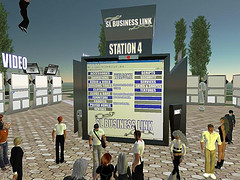
Second Life business link terminalHere’s an interesting development in the metaverse – Linden Lab, creators of Second Life, have announced the formal launch of their “Second Life Enterprise” platform, which is essentially a fragmented piece of the virtual world that runs on corporate servers behind the firewall. Private, hermetically-sealed virtual worlds, in other words. [image by Daneel Ariantho]

This is important for two reasons. First of all, it’s a major step in Linden Lab’s attempts to turn a decent profit from Second Life, which it has struggled to achieve with the free-to-use business model of the public version. If they can convince some big players of Second Life’s utility as a collaborative business tool, the subsequent inflow of money might enable them to step up the bug-hunt and fix some of the virtual world’s bigger flaws. IBM have been a presence in SL for some time, as have other big corporations (to whom we can now add the US Army’s Medical Research and Materiel Command branch, who are financing a “therapeutic space” for amputee veterans using SL Enterprise); the potential for the same tools in a more secure environment (e.g. devoid of flying penis barrages, for a start) may entice more money into Linden Lab’s coffers, and open up the field for competition from other virtual worlds. So now’s the time to set up a business making sharp business suits for executive avatars, I guess…

Secondly, the veil of privacy will doubtless encourage experimentation, and should lead to some new and weird ways of interacting with (and creating within) synthetic spaces. After all, you wouldn’t want to go developing your top-secret big-money idea in public where anyone could see (and copy) it, would you? Imagine for a moment that DARPA decided to set themselves up with an SL Enterprise installation… I’d pay a good big bribe to check out the crazy crap they’d have filled it with after a year or so of getting to grips with the interface, that’s for certain.

And, of course, one can’t help but be reminded of the abandoned corporate virtualities featured in William Gibson’s Bridge Trilogy, most particularly Idoru. Like the adandonware websites that already festoon the web, sat on some server somewhere, waiting for a rental agreement between two companies that no longer exist to expire, the metaverse could soon become a multimetaverse, with a few vast virtualities with public access and countless little bubbles of digital existence locked away behind firewalls and restrictive protocols. Urban exploration is a growing trend at the moment, but in a decade or so, the adventurous people will be cracking their way into abandoned corporate and gubernatorial realities to see what they can find lying around… and hell knows some of it will be more interesting than rusty old swivel chairs.

Transhuman equality? Athletes with a prosthesis do not have an unfair advantage

Remember all the fuss last year about Oscar ‘Bladerunner’ Pistorius, the amputee athlete who was banned from competing against able-bodied runners in the Olympics because the authorities were concerned that his prosthetics might give him an unfair advantage? Well, it turns out that the authorities guessed wrong – recent research suggests that, far from conferring a performance edge, Pistorius’ blades are more likely to be putting him at a disadvantage:

Simon Choppin, a sports engineer at Sheffield Hallam University, said the Pistorius controversy rested on whether his prosthetics increased the efficiency of his limbs, allowing him to achieve higher speeds for less effort.

“So, simply, you can move the prosthetic quicker and you’re ready for the next step faster than someone who has a leg,” said Choppin. Another possible advantage was that the prosthetics might allow the athlete to get back more of the energy they put into the track compared with able-bodied athletes. “But this [Grabowski] paper suggests you’re at a disadvantage if you’ve got one of these blades.”

We can hope that the competition authorities will look at research like this and allow transhuman athletes to compete alongside everyone else, at least until more advanced prosthetics confer a genuine and insuperable advantage (which is bound to happen eventually). But given competitive sport’s strong role in maintaining the mythology of the perfect conformist human body image – think back to the disgusting treatment of Caster Semenya, for example – I suspect they’ll find some other reason to keep the Olympics “pure” and “fair”.

Required reading: mapping the favela

favela housing, Rio de JanieroVia Chairman Bruce, here’s some required reading for anyone writing near-future fiction that involves a favela as a setting… and given the way the world is becoming urbanised, a near-future story that doesn’t feature a favela can probably be considered to have something missing from it! It’s an article from 2008 in the Harvard Design Magazine, titled “Resisting Representation: the Informal Geographies of Rio de Janiero“, and it’s well worth the half hour or so it’ll take you to read it. Here’s a brief sample:

Rio de Janeiro is a city with a population of just over six million in its central urban areas, of which, according to officials, an estimated 20% are residents of favelas. These favelas vary enormously in size and character. These urban islands, like those of the earth’s waters, have formed according to several genealogies and geologies. Some, like continental islands, share a history and underlying structure with those around them, as if they have collectively broken off from a land mass. Others, like volcanic islands, seem to develop independently and suddenly from more isolated and turbulent forces. Still other favelas, like coral atolls, build slowly on an underlying urban structure. These metaphors show how favelas differ in their relationship to their surroundings—their seemingly insular status belies the fact that submerged structures tie them to the city.

Read on for more details about the utilities and transport infrastructures that enable favelas to exist, and the socioeconomic pressures that ensure they keep growing and multiplying in spite of all attempts to curb the expansion. [image by anthony_goto]

And as an added bonus, here’s a game-changing technology to drop into your fictional favela – Contraptor is the name of both an organisation and the open-source rapid prototyping system it has designed and built. Like a more sturdy and diverse answer to the RepRap, in other words – an affordable way to put the means of production into the hands of pretty much anyone with a few hundred dollars and an internet connection [via Fabbaloo]. You’ve got your setting, you’ve got your novum – and you’ve got a thousand stories waiting to be written.

Rocket Boy and the Geek Girls – affordable e-anthology from Book View Cafe

Regular readers will be aware of my interest in new and experimental publishing models for niche authors… and with that in mind I’m very pleased to be able to pass on news of a new digital-only anthology from the Book View Cafe collective. So, with no further ado, here’s the skinny:

Book View Café, the Internet’s only professional author cooperative, announces the creation of Book View Press. Book View Press will expand the Café authors’ mission of bringing the best online fiction to the readers by bringing new work ready-to-read on the most popular ebook devices, including the Amazon Kindle, the Sony eReader and a variety of cell phones.

This group of award-winning and best-selling authors is launching their new press with its first science fiction anthology: ROCKET BOY AND THE GEEK GIRLS, a collection of rare reprints, hard-to-find favorites and bold new tales by some of SF’s finest authors including Vonda N. McIntyre, Katharine Kerr, Judith Tarr, P.R. Frost, Pati Nagle, Amy Sterling Casil, and Maya Kaathryn Bohnhoff.

Rocket Boy and the Geek Girls is available at  http://bit.ly/rgr4K for the Kindle version and http://www.bookviewcafe.com/index.php/BVC-eBookstore/ for other formats including pdf, mobi, prc, lit, lrf, epub.

To celebrate the launch of Rocket Boy, BVC is holding a TwitterFic contest. For details visit the contest page: http://www.bookviewcafe.com/index.php/News/BVC-Twitter-Fic-Contest-8-Celebrating-Book-View

For  more info contact: media.relations@bookviewcafe.com

“Fasten your seatbelts and brace your tentacles.  These all-star tales of epic wonder from the genre’s masters will sizzle through your mind like a spaceship on re-entry burn.”  –Dave Williams, author of The Burning Sky

Sounds like an interesting project, no? So go take a look, spread the word, maybe buy yourself a copy.

Sucking rats: Tarkus by Emerson, Lake and Palmer

The Adam Roberts Project

Ladies, gentlemen, permit me to present to you the stone cold weirdest SF music ever recorded: ELP’s 1971 magnum opus Tarkus. Interestingly, Tarkus backwards is Suk Rat, which must be more than a coincidence, because that’s precisely what the song “Tarkus” does. It sucks a rat. It sucks a rat’s balls. It sucks a futuristic cyborg rat’s balls. Continue reading Sucking rats: Tarkus by Emerson, Lake and Palmer →

Presenting the fact and fiction of tomorrow since 2001