Five lies writers believe about editors

Hey, fiction writers – ever wonder what really makes editors tick? Sure you do; you’d love to know what really happens to your story when you wing it off for consideration at a favourite magazine or website.

Well, you’re in luck – Jeremiah Tolbert, himself a writer but also currently submissions editor at Escape Pod, explodes five myths about the editorial process. Here’s the first:

  • LIE #1: Editors give every story fair consideration. OR: Editors reject stories without reading them at all.

The truth is, the slush is deep, and it’s rarely an editor’s favorite part of the job. Why do you think so many places have slush readers?

Every story doesn’t get fair consideration. Not every story deserves it. If you can’t be bothered to read the submission guidelines and follow them, it’s an easy rejection. If you have five grammar and spelling mistakes in the first two paragraphs, it’s an easy rejection. If it’s a story about vampires, and I hate vampire stories, it’s mostly an easy rejection.

Most stories get at least a page out of me. Then I skip to the last 3 paragraphs, if I’m feeling generous. Some get less. Some work is so obviously bad that it’s startlingly easy to know it’s not going to work. But every story gets looked at. Nothing ever gets rejected without being partially read. Honest.

All five are honest, pertinent, and pretty funny. Go read.

Friday Free Fiction for 8th May

The days are getting longer and brighter; it’ll be summer before we know what’s hit us. But at least the weekly rituals of life are there to keep us in some cyclic tradition of normalcy – rituals like rounding up big batches of free science fiction stories every Friday!

And as it’s a new month, there’s lots of new stuff from our fellow webzines, so get clicking…

***

A triptych at Manybooks:

***

And a bunch from Feedbooks:

***

New for May at Clarkesworld:

***

New stuff from Apex Online:

And as an added bonus, Open Your Eyes by Paul Jessup is being made available as a free PDF download for the remainder of May.

***

Subterranean Online presents:

***

Here’s episode 2.03 of Shadow Unit: “Sin Eater”

***

Jason Stoddard presents chapter 6.2 of Eternal Franchise

***

Tor.com presents “Last Son of Tomorrow” by Greg Van Eekhout

***

Strange Horizons presents “The Rising Waters” by Benjamin Crowell

***

COSMOS Magazine presents “Delivering Tomorrow, Today” by Robert Friedman

***

HUB Magazine #85 includes “Old Clothes” by Chris Cyr

***

A message from Chris Odhner:

My brother is publishing a new free short story *every day* for the next year.

Thanks, Chris!

***

A message from from Jake Freivald:

The latest edition of Flash Fiction Online is up. Two of our three new flashes are SF: “Jack Rabbit” by Isaac Espriu and “Billions of Stars” by KJ Kabza.

Cheers, Jake!

***

And thanks as always to SF Signal, without whose ubiquitous free-fictional panopticon we would have missed the following:

  • There’s a bunch of new additions to the Suvudu free library:
  • Fusion Fragment presents “For the Love of Ceelie” by Matthew Sanborn Smith
  • The New Yorker presents “The Slows” by Gail Hareven
  • The New Yorker has also published the JG Ballard story “The Autobiography of J.G.B.“
  • The Nautilus Engine‘s May 2009 issue includes fiction from Fabio Fernandes, LL Wise, Daniel Stiles, KM Rockwood, Violet Hilton, Jason L Corner, JD Riso, Mimi Vaquer, and Heath Lowrance
  • Episode #22 of Contagious by Scott Sigler is available for download in PDF and MP3 formats.
  • The latest issue of Aphelion includes fiction by T Richard Williams, Jon Wesick, Joel Realubit, Roderick D Turner, Terry Larson, E S Strout, Ed Barol, Joseph T Christopher, Mary Kiorden Hayden, Tyler Hardin, Philip Roberts, Ken Kraus, and Dan Edelman

***

And finally Sumit Dam steps in with some Friday Flash: “The Reunion”

***

And that’s your lot! Don’t forget to drop us a line about anything you think warrants inclusion in a future Friday Free Fiction; in the meantime, have a great weekend!

A drug to help recover "lost" memories?

492px-Frederick_Leighton_-_MemoriesBack in 2007, researchers at MIT’s Picower Institute for Learning and Memory in Cambridge, Massachusetts, discovered that mice with symptoms of Alzheimer’s disease regained long-term memories and the ability to learn when treated with a new type of experimental drug called a histone deacetylase (HDAC) inhibitor.

Now that same team, led by Li-Huei Tsai, Picower Professor of Neuroscience, has pinpointed the gene involved. It’s called HDAC2. (Via EurekAlert.)

“This gene and its protein are promising targets for treating memory impairment,” Tsai said. “HDAC2 regulates the expression of a plethora of genes implicated in plasticity — the brain’s ability to change in response to experience — and memory formation.

“It brings about long-lasting changes in how other genes are expressed, which is probably necessary to increase numbers of synapses and restructure neural circuits, thereby enhancing memory,” she said.

The researchers treated mice with Alzheimer’s-like symptoms using histone deacetylase (HDAC) inhibitors. HDACs are a family of 11 enzymes that seem to act as master regulators of gene expression. Drugs that inhibit HDACs are in experimental stages and are not available by prescription for use for Alzheimer’s.

As noted in the excerpt from white sands, HDAC inhibitors are experimental and not yet available by prescription for use for Alzheimer’s (they’re actually being tested in pre-clinical studies to treat Huntington’s disease, and some are already on the market to treat certain forms of cancer–they help chemotherapy drugs better reach their targets), but now that a specific target has been identified, more potent and safe drugs can be developed…which is what Tsai and her team will be focusing on next.

Of course, the focus is entirely medical at the moment, but if, as Tsai notes,

The fact that long-term memories can be recovered by elevated histone acetylation supports the idea that apparent memory “loss” is really a reflection of inaccessible memories

then this also raises the intriguing possibility of memory enhancement drugs for non-medical purposes…law enforcement, entertainment, remembering a loved one…heck, even an actor returning to a role he hasn’t played in 20 years could benefit from a drug that helps access “lost” memories.

Hmmm. On the other hand, aren’t there things you really don’t want to remember? What if the drug forced everything you thought safely buried into the light?

There’s an SF story in there somewhere…

(Image: Memories by Frederick Leighton, via Wikimedia Commons.)

[tags]memory,drugs,medicine,pharmaceuticals,brain,Alzheimer’s[/tags]

Does Asimov’s Foundation trilogy hold wisdom about the current crisis?

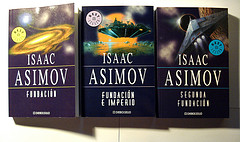
Asimov's Foundation Trilogy in SpanishMartin Börjesson has just been re-reading Asimov’s famous Foundation Trilogy, and found himself wondering whether the books are any use as a way of reframing the current global situation with regard to economics and geopolitics.

Here it is worth noting that the main inspiration too this novel, which started as a series of short stories by a 22 year old Asimov, published from 1942 and forward, came from Gibbon’s famous work “The History of the Decline and Fall of the Roman Empire”. When I see it in this perspective I can’t avoid thinking of the role of the monasteries which worked as knowledge capsules during the dark ages.

What does Dr Seldon say about what causes the fall of the Empire:

  • a rising bureaucracy
  • a receding initiative
  • a freezing of caste
  • a damming of curiosity
  • …a hundred other factors

And the effects will be:

  • its accumulated knowledge will decay
  • the order it has imposed will vanish
  • interstellar wars will be endless
  • interstellar trade will decay
  • population will decline
  • worlds will lose touch with the main body of the Galaxy
  • …and so matters will remain

Do these bullets sound familiar?

Well, of course they do; the ways that big systems collapse are well-known to historians and science fiction writers alike; it’s the political types and economists who seem to have the wilful blind spot in this case.

Can books like Foundation help us see things more clearly? Sure – if you’re the sort of person who’s willing to look for those analogies and think them through for yourself. As a tool to bring the message to the masses, though, I doubt they’re of any greater utility than a celebrity cook-book. [image by draXus]

Murdoch and the paywalls – charging for online tabloids

Oooh boy, I’m revving up my schadenfreude engines now, I tell ya. Rupert Murdoch, global tabloid media mogul, has seen the future of internet news – and it’s hidden behind paywalls.

Encouraged by booming online subscription revenues at the Wall Street Journal, the billionaire media mogul last night said that papers were going through an “epochal” debate over whether to charge. “That it is possible to charge for content on the web is obvious from the Wall Street Journal’s experience,” he said.

Asked whether he envisaged fees at his British papers such as the Times, the Sunday Times, the Sun and the News of the World, he replied: “We’re absolutely looking at that.” Taking questions on a conference call with reporters and analysts, he said that moves could begin “within the next 12 months‚” adding: “The current days of the internet will soon be over.”

“The current days of the internet will soon be over?” At least we now know where the tautological house style of Murdoch’s papers originates from… and, y’know, people pay for the Wall Street Journal because it actually contains some factual reporting and informed opinion pertinent to their careers or investments; I really don’t think people read The Sun for the same reason.

But please, Mr Murdoch, do go ahead with this bold entrepreneurial move. Anything that reduces the amount of crap your media empire spews into people’s eyes (and that hastens your potential destitution and bankruptcy – financial rather than moral, of course) is absolutely fine in my book.

Presenting the fact and fiction of tomorrow since 2001