Laughter and error-correction mechanisms

lightCarlo Strenger has written a good article on enlightenment values on Comment is Free:

…the Enlightenment has created an idea of immense importance: no human belief is above criticism, and no authority is infallible; no worldview can claim ultimate validity. Hence unbridled fanaticism is the ultimate human vice, responsible for more suffering than any other.
…
it applies to the ideas of the Enlightenment, too. They should not be above criticism, either. History shows that Enlightenment values can indeed be perverted into fanatical belief systems. Just think of the Dr Strangeloves of past US administrations who were willing to wipe humanity off the face of the earth in the name of freedom, and the – less dramatic but no less dismaying – tendency of the Cheneys and Rumsfelds of the GW Bush administration to trample human rights in the name of democracy.

As one of the commenters points out, the profound principle has been ignored by both 20th century secular ideologues, religious authorities, and more recent fanatics, is that of always bearing in mind the possibility you might be dead wrong.

The healthy human response to harmless error or misunderstanding is to have a laugh. Thus error is highlighted for all to see and forgiven by all parties. As Strenger puts it:

At its best, enlightenment creates the capacity for irony and a sense of humour; it enables us to look at all human forms of life from a vantage point of solidarity.

A further mistake on the part of humorless fanatics everywhere is to assume that there can ever be one, and only one, eternal truth. It may be that such a thing exists, but it is likely to be beyond our capacity to discern its true form from the vague shadows on the walls of our cave.

And so human beings are prone to error. There’s no problem with this, as failure teaches us more than success.

This notion was articulated by Karl Popper in the 20th century: it is the idea that you can never conclusively prove that an idea is correct, but conclusively disprove an incorrect idea.

And so human knowledge grows and the enterprise of civilization advances, one laughter-inducing blooper at a time.

[image from chantrybee on flickr]

DARPA flirting with transhumanism?

neuronsIt shouldn’t come as any great surprise, I guess; it’s not like DARPA doesn’t routinely churn out ideas with more than a tinge of the science fictional about them. But according to Wired’s DangerRoom blog, everyone’s favourite Pentagon agency has decided to investigate the human brain in the same reductionist/physicalist terms that transhumanist thinkers use to discuss the potential of mind uploading and simulation:
The idea behind Darpa’s latest venture, called “Physical Intelligence” (PI) is to prove, mathematically, that the human mind is nothing more than parts and energy. In other words, all brain activities — reasoning, emoting, processing sights and smells — derive from physical mechanisms at work, acting according to the principles of “thermodynamics in open systems.” Thermodynamics is founded on the conversion of energy into work and heat within a system (which could be anything from a test-tube solution to a planet). The processes can be summed up in formalized equations and laws, which are then used to describe how systems react to changes in their surroundings.

Now, the military wants a new equation: one that explains the human mind as a thermodynamic system. Once that’s done, they’re asking for “abiotic, self-organizing electronic and chemical systems” that display the PI principles. More than just computers that think, Darpa wants to re-envision how thought works — and then design computers whose thought processes are governed by the same laws as our own.

As pointed out, that’s a pretty tall order – even for DARPA, the world leader in tall orders. But if there’s one thing they’re good at, it’s throwing money and expertise at otherwise intractable problems… and in a young field of research like this one, there’s as much to be learned from failure as success. [image by LoreleiRanveig]

And there’s an added bonus – the tinfoil hat crowd have got a nice new conspiracy to gnaw on.

Software and sentiments – language as battlefield

I consider myself pretty fortunate in that I don’t have to moderate the comments here at Futurismic with a heavy hand[1], but that’s down to matters of scale; there just aren’t enough active commenters here to allow severe flamewars to start, but moderating the discussion on a site like BoingBoing is a different matter entirely, and usually requires a layer of direct human interaction after thecommon-or-garden \/1/\9|2/\ spambots have been weeded out.

Those days may be nearing an end, however; New Scientist reports on a new breed of software agent that is programmed to analyse the tone and sentiment of written communication on the web:

The early adopters of these tools are the owners of big brand names in a world where company reputations are affected by customer blogs as much as advertising campaigns. A small but growing group of firms is developing tools that can trawl blogs and online comments, gauging the emotional responses brought about by the company or its products.

[…]

The abusive “flame wars” that plague online discussions are encouraged by the way human psychology plays out over the web, as we’ve explained before. Moderating such discussions can be a time-consuming job, needing much judgment to spot when a heated exchange crosses over into abuse.

Sentiment-aware software can help here too. One example is Adaptive Semantics’ JuLiA – a software agent based on a learning algorithm that has been trained to recognise abusive comments. “She” can take down or quarantine comments that cross a predetermined abuse threshold […]

Work is underway to expand JuLiA’s comprehension abilities – for example, to decide whether text is intelligent, sarcastic, or political in tone.

That’s all well and good, and it’ll probably work for a while – but much like anything else, it’ll be seen as a challenge to exactly the sort of people it’s designed to filter, and we’ll have another software arms race on our hands – albeit one initially played for much lower stakes than the virus/anti-virus game.

But look here a moment:

Another firm, Lexalytics, uses sentiment analysis to influence what people say before it is too late. It can identify which “good news” messages from company executives have the greatest effect on stock price. These results can then be used to advise certain people to speak out more, or less, often, or to gauge the likely effectiveness of a planned release.

Now there’s a double-edged sword; if you can use that analysis to protect and strengthen a stock price, someone can surely use it for exactly the opposite. And even beyond the battlefields of the trading floors and corporate boardrooms, there are plenty of folk who could find a use for software that could advise them on how to make their communications less offensive or incendiary… or more so, if the situation demanded it.

We live in the communication age, so I guess it’s inevitable that communication should become another new frontier for warfare… but look at the bright side: slam poetry contests are going to become a lot more interesting for spectators and participants alike. 😉

[ 1 – That’s not a challenge or a complaint, OK? Thanks. 🙂 ]

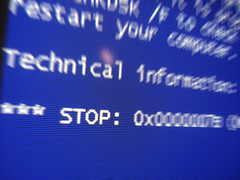
Botnet blue-screens 100,000 PCs

Ye olde Blue Screen of DeathUsually, it’s in the best interests of a botnet operator to let the infection sit on the host machine until finally detected and expunged by the end user. After all, the longer you stay in, the more chance you’ve got of hoovering up useful goodies and infecting other computers.
But the worms and trojans that carry the infections often have less subtle capabilities built into them, as was demonstrated last month when the person (or persons) controlling the Zeus botnet used it to completely FuXx0r a hundred thousand windows machines:

Zeus, unlike many other malware programs, managed to make each installation appear different to virus trackers so that it would be more difficult to remove. But Zeus had another interesting feature—one that isn’t terribly uncommon among botnet software, it turns out. A command was built into the software to kos—or “kill operating system”—and it was apparently executed some time last month.

The reason for BSODing 100,000 machines isn’t quite clear, but several security experts have offered up their opinions. S21sec wrote on its blog that those behind Zeus might have wanted more time to exploit the financial data they had harvested by removing the user’s ability to get online and see that money was being transferred.

It may even have been a momentary error, or a flashy cut-and-run. What interests me about this story is that it shows a new potential angle for so-called cyberwarfare – one that could be more easily justified as a politically motivated attack.

Let’s say you could target all the computers belonging to a specific government or corporation; that wouldn’t be too hard to do with a little research into IP numbers and so forth. If you get a good enough infection rate – and knowing how weak most computer security procedures are, even in organisations that should know better, that shouldn’t be too hard a trick either – you could then choose to deep six that organisation’s computer infrastructure at a time of your choosing with the press of a few keys. If your trojan was designed to do nothing else, or its other capabilities were left inactive, that potential could sit unnoticed for some time – until your revolution was ready, perhaps, or your planned day of protest actions, or your stock value raid. To put it in medieval terms, it would be like having a bunch of sleeper-agent sappers spread throughout your enemy’s castle, waiting for the horns of Jericho. [image by Justin Marty]

It’s probably not the sort of thing that an organisation or country with any reasonable military clout would bother deploying, but destructive botnet warfare (as opposed to corrosive attacks, fraud or espionage) will appeal to the geographically-scattered groups who lack the sort of conventional leverage that can be gathered in one place; 100,000 dead PCs won’t bring down a government or kill a company, but it’s going to make a loud and expensive statement for a very small financial outlay.

Botnets still seem predominantly the concern of criminals with a financial motivation, but as the recent Palestinian conflict demonstrated, political factions are waking up to the potentials; when the situationists and anarchists get wind of this stuff, they might start thinking bigger than smashing bank windows or releasing the penguins from your local zoo.

Presenting the fact and fiction of tomorrow since 2001