
Biofueled car might have been a senseless waste of chocolate

chocolate-carIt’s not quite the “chocolate-fueled car” that the headline from the indispensable PhysOrg.com promises. What we have instead may be close enough — a car its makers claim can reach 145 miles per hour,

powered by waste from chocolate factories and made partly from plant fibers….

The steering wheel is made out of plant-based fibers derived from carrots and other root vegetables, and the seat is built of flax fibre and soybean oil foam. The body is also made of plant fibers….

Scientists at the University of Warwick say their car is the fastest to run on biofuels and also be made from biodegradable materials. It has been built to Formula 3 specifications about the car’s size, weight, and performance.

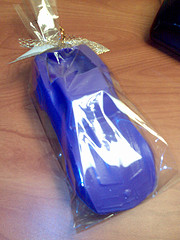
[Image: Never Eat Purple Chocolate by i’m george]

Why hasn’t mobile banking spread out from Africa?

Kenyan woman with mobile phoneIf there’s been one good thing to come out of the global financial shitstorm, it’s that all of a sudden we’re looking afresh at established institutions and questioning whether, actually, there aren’t much better ways we could be doing things.

Point in case: mobile peer-to-peer banking, which is going gangbusters in parts of Africa but has yet to make much of a splash beyond that continent. The Guardian‘s Victor Keegan takes a closer look, and wonders whether it might be the key to saving the UK’s continually beleagured, semi-nationalised and utterly mismanaged postal service:

If you want to see pioneering experiments in banking you will have to go to a surprising place – Africa. And the question is, why can’t we do the same here? If the Post Office is looking for a new role, it need look no farther. In Kenya, customers of M-Pesa can send money to each other from around the country in 14 seconds flat using their mobiles. In the UK it takes three days, thereby endowing the banks with a huge float of money in transit on which they can earn interest. In Kenya, people leave their money at a trusted outlet such as a shop or pharmacy, where it is loaded into their sim cards.

At a Forum Oxford future technologies conference at the weekend we were updated on the startling success of the operation. It is reckoned that 17% of the Kenyan population is on M-Pesa. As a result they don’t need to carry cash any more, as everything from a can of Coke to your funeral can be paid for by phone. It works because the cash is held centrally by the bank, thereby enabling transactions to take place at very fast speeds. The average transaction is $30 (£20) because people trust it to do big ticket items.

Of course, there is always PayPal (which offers a mobile-linked transfer system as well), but finding a business that will accept PayPal that isn’t internet based is a big challenge. So, why hasn’t the idea caught on in more developed nations? [image by whiteafrican]

Maybe it is because we are not used to the idea of technology transfer coming from poorer to richer nations that industrialised nations have been so slow to realise not only that Africa is leading the world in mobile banking, but that it has big lessons for us.

Call me cynical (O RLY?), but I suspect it has a lot more to do with the fact that banks have no need to sell their services to us in a manner that emphasises our convenience, because our lives are so inextricably entangled in their profit generation systems already. Just like a drug dealer, they like to keep you waiting so as to remind you whose bitch you are…

Culture is carried by DNA?

pair of Australian zebra finchesIt sometimes feels like you can’t go two weeks without some new aspect of human life or behaviour being declared as being related to our DNA. The latest attempted conquest of genetic determinism? Why, our very culture itself!

You see, male zebra finches usually learn their courtship song patterns from their fathers, but it turns out they can generate the same songs spontaneously after a few generations without influence:

“It’s the classic ‘chicken and the egg’ puzzle,” Mitra said. “Learning may explain how the son copies its father’s song, but it doesn’t explain the origin of the father’s song.”

Mitra’s team wanted to find out what would happen if an isolated bird raised his own colony. As expected, birds raised in soundproof boxes grew up to sing cacophonous songs.

But then scientists let the isolated birds give voice lessons to a new round of hatchlings. They found that the young males imitated the songs — but they tweaked them slightly, bringing the structure closer to that of songs sung in the wild. When these birds grew up and became tutors, their pupils’ song continue to conform, with tweaks.

After three to four generations, the teachers were producing strapping young finches that belted out normal-sounding songs.

Uhm. Well, if you’re thinking that seems a little tenuous, you’re not alone:

Mitra admits that the analogies between bird culture and human culture are tenuous. “But there are resemblances. Culture is just learned behaviors. The motivating scenario is, if you isolate human babies from culture, put them on an island and come back after a few generations, what would their culture be like? What sort of language would they have? What sort of politics would evolve?”

That experiment probably won’t take place in the near future. In the meantime, Fitch says we can learn valuable lessons about human culture from songbirds, both at theoretical and mechanistic levels.

“Social learning is shared between the two, and songbirds are a well-understood and experimentally tractable system,” he said. “These biologically-grounded studies will lead us beyond the tired ‘nature versus nurture’ or ‘biology versus culture’ dichotomies which dominate the social sciences today.”

With the caveat that I’m not a geneticist or behavioural scientist, I don’t really see how birdsong and human politics are supposed to be different expressions of the same thing; the former is a biological imperative, while the latter is an emergent phenomenon. As Brian Eno once said, “culture is everything we don’t have to do”; a zebra finch that doesn’t sing sweetly won’t pass on its DNA, making its songcraft a matter of reproductive necessity, but I don’t think you can declare the same thing about, say, a great human painter or poet or politician.

That said, I’m all for getting beyond the nature/nurture dichotomy – knowing how culture emerges from biology is one of the most tempting grails of knowledge I can imagine. But in the same way that everything from alcoholism to sexuality seems to be blithely written off as being primarily a function of our genetic code, declaring such a nebulous and complex phenomenon as human culture to be passed along by DNA on the basis of some songbird studies seems… well, it seems pretty daft, really.

If there’s someone in the audience who can set me straight on this subject, I’d be very glad for them to speak up and tell me where my reasoning is wrong, but this story seems to me like just another instalment in our ongoing fetish with genetics as the key to all unsolved mysteries. [image by Lip Kee]
My book is out, and I’m giving it away–the sequel!

Terra Insegura resized Paul recently accused me of being too modest to promote myself here on Futurismic, but this should prove him wrong!

My latest science fiction novel, Terra Insegura, is out from DAW Books tomorrow, and to promote it, I’m running a month-long giveaway at my blog (details here). You’re welcome to enter over there, but as I did last year for Marseguro, I’m also offering a special for Futurismic readers only.

Email me at edward(at)edwardwillett.com and put “Futurismic contest” in the subject line, and I’ll enter you in a Futurismic-only draw. The first name drawn receives a copy of Terra Insegura, and the second name drawn a copy of last year’s Aurora Award-nominated Marseguro. (I’ll only ask for mailing information from the winners after they win, and don’t worry: I’ll ship anywhere in the world.)

I’ll keep this draw open for two weeks, closing it at midnight GMT on Sunday, May 17.

And just a reminder: you can read the first two chapters of the book and/or listen to me read them on my website.

We now return you to your regular Futurismic programming.

(Image: Cover art by Stephan Martiniere.)

[tags]Edward Willett,science fiction, books, novels, contests[/tags]

RepRap creates circuits

just-finishedA moment of history. The RepRap project has created circuits for the first time:

Ed and I have a final-year student – Rhys Jones – who’s working on RepRap for his MEng research project. He’s been taking the old idea of depositing metal in channels and an observation of Forrest’s and Nophead’s (that you don’t need a low-melting-point alloy because the specific heat of metals is so low that they shouldn’t melt the plastic anyway).

Also worth a look: Bruce Sterling points to Darwinian Marxism as a means of ensuring the proletariat gain possession of the means of production sans revolution.

[via the Yorkshire Ranter][image from the Reprap blog]

Presenting the fact and fiction of tomorrow since 2001