by HAL MOUNTSAUERKRAUTEN, Alternate Reality News Service Court Writer
[ This is a guest broadcast from the Alternate Reality News Service. ]
The usually sedate courtroom of Justice Roberta Padwihller erupted yesterday when the star witness in the Macy Maroon murder trial took the stand: the undershirt of Jason Modeska, the man accused of Maroon’s murder.
The protesters, who oppose the idea of smart clothing giving testimony in a criminal case, unfurled a banner that read “Time for clothing to come clean!” while chanting “No shirt! No shoes! No justice!” After several calls for order, Justice Padwihller was forced to clear the court before the trial could resume.
Before the undershirt could be sworn in on a DOS operating manual, defense attorney Marthew Stimson once again raised the objection that it was inappropriate for a piece of clothing, no matter how smart, to be called as a witness in a capital crime. A visibly annoyed Justice Padwihller repeated her ruling that The Province of Ontario v. Hermann P. Grunwald, in which a man’s cufflinks were allowed to give evidence in a fraud trial, was sufficient precedent, and ordered Crown Attorney Michael Michlingburg to proceed.
The undershirt, known in court by the alias John Clothes in order to protect its identity, started its testimony by explaining that it hadn’t originally planned on being an RCMP informer, that it was just hoping to be bought
by some “hard-working regular Joe. You know, a nine to fiver who goes bowling with his buddies on the weekend, drinks just a little more than he should and loves his wife, but will look at other women from time to time.”
At first, the undershirt thought Modeska was that man. It soon became apparent that he drank too much, however, and had a gambling problem. When Modeska agreed to murder Macy Maroon in return for his debt being erased by his bookie, the undershirt claimed it couldn’t believe its auditory sensors. It wasn’t until after the murder took place that the undershirt, realizing the seriousness of what had happened, used its WiFi connection to contact the RCMP.
Some court watchers believe the defense will argue that the admission that it knew of the murder plot in advance makes the undershirt an accessory to the crime, and that it agreed to testify against Modeska in order to get easier treatment from the court. Others believe that this approach entails a substantial risk: if the defense accepts the free will of the undershirt in this way, it could actually strengthen the garment’s testimony.
The undershirt claimed that its story would be corroborated by the shirt, jacket and pants Modeska was wearing the night of the murder. Unfortunately, they have disappeared; foul play is suspected. The socks Modeska wore that evening are not on the Crown’s list of witnesses, possibly owing to the fact that they tell conflicting stories: while the right sock corroborates the undershirt’s story, the left sock insists that Modeska was at home sleeping at the time he was alleged to have committed the murder.
Another of the Crown’s witnesses, the washing machine in which Modeska is alleged to have cleaned the blood off of his clothes after the murder, is set to testify some time next week. The defense has indicated that it is planning on arguing, however, that the washing machine did not analyze the dirt it cleaned off the clothing, so it cannot say for certain that it was blood – not strawberry jam – and that there was nothing unusual about Modeska cleaning his clothes since Thursday is his regular laundry day.
Igor Lipitinsky, CEO of Future Outfitters, the company that makes smart clothing, including John Clothes, was thrilled by his undershirt’s testimony.
“Our original intention was to use nanotechnology to create smart clothes that could be companions, friends, if you will, to the people who were wearing them,” Lipitinsky stated. “It never occurred to us that our clothes could actually develop a conscience, could actually take their civic duty so seriously.
“I… I’m just so darn proud!”
Lipitinsky did allow that Future Outfitters has benefited from the publicity the trial has given the company; enquiries from potential customers have skyrocketed, he claimed. Market watchers are more skeptical, pointing out that anybody with a secret – from cheating spouses to people who cannot stay on their diets – will not want to wear clothing that could potentially rat them out.
The trial continues, with cross-examination of the undershirt expected to start next Tuesday.
Excerpted from Alternate Reality Ain’t What It Used To Be. Copyright 2008 by Ira Nayman.
Print versions of Alternate Reality Ain’t What It Used To Be can be purchased through Amazon.com and major bookstores. A complete digital version of the book (except for the amazing cover – sigh) can be found on the Web site Les Pages aux Folles, which also features three new Alternate Reality News Service stories every third week.
The Alternate Reality News Service: “If you don’t like this reality, try another one!”
 In case you missed Kim Stanley Robinson‘s appearance in Second Life, you can hear the man himself being interviewed by fellow writer James Patrick Kelly on a special episode of Mur Lafferty’s I Should Be Writing podcast.
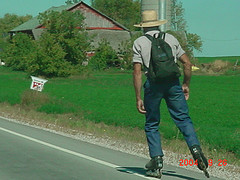 Thanks to movie clichés, we all know that the Amish eschew technological advances in favour of a minimalist pastoral lifestyle of horse-drawn buggies and water mills. But as with many of clichés, there’s a lot of falsehoods clustered around a grain of truth.
 Remember we mentioned late last year that
  Last year Australian doctors wrote up a case of