The small world in our hands

wirelessmicrScientists at John Hopkins University, Maryland have developed minute hands that can grasp tiny pieces of tissue when exposed to particular chemicals:

The researchers describe development of tiny metallic microgrippers shaped like a hand that work without electricity. The grippers are about 0.03 inches wide when open — smaller than the diameter of a grain of sand and made from a gold-coated nickel “palm” joined by six pointy metallic “fingers.”

The addition of certain chemicals triggers the hands to open or close. In laboratory studies, the scientists demonstrated that the grippers could grasp and release tiny pipes and glass beads and transport these objects to distant locations with the aid of a magnet, showcasing their potential for pick-and-place operations that are ubiquitous in manufacturing, they say.

The field is apparently called Micro-Chemo-Mechanical-Systems (MCMS) and along with Micro-Electro-Mechanical-Systems (MEMS) is set to have a major impact over the next several decades, particularly in the realm of health and medicine:

…the untethered grippers devised by Gracias’ team contain gold-plated nickel, allowing them to be steered by magnets outside the body. “With this method, we were able to remotely move the microgrippers a relatively long distance over tissue without getting stuck, he said. “Additionally, the microgrippers are triggered to close and extricate cells from tissue when exposed to certain biochemicals or biologically relevant temperatures.”

[from Physorg][image from the Physorg article][also check out the paper for more technical details]
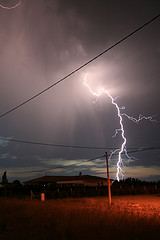
Exhaust fumes are lightning magnets

rural lightning strikeChalk another item up on the list of environmental effects caused by car exhaust fumes – they increase the likelihood of lightning strikes.

“In the south-eastern states [of the US], lightning strikes increased with pollution by as much as 25 per cent during the working week. The moist, muggy air in this region creates low-lying clouds with plenty of space to rise and generate the charge needed for an afternoon thunderstorm.

Surprisingly, the effect was not strongest within big cities with high pollution, but in the suburbs and rural areas surrounding them… “

Now there’s a tenuous techno-thriller plot device just waiting to be used… I wonder if a big enough car-generated lightning storm could deflect an incoming NEO? Call Bruce Willis! [story via BLDGBLOG; image by M0i et c’est tout]

NEOs: Near Earth Objects, or Nasty Existential Obliteration

meteorite impact sculptureHere’s something else that, alongside finding we have living neighbours on the planet next door, might give the space programs of the world a much needed kick in the backside. President-Elect, take note of the large number of Near Earth Objects, and our current inability to track them all effectively, let alone deal effectively with one on a collision course:

The numbers here are stark. NASA’s Near Earth Object Program reports that we’ve found 5,955 NEOs, some 763 of which are at least one kilometer in diameter. 1008 NEOs larger than 140 meters across come within 4.5 million miles of Earth’s orbit, dangerous to us because perturbing influences could change their trajectories in the future. Centauri Dreams believes that the discovery of an object on a collision course with Earth would galvanize the space program as researchers looked for the best ways to deflect its path. The problem is time.

As existential risks go, a meteor strike is rather different to the others – statistically less likely to happen (or so we hope), but fast and utterly devastating of it does. Keep watching the skies, people… [image by larkspurlazuli]

How to Communicate More Effectively, Part 7 – Bringing it All Together

[How to Communicate More Effectively is a series of guest posts from Gareth L Powell. In case you missed ’em, here’s part 1, part 2, part 3, part 4, part 5 and part 6.]

As writers, bloggers, editors and publishers, we’re in the business of communication. Over the last week, I’ve outlined one strategy you might use to get your message across to your audience. There are other methods, and I suggest you check out as many as possible, which is why I’ve included a list of reference books at the end of this post.

I hope you’ve enjoyed this guide. Personally, I’ve found the discipline necessary to write good marketing copy has helped me in my creative writing endeavours.

In summary, some final advice for you:

  • Know your audience and write for them.
  • Start with a killer title that they can’t resist
  • Hook them in with the first sentence and don’t let them go.
  • Get them emotionally involved as soon as possible. Make it personal. Give them a reason to care.
  • Use as many short sentences as possible to create pace.
  • Use evocative words that conjure impressions in all five senses – smell, taste, touch, sound, and sight.
  • Avoid clichés.
  • Use positive, action-packed phrases to make your prose come alive.

In these times of dwindling magazine subscriptions and slumping book sales, we need to use every tool we can in order to attract and retain our readership. If we put a fraction of the care and attention we invest in our creative endeavours into marketing them, I’m sure it’ll do us all the power of good.

Further Reading:

  • Scientific Advertising by Claude Hopkins (Free download: http://pge.rastko.net/etext/100010)
  • Write To Sell by Andy Maslen
  • The Copywriter’s Handbook by Robert W. Bly
  • How to Write Sales Letters That Sell by Drayton Bird

Presenting the fact and fiction of tomorrow since 2001